Isaiah 20

Assyria Will Defeat Egypt and Ethiopia

V1 Sargon II was the king of Assyria. He assigned his military commander to fight against Ashdod. The commander went there and captured the city. 

V2 At that time the Lord spoke through Isaiah son of Amoz. He said, “Go, take the sackcloth off your waist and the sandals off your feet.” So Isaiah obeyed the Lord and went without clothes or sandals.

V3 Then the Lord said, “My servant Isaiah has gone without clothes or sandals for three years. This is a sign for Egypt and Ethiopia. 

V4 The king of Assyria will defeat Egypt and Ethiopia. Assyria will take prisoners and lead them away from their countries. People, young and old, will be led away without clothes or sandals. They will be completely naked. 

V5 Those who looked to Ethiopia for help will be shattered. Those who were amazed by Egypt’s glory will be ashamed.”

V6 People living along the coast will say, “We trusted those countries to help us. We ran to them so that they would rescue us from the king of Assyria. But look at them. They have already been captured, so how can we escape?”

APPENDIX

EXTRA NOTE: Sargon II was the king of the Neo-Assyrian Empire from 722 BC to his death in battle in 705. Probably the son of Tiglath-Pileser III, Sargon is generally believed to have become king after overthrowing Shalmaneser V. Shalmaneser V was probably his brother. 

Died: 705 BC, Tabal

Children: Sennacherib

Parents: Tiglath-Pileser III

Prophets during Isaiah’s time in history…

  • Hosea: Prophesied in the northern kingdom of Israel until its conquest by Assyria in 722 BCE, using the metaphor of his own difficult marriage to illustrate Israel’s unfaithfulness to God.
  • Isaiah: His active ministry took place before and during this period, and he continued to prophesy in Judah, offering warnings and assurances to the kingdom during the Assyrian threat.
  • Micah: Also, a prophet in Judah, his ministry overlapped with Isaiah’s, and he prophesied during the time of the Assyrian siege of Jerusalem.
  • Jonah: While the book of Jonah is set in the 8th century BCE, the time period of Isaiah, he was not involved outside of his mission to Nineveh.

Rev. Dr. Jstark – 2025

 Chapter 19 – About Egypt/End Time; In that Day

NOTE: In this chapter, the LORD, the four-letter Hebrew name for GodYHWH, presents both a prophecy against (verses 1-18) and for Egypt (19-25); perhaps a hint of End Time. This means chapter 19 is two-fold. At times it reads as a soon to happen prophecy. Other times it reads as End Time Prophecy.

*Click on the highlighted V? to read the actual verse

V1:The Lord rides on a cloud …into Egypt.” He will turn his face [paw-neem’] toward Egypt. His attention will be upon Egypt and its people. In short, all Egypt will be confronted and they should note it.

V2: Very similar to Matthew 24:7 and Luke 21:10 if not the same situation. “I will stir up the Egyptians against the Egyptians: and they shall fight everyone against his brother, and everyone against his neighbor; city against city, and kingdom against kingdom.” This has yet to happen on a major scale therefore making it End Time prophecy.

V3: Verse three states that Egypt, and others if this verse includes End Time prophecy, will seek counsel from anyone and anything other than God. Dr. David Guzik states that during the exodus of Israelis from Egypt, God invoked a plague for 10 of its 20+ male idol gods. Egypt also had many female idol goddesses… For an astonishing list of Egypt gods, CLICK HERE.

V4: Egypt will fall under the hands and rule of a fierce and hated ruler. Rev. Dr. Poole says, Egypt will be divided into 12 kingdoms (Dr. Rev. Poole). Nothing in history suggests this has already occurred.

V5 & 6: River waters will dry up and have an overpowering smell to them.

V7: Things watered by the rivers will cease to grow.

V8: Fishing will be fruitless.

V9: Fabrics made from vegetation will no longer sustain its workers.

V10: Those who earn and depend upon a living [in Egypt] will fear for their future.

V11: Fools will council Egypt.

V12: People will ask where are the wise of Egypt. None is found.

V13: Those who are the leaders in Egypt will deceive and be deceived.
              “Zoan” mostly used as a variation of the Hebrew name “Noah”,             meaning “rest.”  It can also be or mean a place in Egypt.
              “Noph” most commonly refers to the ancient Egyptian city of Memphis. 

V14:The fear of the LORD is the beginning of wisdom, and the knowledge of the Holy One is understanding” (Proverbs_9:10). Egyptian leaders will lack in wisdom, knowledge, and common sense.

V15: Uses of the phrases “head or tail” and “Palm branch or Bulrush” indicate that all social classes, from the highest to the lowest will be failing in Egypt.

NOTE:
19:1-15 do not take place at the same time; neither are they sequential. Click Here for a 4½ minute video of chapter 19.

Starting with verse 16 of chapter 19 we get a series of “IN THAT DAY” verses. The word “day” in no way means a 24-hour time. One might say, at that time.

V16: Isaiah 19:16 is a powerful and vivid depiction of the fear and trembling that will come upon Egypt [perhaps meaning all nations] because of the Lord’s judgment. The imagery of Egypt, being like unto women, the shaking of the hand of the Lord, and the phrase “In that day” all serve to underscore the certainty and seriousness of God’s impending judgment [of End Time]. Emphasis mine.

V17: Here Isaiah uses the term “everyone” meaning “kole” in Hebrew. KOLE means so there are no exceptions. This may mean no global exceptions.

V18: “… five cities in the land of Egypt shall speak the language of Canaan, and swear to Jehovah of Hosts…” The use of the name Canaan is not easy to understand. There is no Canaan today, yet this verse is written in the future tense. Therefore Canaan is symbolic.

V19-20:In that Day” “a pillar to the Lord” (place of universal worship); “it will be for a sign (perhaps the Bethlehem history);” “because of the oppressors;” these are all terms that must be taken as a whole for context. The Savior and Mighty One mentioned in V20 requires that one follow the context through to the end of chapter 19. This also fits into the second coming of the Lord. Another consideration… much of this has yet happened.

V21-25: In that Day. Egypt is My people; *Assyria is the work of My hand, Israel is My inheritance. Once again, history does not reflect a time when this has been true. This is IN THAT DAY! Might this reference End Time antichrist era, i.e. north verses south?

*It should be noted that Assyria, just as was Babylon (Jeremiah 51:20-23), both used by God. This made them, at these moments in scripture, instruments of God.

Rev. Dr. Jstark – 2025

Isaiah 18 – a short read and chapter

NOTE: The term Egypt has three geographical possibilities. There is lower Egypt (towards the Mediterranean) meaning the primary lands at the mouth of the Nile on the Mediterranean Sea and what we see as the Egypt of 2025. Then [2nd] there is upper Egypt which includes parts of the lands of Sudan and Ethiopia. And third, the combined territories of Lower Egypt, and upper Egypt which includes parts of Sudan and Ethiopia.

Confusing? Yes, BUT not unusual when one references, any place below the equator. The confusion comes from Africa being below the equator. Consider Egypt as flows the Nile River. It starts in the upper Ethiopian and flows north to lower Egypt and the Mediterranean Sea. It flows from south to north.

V1 When a verse in scripture stars with WOE, pay attention. It is like a rider stopping a horse. It is expressing true consequences if one continues doing what ever the woe is addressing.

V2 The Bible mentions other groups or tribes as having large, tall, or giant people, but not in combination with also having smooth skin. Ethiopians with Ethiopia are the only ones that mention all three characteristics: tall, smooth skinned,… and divided by many rivers.

AHAMOMENT: MOST of the giants mentioned in the Bible include:

  • Emim: A tall people who lived east of the Jordan River. Their name translates to “the dreaded ones” or “terrors“. They were a branch of the Rephaim and lived in the land later occupied by the Moabites. They were descended from Lot and his daughter.
    Zamzummim: Also called the Zuzim, who also lived east of the Jordan River. Deuteronomy 2:20 states that the land previously inhabited by giants called Rephaim is considered by the Ammonites to be the land of the Zamzummim. These giants were a people of great size, but God destroyed them before the Ammonites took their land. 
  • PS: The Ammonites and the Amorites are two different people.
    Amorites: Described as being exceptionally tall. Their name means westerner [Syria]. A Westerner of the Middle East.  
    Rephaim: A group associated with the conquest of the promised land, with Goliath being a member of that Tribe; Rephaim.
    Anakim: Descendants of Nephilim who battled the Israelites in Canaan. Sometimes the term refers to the departed dead in the underworld (Sheol). 

V3-4: This verse is part of the overall prophecy in Isaiah 18. It deals with God’s plans for a nation beyond Egypt (likely Ethiopia) and the impending threat of an empire like Assyria. The words ALL nations, as we have discussed many times before, (all=KOLE in Hebrew) means that there are no exceptions. This means all/kole the people of the world; present, and future. God is looking at earth from His Throne which is above all things. God will differentiate in his judgement between the good and bad ACCORDINGLY… a global judgement.

V5: Symbolically Isaiah uses man’s judgement as a vineyard about to be harvested. It is part of the larger prophecy of Isaiah 18 addressing the powerful nation of Ethiopia (Kush) and the world’s armies. John Wesley: “Before they (Israel) receive/reach the end of their hopes.” When? When the bud or flower is turned into a grape, which gives hopes of good vintage. He – The Lord. The branches – Instead of gathering the grapes, shall cut down the tree, and throw it into the fire.

V6: The prophecy warns against Israelis trusting in worldly alliances instead of God. The Amplified Bible states it: “They (dead warriors) will be left together for the mountain birds of prey, And for the beasts of the earth; And the birds of prey will [spend the] summer feeding on them, And all the beasts of the earth will spend harvest time on them.”

V7: Here for a second time in Isaiah 18 we find this unnamed nation of tall and smooth skin people. They are described as people who were mean from the beginning. Plus, once again they are from a land that is divided by many rivers. Geographic research points to the land of Ethiopia.

At first glance one might wonder how the Bible in the Old Testament Middle East is connected to south-eastern Africa, Ethiopia. Chapter 18 in scripture call this chapter A Proclamation Against Ethiopia. In the Bible, “Ethiopia” (the Greek translation of the Hebrew “Cush”) primarily refers to a geographic region south of Egypt, encompassing parts of modern-day Sudan and parts of northern Ethiopia. Cush plays a major role in End Time scriptures. During this time in history, the Ethiopians were a powerful nation.

The Queen of Sheba during King Solomon’s time ruled over Ethiopia. In her time, it was much larger than it is today. It even reached across the Red Sea into a portion of south-western Saudi Arabia and Yemen. From a point of curiosity, the giants mentioned in scripture hail from nearby territories to the north. The Bible refers to Ethiopia and Egypt as nearly synonymous terms. There is a connection between Biblical Ethiopia and Judah when Ethiopia was hoping for a coalition against Assyria (NKJV-Jeremiah Study Bible).

Next article is Isaiah 19… The Burden Against Egypt. It is a powerful vision of End Time.

Rev. Dr. Jstark – 2025

Isaiah 17 – Prophecies against Damascus and Israel

  • Damascus: Chapter 17 begins by prophesying that Damascus will become a ruined and deserted city; a consequence of its past actions against God and Israel. This verse suggests our past sins matter, but Jesus steps in and says, He has paid for those sins if the one being judged is a believer.
  • Israel (Ephraim): The prophecy extends to the cities of Israel, which will become deserted. This is leading to a significant decline in population and glory of Israel. Two times this did or will happen. The Northern Kingdom of Israel (Samaria) has never been repopulated by Hebrews since the Assyrians dismantled it in 722 B.C. It will be the same in End Time per the number of Israelites still alive. Many will have been slaughtered.
  • Idolatry and alliances: Isaiah connects this judgment to God’s appointed people of Israel’s and their abandonment of God and reliance on foreign alliances. Isaiah symbolized this by the planting of “pleasant plants” and “foreign seedlings,” which will ultimately yield. 

Isaiah does it once again. He uses lingo that is often symbolic of something or somewhere else. It makes a deep-dive-study to discover or unravel what a verse or passage is saying. Chapter 17 is one of them.

V1: Damascus will cease from being a city. This is quite a bold statement for a city that is possibly the longest occupied city of significance in history. It will be a ruinous heap. Historians and globalists would challenge this on what they see. Damascus has been around for a long time using archaeological evidence to prove it. This is End Time prophecy.

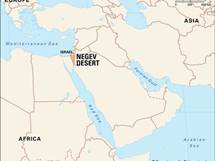
NegevV2:[JS1]  “The cities of Aroer…”? There are three different BIBLE and historical locations identified as Aroer territories. One is near the Arnon River in modern-day Jordan, one in the territory of the Tribe of Gad, and one in Judah in the Negev desert [see map to the right]. The Negev or Naqab is a desert and semiarid region of southern Israel. Its main city is Be’er Sheva.  This is too far south to be the Aroer of Isaiah. This map is not southern Jordan. Thus, we are left with Aroer somewhat to the north where verse 3 is closer to Damascus.

The lands and cities of Aroer will be desolate.

AHAMOMENT: The Ammonites are descendants of Ben-ammi, who was the son of Lot (Abraham’s nephew) and Lot’s younger daughter (Genesis 19:38).

The Moabites are descended from Moab, the son of Lot and his oldest daughter (Genesis 19:37). 

 The Edomites are the descendants of Esau, Jacob’s twin and Isaac’s eldest son. In short, Edomites are blood relatives to the Israelites. Verse 1-5 tell why to NOT make a vow to God. Don’t say to God in a prayer … you do this for me; I will do such-n-such [Matthew 5:33-37]     

V3: Recall Ephriam’s name is often used as a synonym for the ten northern tribes of Israel. This is one of those times. God means the northern ten Tribes of Israel when he says “Ephriam.” Shortly after, Assyria fulfills this prophecy. In 722 B.C. the Assyrians turn on and destroy the northern Kingdom of Israel. The Northern Kingdom tribes are dispersed in multiple directions. Nineveh of Assyria then becomes the big dog on the block.

V4: “In that day the glory of Jacob will be brought low, and the fat of his flesh will grow lean.” Jacob/Israel will become a nobody. This is another near and distant prophecy. Once at this time and a second during the tribulation.

V5:  All-in-all, verses 1–5 prophecy of Israel to the north, through the soon-to-invade armies of the Assyrian Empire under King Sennacherib, will seek their complete destruction and dispersion. The Northern Kingdon never recovers and Israelis do not return to their homelands until end time.

V6:Gleanings will be *left in it, as when an olive tree is beaten— two or three berries in the top of the highest bough, four or five on the branches of a fruit tree, declares the LORD God of Israel.” 
* In their former tribal territories in northern Israel. They become the Ten Lost Tribes.

V7: In verse 7 we find that phrase again, In that Day” man will look for his maker.  Isaiah jumps ahead to THE future of End time. All of Israel will look to their left and to the right finding very few Hebrew neighbors. Israelites, meaning all 12 Tribes, including Jerusalem, look to God and Messiah Jesus. They will need his help, better said, his complete intervention. This could also include mankind. The Tribulation will be over and many will die in Armageddon.

V8 – 9: In that Day” mankind will find that wealth or possessions are not a safety net. This firstly applies to the north ten Tribes. The world under antichrist will be self-destroying. Dr. Jeremiah: One of God’s purposes in judgment is to turn our focus away from the things we have trusted in instead of toward Him. Israel’s dependence on earthly allies in their near future did not help. End time dependence on others will totally fail. Instead, those Israel thinks will help will become invaders.

V10 – 12: From Verse 10 to the end of chapter 17, we find what Gods’ hand is going to do. What man may carefully plant will be of little value. The seed will flourish looking promising, but the crop will fail. V11 once again uses that phrase, IN THAT DAY.

V13 – 14: In the Jeremiah study Bible the footnote states: “God will blow away the foreign nations like the chaff separated from the grain. They will create a giant dust storm, and they will vanish in a day. (This is the ON THAT DAY) God will ultimately rescue His people and deal justly with all nations aligned against her.” These verses emphasize that the enemies’ “portion” and “lot” is their own ruin, a direct result of their oppressive actions against God’s people. God’s people in this verse can include any believer, but especially Israelis.

Rev. Dr. Jstark – 2025


 [JS1]https://www.biblegateway.com/passage/?search=Isaiah%2017%3A2&version=NASB

Isaiah 16

Isaiah 16, as explained by Halley’s Bible Handbook, describes a prophecy of judgment against Moab for its pride, which was a continuation of the message in chapter 15. It calls for Moab to send a flock lambs as a tribute to Jerusalem, symbolizing their need to submit to Judah and the ruler of Judah’s land. A flock of lambs is no great issue for Moabites. However, it also reveals that Moab’s arrogance led to the destruction of its prosperity and a devastating downfall. 

Moab’s desperate plea and punishment

  • The chapter begins with a plea for Moab to send *a lamb as a tribute to the ruler of Judah, a gesture of seeking favor and protection.

*Probably a flock of lambs. Some translations read “lamb” while others use the plural form … “lambs.”

  • Isaiah describes Moab as being like a “fluttering bird” pushed from the nest, showing their helplessness and confusion as they are fleeing an oppressor.
  • Look at Deuteronomy 2:9. They were not to destroy Moab and take their land. King David, Israel’s greatest king, was one-quarter Moabite. His paternal grandmother Ruth was from Moab, and David entrusted his father and mother to the protection of the king of Moab when he was a fugitive from Saul (1Samual_22:3-4).

The Ultimate Destruction and judgement of Moab

  • Despite their attempts to find refuge, the prophecy states that Moab’s gods were unable to help them.
  • The judgment is described as a devastating downfall, with the destruction of their vineyards and a wailing cry throughout the land.
    • NOTE: There is no MOAB today. Moabites were not simply scattered but slaughtered. There is no promise from God that they will retrieve their lands as is promised to Israel.
  • Isaiah emphasizes that Moab’s pride and arrogance are the cause of their judgment.
  • Within three years, what is left of Moab’s glory and power would be destroyed, leaving only a small remnant of scattered survivors. 
  • The land of Moab, specifically the area called Ar, had already been given by God to the descendants of Lot as their possession.

Lessons from the prophecy

  • The danger of pride: The prophecy serves as a warning against excessive pride and arrogance, which can lead to self-destruction. This is still true today.
  • The consequence of late repentance: Moab is condemned for waiting until it was too late to repent.
    • Sincere repentance is never “too late” if there is life, many Bible verses warn that those who delay repentance are likely to find it difficult to turn to God. It MUST be a real thing. It is not a nearby life vest one can grasp as their ship is obviously sinking.
  • God’s mercy and justice: God’s actions toward Moab demonstrate his mercy and desire for righteousness, while also carrying out justice against those who oppose him.
  • The importance of submission: The prophecy illustrates the importance of submitting to God’s authority and accepting the help that he offers, instead of relying on one’s own strength and pride.
  • A message of hope: The prophecy offers a glimmer of hope for the future, suggesting that God’s kingdom will be established on mercy and that he will quickly bring righteousness. 

There is no Moab or Moabite today. Their kingdom is all part of Jordan. Yes, names have been changed over time. Moabite culture was centered on agriculture and animal husbandry in a fertile land, with a polytheistic religion that prominently featured the god Chumash. Again, sending a tribute was not an issue for Moab, but they refused. Their pride got in the way.

They had a language similar to Hebrew. This is a no-brainer since they are/were relatives of Israelis. Lot, Abraham’s nephew, was the ancestor of the Moabites through one of his two daughters. At the fleeing of the twelve Tribes of Israel from Egypt, Moabites were part of the Canaanites found in the Bible. Genesis19:36-37 (cntrl/click or tap) state that Lot’s eldest daughter bore a son naming him Moab.

Rev. Dr. Jstark – 2025

Isaiah 16

Isaiah 16, as explained by Halley’s Bible HandbookIt describes a prophecy of judgment against Moab for its pride, which was a continuation of the message in chapter 15. It calls for Moab to send a flock of lambs as a tribute to Jerusalem, symbolizing their need to submit to Judah and the ruler of Judah’s land. A flock of lambs is no great issue for Moabites. However, it also reveals that Moab’s arrogance led to the destruction of its prosperity and a devastating downfall. 

Moab’s desperate plea and punishment

  • The chapter begins with a plea for Moab to send *a lamb as a tribute to the ruler of Judah, a gesture of seeking favor and protection.

*Probably a flock of sheep. Some translations read “lamb” while others use the plural form … “lambs.”

  • Isaiah describes Moab as being like a “fluttering bird” pushed from the nest, showing their helplessness and confusion as they are fleeing an oppressor. A baby bird.
  • Look at Deuteronomy 2:9. They were not to destroy Moab and take their land. King David, Israel’s greatest king, was one-quarter Moabite. His paternal grandmother Ruth was from Moab, and David entrusted his father and mother to the protection of the king of Moab when he was a fugitive from Saul (1Samual_22:3-4).

The Ultimate Destruction and judgement of Moab

  • Despite their attempts to find refuge, the prophecy states that Moab’s gods were unable to help them.
  • The judgment is described as a devastating downfall, with the destruction of their vineyards and a wailing cry throughout the land.
    • NOTE: There is no MOAB today. Moabites were not simply scattered but slaughtered. There is no promise from God that they will retrieve their lands as promised to Israel.
  • Isaiah emphasizes that Moab’s pride and arrogance are the cause of their judgment.
  • Within three years, what is left of Moab’s glory and power would be destroyed, leaving only a small remnant of scattered survivors. 
  • The land of Moab, specifically the area called Ar, had already been given by God to the descendants of Lot as their possession.

Lessons from the prophecy

  • The danger of pride: The prophecy serves as a warning against excessive pride and arrogance, which can lead to self-destruction. This is stilltrue today.
  • The consequence of late repentance: Moab is condemned for waiting until it was too late to repent.
    • Sincere repentance is never “too late” if there is life, many Bible verses warn that those who delay repentance are likely to find it difficult to turn to God in late life. It MUST be a real thing. It is not a nearby life-preserver one can grasp as their ship (life) is obviously sinking.
  • God’s mercy and justice: God’s actions toward Moab demonstrate his mercy and desire for righteousness, while also carrying out justice against those who oppose him.
  • The importance of submission: The prophecy illustrates the importance of submitting to God’s authority and accepting the help that he offers, instead of relying on one’s own strength and pride.
  • A message of hope: The prophecy offers a glimmer of hope for the future, suggesting that God’s kingdom will be established on mercy and that he will quickly bring righteousness. 

We insert this map to help readers mind-map the many cities, kingdoms, and locations mentioned by Isaiah. Some of these locations did not exist at the same time as did Isaiah’s writing. This is called proximity-help. This map is to help the reader find locations that Isaiah mentions in scripture.

Kingdoms change as do nations. People migrate and are forced to move by conquering enemies … a practice by the Babylonian and the Assyrian. The Philistine here are the Gaza people in today’s news.

There are no Moab or Moabites today. Their kingdom is all part of Jordan. Yes, names have been changed over time. Moabite culture was centered on agriculture and animal husbandry in a fertile land. They with a polytheistic religion that prominently featured the god Chemosh. Again, sending a tribute was not an issue for Moab, but they refused. Their pride got in the way.

They had a language similar to Hebrew. This is a no-brainer since they are/were relatives of Israelis. Lot, Abraham’s nephew, was the ancestor of the Moabites through one of his two daughters. At the fleeing of the twelve Tribes of Israel from Egypt, Moabites were part of the Canaanites mentioned in the Bible. Genesis19:36-37 (cntrl/click or tap) state that Lot’s eldest daughter bore a son naming him Moab.

Rev. Dr. Jstark – 2025

Isaiah 15:1-9

The “Burden against Moab”: 

V1: This chapter is explicitly titled an “oracle” or “burden” against Moab. Moab is the subject of this prophecy because it mistreated Israel, *refusing to let the Israelites pass through its land, and as a result, God will bring judgment upon it.

*Inference to refusing passage by Israelites goes all the way back to when Moses asked for minimal passage through Moab while leaving Egypt. Ar was the capital of Moab. Just like the name Babylon, the Bible sometimes uses “Ar” to refer to the entire nation of Moab. 

The noun ‘ar (עָר) is used to describe an enemy or adversary. The Bible sometimes uses ‘ar to define the entire nation of Moab. Today this area is inside Jordan (Genesis_19:30-38). There was a Moabite connection with Israel. They were related to Israel because Lot was Abraham’s nephew. Because of this, God told Israel in Deuteronomy_2:9 to not destroy Moab and take their land.

V2: This verse is part of a larger prophecy against the nation of Moab. It details a prophecy of judgment and destruction. Nebo and Medeba if Moab have already suffered destruction or a pending destruction. The Bible is not specific other than it has been or would be destroyed. Their wailing and crying was not limited to Nebo and Medeba destruction, but more of a concern that they would be next in line for destruction.

V3: As noted in verse 2, yes, they were fearful of their own skins, but it included their fear of their destruction as a nation. King David had put the Moabites under tribute to Israel then became a tributary of the Assyrian Empire in the late 8th century BCE. Following that their conquerors were the Babylonians, the Persians and later, the Greeks. Eventually they fell to Rome. Now we know what happened to the Moabites, bitter enemies of Israel.

The Nabataeans occupied the land of Moab just before their conquest by the Romans. They are often identified with the Nabayat of Assyrian records. The Genesis 25:13 (or Nabaioth), was the firstborn son of Ishmael (Genesis 25:13).

NOTE: Life’s lineage can become a bit complexing. We only trace the connections to past people to help us understand where, when, how, and who, that makes history both earthly and scriptural. Such as… The listing of Ishmael’s twelve sons in Genesis 25:13is significant because God had promised Hagar that Ishmael would “father twelve princes” who would become the heads of their own tribes.

V4: *Heshbon and Elealeh, cities of Moab, are east of the Jordan River. They too will fall. Their cry and fear of destruction will spread throughout the area into neighboring nations. These two former cities of Moab would have been in modern-day Jordan.

*These two cities are in territory that was originally given to the Israelite tribes of Gad and Reuben (Numbers 32:1–5). 

V5:My heart shall cry out for Moab…” The word “cry” (zaw-ak’ ) is shriek in the Hebrew. It is much more meaningful than in the English word cry. The Moabite army trembles in their souls, so distraught that they could not defeat the invasion by a powerful enemy.

V6 &7: These two verses help us understand how TOTAL was the destruction in Moab. Up to this point in this article, chapter 15 defines and describes the finality of Moab. It doesn’t even exist today, but southern Jordan does. WE should note, all this destruction to Moab is due to their animosity of Israel. What might this relate to end time or the animosity in the UN and the world today? It will be the same thing. HeEd this as a warning o’ world.

V8:For the cry is gone round about the borders of Moab; the wailing thereof unto Eglaim, and the wailing thereof unto Beer-elim.” A fascinating bit of information is the name Eglaim. It is potentially linked to “En-eglaim” in Ezekiel 47, a location where fishermen will spread nets in a future, revitalized Dead Sea during the millennial reign of Christ.

V9:For the waters of Dimon will be full of blood.” Dimon may be Dibon. The name “Dimon” may have been chosen to sound like the Hebrew word for “blood.

  • A Near-Future Prophecy: Isaiah specified that this judgment on Moab would be fulfilled within three years of his prophecy. Isaiah 16:14 points this out so we know it is not part of End Time. Chapter 16 is next.

It will be nothing short of elimination of the Moabites. They do not exist today, other than, perhaps, a very few coat-tail people who do not know who they are.

Rev. Dr. Jstark – 2025

Isaiah 14:1-4 click on each blue “V” to read the quote from the NKJV

This post should have been last week. Sorry for the technical issue of posting

V1: This verse is a tell-all per mankind in and after end time. Mercy on Jacob is self-evident. “Jacob” can be none other than his descendants. Keep in mind that this Bible conflict with the Jews suffering goes back to Genesis. The REAL conflict is between God and Lucifer/Satan/serpent. God created a Chosen People to be His light to the world through Abraham-Isaac-Jacob. However, this does NOT exclude Gentiles. We see this in verse one. God will continue to choose Israel (the 12 tribes); to resettle them in His Promised Land. The ancient city of Babylon remains a ruined archaeological site located in modern-day Iraq. Once a thriving metropolis, the city is now largely unexcavated and is a UNESCO World Heritage site being conserved for future tourism. A different meaning for “Babylon” also exists. In some cultural and religious contexts, the name refers to a system of oppression.  

The Promised Land is two-fold. First, it is the traditional land promised to Abaham. Second, the promise of a kingdom that has yet to come.

Let’s look at number 2. Why? Because it has yet to happen. Many Bible commentators, but not all, miss this point. “…and strangers will join them.” That too has yet to happen. It isn’t going to happen during the Tribulation. That time will be a very bad for Israel, land and people. It is during the Millennial reign of Christ. Key biblical prophecies of this include visions from Isaiah, Micah, Jeremiah, and Zechariah. These texts predict a future where Jerusalem becomes the center of worship for all nations during the aftermath of the Tribulation. These are visitors, i.e. the strangers mentioned in verse one. Jerusalem is central to God’s universal kingdom, and gentile nations join in His worship. In the Hebrew, the word for “strangers” is gêyr. This translates “a foreigner: – alien, sojourner, stranger” [H1481]. It does not mean occupants. There may be some but not many.

V2: Amazingly, in verse 2 we have something that has seldom happened. Traditionally Israelites have been expelled from foreign countries. Here in the first sentence of verse 2, we find foreigners paying for, aiding, and taking Israelite to Jerusalem. Many strangers recognizing the God intervened circumstances “ and will CLING to the house of Jacob”. They will remain as servants and maids [v2b]. Zechariah 8:23 states: “In those days ten people from all languages and nations will take firm hold of one Jew by the hem of his robe and say, ‘Let us go with you

NOTE: Verses 3 to 11 are the fall of the king of Babylon. This again is a two-fold use of the word Babylon.

V3: In that day of the Lord” Isaiah assure his fellow Israelis that a day is coming when the House of Jacob will no longer be suppressed at home or in foreign lands. Here the name Babylon is a synonym for nations and people who traditionally and historically abused Israelites as a people. “…You will take up this saying (V5-11) against the King of Babylon.” The Bible describes the “joy of the earth” at Babylon’s fall in both Isaiah and Jeremiah. Where it says the earth far exceeds just a few local nations. Look at the world today as nations and kingdoms line up against Israel. This includes all of them.

The rest for Israel during End Time includes gentiles. The Bible describes the “joy of the earth” at Babylon’s fall in both Isaiah and Jeremiah. This includes all believers. See Matthew 11:28. Jesus said, “Come to Me, all you who labor and are heavy laden, and I will give you rest.”. What will apply to the Israelis during the Millennial reign will include both Israeli and Gentile believers. Some promises from God will be exclusive to His chosen people, Israel.

NOTE: Why we at ahabiblemoments do not think this is simply a reference to the release of Jews from Babylon as some commentaries state. Israel’s joy is overwhelming. In verse one we read of the House of Jacob; In verse two we read of the house of Israel.

V4: This verse introduces the remaining and fascinating verses in chapter 14. The “king” mentioned in verse 4, i.e. the king of Babylon, is actually Satan. Babylon is the earth. Prophecy often has both a near and a distant fulfillment. This is one of those times.

Since the remainder of chapter 14 is one continuous prophecy, we will cease investing your reading time at verse 4. The next several verses itemize nations, places, and people who will fall under God’s End Time judgement. In short …this means everyone. Us at ahabiblemoments included.

Rev. Dr. Jstark – 2025

Isaiah 14:12-32 [click or tap on each V_ to read the actual verse in the NKJV]

In examining this passage, it’s important to recognize the deliberate choice of language and its theological implications. The distinction between LORD and Lord is not merely stylistic but carries deep significance in understanding the nature and authority ascribed to God in the original Hebrew texts. By highlighting these nuances, the author sets the stage for a richer interpretation of Isaiah’s prophetic message and its relevance to both historical and spiritual contexts.

Before we begin this article, has anyone noticed that this particular passage uses the spelling LORD instead of Lord? Recall from a previous article a few weeks back that LORD [all caps] yehôvâh is different from Lord Adonai [caps versus lowercase]. LORD represents God’s personal name, YHWH, while Lord is a translation of “Adonai,” meaning “my Lord” or “master”. Isaiah uses YHWH in this passage.

Briefly… Isaiah describes God’s judgment against the oppressiveness of Satan Lucifer, Babylon, Assyria, Philistia, then in the next chapter, Isaiah adds Moab to this list.  Keep it in mind that Lucifer is called the King, or better said, the god of earth. We find this in 2 Corinthians 4:4 where it states that the “god of this age” has blinded the minds of unbelievers so they cannot see the light of the gospel. This doesn’t mean man has lost his option of choice. It does mean man has the option of knowing good fruit and bad fruit. Blinded means man does not know the difference.

The fall of Satan:

V12 – 15: Here we get a very good description of “O’ Lucifer” [v12]. Satan claims to be and once was the Son of the morning sun (the meaning of his name in Heaven). He has weakened the nations, claims to ascend to a throne above God, convinced in his heart that he is equal to God or perhaps greater [verse 14b]. He will sit in the north looking south from all sides, yet Isaiah writes …you O’ Satan (you); V15) will be brought down to Sheol (hell), the lowest depths of the pit. This is during the Millennial Reign of Jesus.

V16-17:Those who see you will look [shaw-gakh’] at you will use a narrow glance  [as if out of the corner of or squinted eyes]. This infers to make a glance at something suspiciously. In their minds people will question if this is the same one who commanded the world prior to the return of Jesus return? One who made the world tremble, shook kingdoms, made the world a wilderness, destroyed the cities, refused to release his captives…? This verse serves as a prophecy of Satan’s downfall, highlighting his oppressive nature and ultimately contrasting himself with the mercy and justice of God.

V17: Clarification… (NKJV) who did not open the houses of his prisoners”. Those who are headed to or contained in hell, there is no way Satan is willing or can return them to a life on earth giving them a second chance at salvation. He does not want a single person to believe in Jesus Christ/God.

V18: Oddly. This verse is contrasting Gentiles with Israelis who are making this glancing look. How do we suspect this to be true? The word “nations” is gôy in the Hebrew. This word means a foreign nation; hence a Gentile.

V19-21: This is an extension of the previous verse and accusations. *Some commentaries identify these verses as the ancient king of Babylon. Keep it in mind that the name Babylon can be a synonym for other nations and people outside of God’s will. Look at verse 26. It shows God’s execution of His will is to nations and not just Babylon.

*This is the plan that concerns all of the earth

Babylon Destroyed

V22-24: Once again we find one of those present and future uses of the name Babylon. It is true that the place called Babylon will be a place never to be occupied after it’s gradual decline. Cyrus the Great and his forces entered the city through the dried-up bed of the Euphrates River while the King was hosting a major festival. While the initial conquest was swift and led to Babylon’s loss of political independence, afterwords it declined over centuries to total abandonment. It was destroyed over time by nature and her abandoning population.

Assyria Destroyed

AHA MOMENT: Asshur, the second son of Shem; also, his descendants and the country occupied by them (that is, Assyria). Shem was the son of Noah (H804). One would wonder how experiencing the Great Flood, s/he would not walk the narrow path of God. Shem didn’t.

V25: This verse probably refers to Israel and the burdens and hatred aimed at them over the centuries will be lifted i.e. the Millennial Reign. Satan will be in the bottomless pit and people will be left to OUR free choice without Satan trying to influence our choices and decision making. HOWEVER, there will still be choice.

V26: This verse is why the previous verses are using the name Babylon as a synonym for the evil on earth and in it. “This is the purpose that is purposed against the whole earth”. Verse 26 leaves little room for God’s judgment being isolated to Assyria.

V27: God will once again rule over His creation. Isaiah says: “who dares to try and reverse the will of God.” There is none, no, not one.

Philistia Destroyed

One by one we find out the destiny of the world (earth). The fate of evil itself that manifests through humans, continues in the next couple of chapters.

NOTE: The Assyria we just discussed is the fate of earth. Chapter 21 is the fate of the actual Babylon.

Philistia – Bible Mapper AtlasV28: Philistia is GAZA today. Since Israel, mostly the Tribe of Dan, did not conquer Gaza (Philistines) when Joshua assigned territories for each Tribe of Israel, they have been a thorn in the side of Israel to this very day.

V29: During his reign, King Ahaz of Judah faced attacks from the Philistines, who, along with the Edomites, invaded cities in Judah while the kingdom was weakened by the Assyrians. Ahaz sought the help of Assyria to ward off the attacks of the Philistines and Edomites. Recall that the Edomites descended from Esau, Isaac’s brother. The “rod” mentioned in verse 29 is the combined forces of Judah and Assyria. Ahaz is an abbreviation of Jehoahaz II. His reign was next to the last king of Judah, King Hezekiah, his father. Some theologians see this as a future judgment of “modern Philistines,” that is, Palestinians or Palestinians of Gaza.

V31: Do not rejoice Philistia. “Smoke will come from the north.” This applied back then and today. Isaiah 14:31 is a warning to those who oppose God and His people, demonstrating the futility of relying on human strength or alliances in the face of God’s inevitable judgment. Might this be a prophetic warning for today’s Israelis?

Rev. Dr. Jstark – 2025

Chapter 13 is around 670 B.C. (Verse 1- 14) click on each V? to get the verse in its entirety

Isaiah is nearing the end of his ministry as a prophet. It is thought by some that he died in 660 B.C. This is at a point in history that is a short plus for end-time prophecy. We at ahabiblemoments conclude that this chapter is one of those dual-time prophecies. Why? Because of verse 13:5. They come from a far country, from the uttermost part of heaven, even Jehovah, and the weapons of his indignation, to destroy the whole land. Who are THEY? The enemies of Israel’s ten northern Tribes of Israel? In End-Time it is basically the world powers. Chapter 13 and forward is about the land and people in all Israel AND end time. Some studied theologians feel the topic of Chapter 13 goes through Chapter 23. Whatever it is, Judah’s (southern kingdom) time is also in the cross-hairs. It may be another 80 plus years until Babylon and the Medes destroy Jerusalem but it was coming.

The burden (v1) against Babylon (as symbolic of then and end time). It will continue into chapter 14. We must make note that at times the name Babylon is the nation itself and at other times it is a synonym for many other nations as a whole. Plus …even though the Kingdom of Judah was not overrun until 586 B.C. they were under tribute to Assyria, before Judah’s 70 year captivity. Recall that very few Babylonian captives opted to return to their native Promised Land after Cyrus the Great released them.

V2:Lift up a banner on the high mountain, raise your voice to them; Wave your hand, that they may enter the gates of the nobles.” This was prophesied long before Babylon even became a powerhouse. We must go back to Daniel 5 to read about this fall of Babylon.

V3: Sanctified ones? This can easily be confusing due to the word sanctified. This is similar to Nebuchadnezzar and/or others who God uses to carry out his will even though they are not one of his followers. Even the mightiest empires are not beyond His control and are ultimately instruments of His will. It was true then and remains true today (see Daniel 2:21 and Psalm 75:7).

V4: Woe! Here is verbiage that takes us into a future tense not yet seen. Why? “…the noise of a chaos of the kingdoms of the nations gathered together!” At this point in scripture we are talking about Assyria, Babylon, Judah, and Israel. This sentence is much larger in its scope. This reminds us of Ezekiel 38–39; Zechariah 12 and 14. The plurality of this sentence goes far beyond the THEN.

V5:They come from a far country. How far is far? One of the Hebrew translations for this verse and words, the word for country is ‘erets. This means the earth itself. The next sentence in verse 5 is …”From the end of heaven‘erets, Heaven? This doesn’t take a scholar or theologian to conclude. It goes far beyond the principle of Babylon. “to destroy the whole land?It is global.

V6:…the day of the LORD is at hand.” This phrase or something similar to it is used over 200 times in the Bible. Each time it refers to an ultimate time.

V7: Again we must visit the meaning of words used in any specific scripture. The words “all” and “every” in this verse 7 when using the American Standard Bible and many other translations is from the Hebrew “KOLE”.  It simply means there are no exceptions. “Therefore shall all hands be feeble, and every heart of man shall melt. It isn’t to be thought of as referring to a specific group, but the all (kole) of mankind.

 V8: Verse 8 reaffirms the previous verses. Scripture at this point is speaking globally but includes this time in history (His-story).

V9:…and he (God) will destroy the sinners from it.” Isaiah is prophesying the return of Jesus (yeh-ho-vaw’ ) to earth to judge and to rule. This is NOT the time of the Tribulation. It is after it. It is far more than just dealing with Assyria or Babylon. But it does include the rule of Babylon and Assyria in THEIR TIMES. It includes and is mostly about Israel in both time periods.

V10:For the stars of Heaven (our earthly sky/heaven…) will not give their light. The moon and sun will not give their light.” Such a statement appearance is found in books like Isaiah, Joel, Matthew, and Revelation, where it symbolizes a time of divine judgment.

NOTE: Yes, this passage is speaking mostly of the fall of Babylon, but it is also defining the happenings in end-time. See Revelation 6:12.

V11-14: Here one reads of what God will do to his created earthlings and his created earth and heavens… Even man will be made “rare” on earth (eritz). The Tribulation is not about the brave and might of man. It is about the judgement of God on man. “the earth will remove out of its place.” Examining the Hebrew, this does not mean the earth loses its orbit, but it is more like an unbalanced tire on a vehicle or worse. Earth will be experience a global earthquake. One can only imagine.  It will move in and out of its rotations like an earthquake (Revelation 6:12). Matthew 24:29 may help one better grasp the finality of the end of “end time” i.e. the Tribulation. This verse includes the powers of the heavens that will also be shaken.

At verse 15, Isaiah returns to his narrative and prophecy of this time in and around Jerusalem/Israel. It will be a time of absolute brutality for Israel. Check a Middle East history book about the brutality of the Assyrians. The Medes and Persians treated them just as and greater than did the Assyrians did to their captives. Next article will begin at the kickoff of the rest of chapter 13 which is verse 15.

Rev. Dr. Jstark – 2025