Article #32 – Chapter Outline in Daniel

ARTICLE #32 – OUTLINE of each Chapter in Daniel
NOTE: The chapters of Daniel are not sequential as recorded

I. Daniel’s Dedication, 1:1-21
A. Daniel’s Circumstances, 1:1-7
B. Daniel’s Dedication, 1:8-16
C. Daniel’s Rise to Favor, 1:17-21

II. Nebuchadnezzar’s Dream: The Great Image, 2:1-49

A. The Dream received by Nebuchadnezzar, 2:1-6
B. The Dream revealed to Daniel, 2:7-23
C. The Dream recited then interpreted to Nebuchadnezzar, 2:24-45
D. The Promotion of Daniel in the Babylonian Empire, 2:46-49

III. The Fiery Furnace: A Lesson in Faith, 3:1-30

A. The Test of Faith, 3:1-12
B. The Demonstration of Faith, 3:13-18
C. The Vindication of Faith, 3:19-30

IV. Nebuchadnezzar’s Vision of the High Tree, 4:1-37 (chopped down but the stump remained).

A. The Vision Narrated by Nebuchadnezzar himself in the first-person, 4:1- 18
B. The Vision Interpreted by Daniel, 4:19-27
C. The Vision Fulfilled by God, 4:28-37

V. Belshazzar’s Feast, 5:1-31

A. Belshazzar’s Contribution to the Feast: Unrestrained Sensuality, 5:1-4
B. God’s Contribution to the Feast: Handwriting on the Wall, 5:5-6
C. Daniel’s Contribution to the Feast: Announcement of Doom, 5:7-29
D. Darius’s Contribution to the Feast: Destruction of Babylon, 5:30-31

VI. Daniel in the Lions’ Den, 6:1-28

A. The Position of Daniel, 6:1-3
B. The Plot Against Daniel, 6:4-9
C. The Prayer of Daniel, 6:10-11 [This is more like a prayer we should recite or follow as an example of prayer in church. The Lord’s Prayer was preceded by the command to do that prayer in a closed closet of private communion with God the Father]
D. The Prosecution of Daniel, 6:12-17
E. The Protection of Daniel, 6:18-28

VII. Daniel’s Vision of the Four Beasts, ten horns, little horn and the Ancient of Days, 7:1-28

A. Historical Data, 7:1-3
B. The Vision and the Interpretation, 7:4-15
C. The interpretation 7:16-28

VIII. Daniel’s Vision of the Ram, Goat, and Little Horn, 8:1-27

A. The Vision, 8:1-14
B. The Interpretation, 8:15-27

The Ram

1. The ram, 8:15-20
2. The goat, 8:21-22
3. The little horn, 8:23-25
4. The effect on Daniel, 8:26-27

IX. Daniel’s Prophecy of Seventy Weeks of 7 Years each week, 9:1-27; i.e. the seventy 7’s prophecies. We translate the 70-7’s as 70 weeks but this is incorrect Hebrew. Not weeks but seven years per each of the 70 years: 7 weeks; 62 weeks; 1 week (End Time anti-Christ).

A. Historical Data, 9:1-2
B. Daniel’s Prayer, 9:3-19
C. The Prophecy, 9:20-27

X. Daniel’s Prophetic Landscape, 10:1-12:13

A. Daniel’s Vision, 10:1-9
B. Daniel’s Strengthening, 10:10-11:1
C. Prophecies Concerning the Nations, 11:2-45

1. Persia, 11:2
2. Greece, 11:3-4
3. Egypt and Syria, 11:5-20
4. Antiochus Epiphanes, 11:21-35 (nicknamed Epiphmanes: the insane’by many of his vindictive but so-called friends and administrators)
5. Antiochus’s actions parallel those of the End Time Antichrist, 11:36-45

D. Prophecies Concerning Israel; Daniel 12:1-13

JIV Note: per my comments in bible classes or from the pulpit, God’s covenants with Israel and the covenants for the New Testament church can follow parallel lines but are not always in-common. Quick example: Israel is promised the “Promised Land;” physical property in the Middle East during the Millennial Reign. The church is promised a rapture and Heavenly Promised Land.

Ephesians 6:12, 13 For we do not wrestle against flesh and blood, but against principalities, against powers, against the rulers of the darkness of this age, against spiritual hosts of wickedness in the heavenly places. Therefore, take up the whole armor of God that you may be able to withstand in the evil day, and having done all, to [take a] stand.” (Emphasis mine)

Take a Stand

Self-Discussion: The Book of Daniel discusses the battles between angels, angelic forces and the necessity to be prepared for such deception and attacks of the prince of darkness. This Old Testament book gives us a better understanding of why Paul tells us in Ephesians 6 to put on the full armor of God; not to fight fellow mankind believers, but to resist the devil and his fallen legions in spiritual warfare [See Daniel 10 for examples].

This discussion between the angel Michael and Daniel in chapter 11 actually begins in Daniel 10:14 where he tells Daniel… “Now I have come to make you understand what will happen to your people(Israelites) in the latter days, for the vision refers to many days yet to come. Daniel and the angel Michael are talking about Israel and the chosen people; not the church. What more could have happened to God’s chosen people since the split in the nation of Israel into two separate kingdoms; i.e. the total dispersion of the Northern 10 tribe Kingdom of Israel by the Assyrians into the hinterlands of the world and in Daniel’s time the Southern Kingdom of Judah to Babylon? These are latter day events yet to be fulfilled.

Only a very few of these Judeans (Jews) returned to Judah/Jerusalem with Zerubbabel, Ezra, and finally Nehemiah. The New Testament “Jews” are the descendants of those who returned from Babylon, not from the Assyrian diaspora or dispersion of the tribes from the Northern Kingdom.

Article 31- The Historical Background

Not just great stories—Bible history is part of what we refer to as secular history


As is my teaching style, it helps when one can put an event or series of events into perspective or within other historical events of secular history. Remember that the bible does not need to prove itself according to history. History needs to be placed against what the bible states. There is no revision of secular versus scriptural history but there are many who wish to revise scripture to make God what s/he wants instead of us as individuals being what God wanted upon our creation.

  1. King Pekah of Israel [700’s B.C.] along with his ally King Rezin of Aram, threatened Judah and its main city of Jerusalem. Ahaz, the king of Judah, called upon King Pul [Tiglath-Pileser III] of Assyria to intervene. He did intervene therefore defeating Israel (the Northern Kingdom) then executed King Rezin of Aram (Damascus).
    1. Assyria was a Semitic nation, but not Israeli, from the 24th century BC to 608 BC.
    1. Assyrians were offspring of Shem’s (Noah’s ark) eldest son *Elam: Genesis 10:22, Ezra 4:9. *Elam itself was once an empire called the Elamites now part of Iran. The person Elam was a son of Shem making him a grandson of Noah.
  2. At this time, Damascus was not the capital of Syria. It was a large city-state in its own rights.
  3. Assyrians attacked the Kingdom of Israel (ten northern tribes) first dispersing the East of Jordan tribes of Gad, Reuben, and the half tribe of Manasseh in 732 B.C. [2 Kings 16:9].
  4. 720 BC: Assyria invades the remaining tribes of the northern kingdom of Israel including a few cities within the borders of the Kingdom of Judah. All captives are exiled to unsettled lands to the north, east, and west specifically mentioned, it includes the cities of the Medes.

JIV NOTE: This plays significantly into the Babylonian captivity of the southern Kingdom of Judah 120 years later, the 70 year Babylonian captivity, and to connect the dots……the invasion of Babylon by the MEDES and Persians and eventually Queen Esther of the Book of Esther.

  • Daniel of Babylonian fame was a contemporary of Jeremiah, Ezekiel, Shadrach, Meshach, Abednego, Ezra, Nehemiah, and Zerubbabel. These men were exiled from the southern Kingdom of Judah or were born during Babylonian captivity. Interestingly, they all were in the service of the government of Babylon; Daniel also served within the Mede-Persian government of Babylon.
  • Daniel lived during the time of Nebuchadnezzar and Belshazzar, father and grandson, who were kings of Babylon, and the Mede-Persian ruler Cyrus (Darius?).
  • He lived in Babylon during the entire 70 year captivity and several years beyond.
  • Daniel never left Babylon after being exiled from Judah. He continued to serve in the service of the Persian conquerors of Babylon.
  • Sequence of nations:
    • The nation Israel of Saul, David and Solomon co-existed with Assyria
    • Israel divided into two separate kingdoms: the Kingdom of Israel to the north with ten tribes and the Kingdom of Judah to the south with 2 tribes plus many stragglers from the northern kingdom who were faithful to Judaism and Jerusalem.
    • Ten tribes to the north are dispersed in the 700 B.C. over a period of 20 plus years; first by Tiglath-Pileser III [sometimes called King Pul], then Shalmaneser V, finally by Sargon II; all were kings of Assyria. Time period around 740 B.C.E. to around 720 [?] BC.
    • Kingdom of Judah continued to exist for another 120 years; until about 606 BC.
    • Babylon rebels against and overthrows Assyria; 637 BC to around 612 BC. The overthrow of the Kingdom of Judah followed.
    • Nebuchadnezzar (606 BC) of Babylon invades the Kingdom of Judah and begins a series of dispersions bringing Judean Jews [including Daniel] to Babylon. [Daniel 1:1-4]
      • 605 BC.; 597 B.C.; 586 BC. [the three reasonably close dates of Judean dispersion and exile to Babylon]
  • Daniel becomes an advisor and dream interpreter for Nebuchadnezzar  [Daniel 2:1-49]
  • Shadrach, Meshach and Abednego face the fiery furnace [Daniel 3:1-30]
  • Nebuchadnezzar goes insane and eats grass with the wild animals of his kingdom [Daniel 4:1-37] His wings are plucked and he is made to stand up like all other men (Daniel 7:4)
  • Daniel interprets the finger of God writing on the wall to *Belshazzar

[Daniel 5:1-31]

  1. *Belshazzar is the grandson of Nebuchadnezzar; overthrown by Medo-Persians (Cyrus of overall all Persia; Darius the Mede was temporarily king of the conquered Babylon). Belshazzar was not the sole king of Babylon during this overthrow. His father made him co-regent of Babylon itself.
    1. King Cyrus, the first Persian king over the Mede-Persian conquered empire of Babylon, signs a decree releasing all Israeli captives within this conquered empire; [538 B.C. – Ezra 1:2-4; 6:2-5] Darius the Mede ruled first but for less than two years. Daniel tells us that this Darius was already 62 years old at the time of the overthrow. He was not King of Persia but a satrap king of Babylon proper.
  2. Daniel and the Lions’ den historical event occurred under the Mede-Persian ruler Darius [Daniel 6:1-28], not Nebuchadnezzar.
  3. The prophetic future according to the dreams of Daniel
    1. The 4 beasts [Daniel 7:1-28]
    1. Daniels dream of the goat and the ram [Daniel 8:1-28]
    1. Daniels 70 week or years dream [Daniel 9:1-27]
    1. Daniel views the end of times (Recall a previous study article: Are We There Yet?) [Daniel 10:1 – 12:13]

Article 30 -Daniel 11

Kingdom of JudahOutline of the Book of Daniel
(chapter 11:1-40: Rev. Dr. Jstark)

Article #30

There is almost as much prophecy in the book of Daniel as there is contention over the prophecies themselves. Daniel was one of the first of three different diasporas from the Kingdom of Judah by Nebuchadnezzar of Babylon; 606/5, 597/6, 586/5, 4 B.C. (approximate dates) He was a close friend of *Shadrach, **Meshach and ***Abednego of the fiery furnace fame; Daniel 1-3. Their Hebraic names were *Hananiah (חֲנַנְיָה), **Mishael (מִישָׁאֵל) and **Azariah (עֲזַרְיָה). These three “teenagers” were exiled to Babylon at the same time as was Daniel.

JIV NOTE: There are significant ahamoments when we look at the origin and meanings of many biblical name. Please be reminded: Hananiah (Shadrach) means “God who is gracious;” Mishael (Meshach) means “Who is like God;” and Azariah (Abednego) means “God is our help, or God has helped”. BONUS: Daniel means “God is my judge.”  These Old Testament name meanings stated as a sentence reveal a New Testament message: God is gracious; who can be like God; God is my help/salvation (and) God will be my judge.

Just as interesting are their Babylonian name meanings: Shadrach means “command of Aku”, Aku being the name of the Babylonian god of the moon; Meshach means “who is (or can be) what Aku is?Abednego means “servant of Nebo,” the Babylonian god of wisdom. This is no Hebraic or Babylonian (Chaldean) verbiage coincident but great insights inspired of God. This is what it means to STUDY the Word[s] of God.

While studying the Book of Daniel, we must keep in mind that the name Babylon is used within other scripture as concerns other yet unfulfilled End Time prophecy. That in and of itself does not always mean the Babylon of Daniel times.  The use of the name Babylon is symbolic or analogous of characteristics of events of end times. We cannot look at the Book of Daniel without including some references to other supportive End Time scriptures that remind us of End Time prophecies by Daniel. This is particularly true of Daniel 11.

PS: His traditional grave site is identified as being in Susa, Iran. Susa today is the city of Shuster in Iran’s district of Khuzestan. This in itself is located within an even more ancient settlement of the Elamites…a former empire named after one of the five sons of Shem; ELAM [Shem’s children: Elam, Ashur, Arphaxad, Lud and Aram, in addition to daughters. Genesis 10:21, 22]

In a broad sense, the Book of Daniel prophecies can be defined under four categories:

  1. Prophecies of things in the distant future (from that point in time, that is up to its fulfillment)
  2. Prophecies of imminent events soon to happen
  3. Prophecies of intermediary or mid-time events plus End Time events of week 70 in Daniel’s vison of the Seventy 7’s.
  4. Words of support and encouragement to not vacillate but remain in the faith.
ATTENTION PLEASE

There are only 12 chapters in the Book of Daniel unless one includes Susannah (chapter 13),  Bel and the Dragon (chapter 14). So much that is relevant to current events were prophesied at the time of Daniel; predictions and warnings of things to shortly happen, and a look into the future including our current era, is crammed into such a short book of the Bible; twelve canonized chapters. CAUTION: If a believer does not know and somewhat understand these prophecies in Daniel 11, s/he will never recognize them as they play out today.

It one of my greatest [JIV: Jim’s Introspective View] challenges and honors to research and annotate  Daniel 11 using the actual names of historical characters instead of the generic or pronoun person, place, or thing used in scripture. Chapter 11 of Daniel is possibly the most controversial in this great Old Testament book. The contentiousness of chapter 11 is not so much over what it contains, but the pinpoint accuracy of it. It is so accurate, some theologians and self-proclaiming wise-guys insist Daniel had to be written “after the fact” by someone else, then inserted into the Book of Daniel. There are some who call themselves Christian who have difficulty understanding that our sovereign Lord is the Aleph – Tav [Hebrew]; knows the beginning and the end; the Alpha – Omega [Greek]…Plus all of history that falls within these two place-markers.

You will find a general overview outline of the Book of Daniel in the next article page(s), then a following, by-name conversion of Daniel 11. If there is an error on my behalf when inserting names into the place and descriptive names used in chapter 11, I accept responsibility. One can only be sure if s/he looks it up him or herself. If God or Jesus says it… do not question it. We teach but YOU must decide.

Our next article covers the historical background and sequence of this time in history. This setting will benefit those who wish to pull together histories that are too often divided between secular and bible events.

Daniel 10 – Article #29

Chapter 10 is essentially a repeat, or perhaps better stated, a reminder of chapter 8. Don’t stop here though. In chapter 9 the gravity of “sealing up” the information given to Daniel in chapter 8 overwhelms him.  *Chapter 11 and 12 continue this Hebrew concern but all four of these chapters add to our understanding. In a sense it is like all (most?) speech instructors tell students is the center to good speech arrangements. Tell whomever what it is what will be discussed therefore setting the stage (chapter 10). Then tell the basics of what is the purpose and content of the speech or lecture (chapter 11). Finally, step three is to remind the listener what was said (chapter 11). More on this as we proceed through the remainder of Daniel.

RE-Chapter 8: For those who missed this article in ahabiblemoments chapter 8 is about Daniel being in Susa, a ram with two horns; one came later but grew larger. Then out of the west comes a goat with ONE HORN and whose feet do not touch the ground. It breaks the two horns of the ram. Soon the significant single horn of the goat out of the west is itself broken. In its place grow 4 smaller horns. These are the historical events of Greece (Macedonia; Alexander the Great) breaking the stranglehold of the Medo-Persia Empire. When Alexander dies, his world empire is broken into four smaller kingdoms. Eventually the two dominant offshoot general/kings from Alexander’s world conquest become embattled with each other; i.e. the example of end time king of the north and king of the south.

However, in chapter 8 Daniel is told to seal up this vision” for the time being. Why? The latter or ending portion of chapter 8 essentially shifts gears from near future to End Time events. It becomes a prophecy about the end of time and the anti-Christ. Even though Daniel is told to “seal up the vision” we get an insight or introduction to the End Time (Jacob’s Trouble).

Euphrates and Tigris confluence, Iraq

Daniel in chapter 10 is walking along or standing on the banks of the Tigris River. He is not alone as other men are with him. In other bible passages this same river is called the Hiddekel in Hebrew.

*JIV: For the curious bible student, this same general location or as noted in Exodus is where the four river heads identify the location of the Garden of Eden.

            *JIV (Jim’s Introspective View)

Daniel 10:1 gives the setting:

  1. The third year of King Cyrus of Persia (not the king of Babylon; a satrap-ruler governs there and is subject to the King of Persia; i.e. Cyrus)
  2. Daniel receives this information
  3. There was (will be) a great conflict; personal and global (Chapter 11)
  4. Daniel understood the meaning
  5. V2 Daniel goes into mourning and becomes sick over vision.

JIV: At this point we have a plethora of theological opinions. Some look at verses 5 & 6 as describing a great angel. After years of thought and study, this author no longer subscribes to the opinion that it is Jesus before his New Testament re-appearance as the Messiah. More likely if is a very high-ranking angel of great significance from heaven. We provide evidence of this toward the end of this article. It matters not so much as to who it is that appears on the river bank, but to the message presented to Daniel of a time yet to come. Again, later in this article it is explained why this “man-like being” is probably an angel.

Daniel 10:7 tells us that Daniel was not alone. Men were with him. They sensed something that brought fear to their hearts and being but did NOT HEAR or see the vision. They feared so much that they fled the area in a panic. In a way this is repeated in Acts 9; Paul’s road to Damascus. Oddly and as reported by 1967 news media, the Israeli Six Day War against its Arab and Muslim neighbor countries of Jordan, Egypt and Syria and early in the conflict, similar overwhelming fear overcame the Egyptian armed forces in the Sinai Peninsula in 1967. So much so that they fled on foot abandoning armament, running tanks, and artillery.

“Israel’s losses in the battles with Egypt were 275 soldiers killed and 800 wounded, very high for a country of only 2 million, but comparatively light considering the size of the battles and the magnitude of the victory. Egypt’s losses were much higher — according to statements by President Nasser more than 11,500 soldiers were killed, and independent estimates put the number of wounded as high as 50,000.” (Barker, p 76)

Of course Daniel is not writing about a war of great fear but he does state in verse one, “it was a great conflict” in his vision. This could be a personal conflict of Daniel’s or the ones that Daniel 11 discusses. Verse 8 in chapter 10 reflects or parallels this article’s reference to the Six Day War between Arabs, Egypt specifically, and the fear that overwhelmed the Egyptians. We use this comparison only to help the reader assimilate or grasp Daniel’s fear when he was probably looking at the Holy One’s personal representative; a high ranking angel. The men with Daniel had fled.

Daniel 10:8 So I was left alone and saw this great vision, and no strength was left in me. My radiant appearance was fearfully changed, and I retained no strength. [ESV]

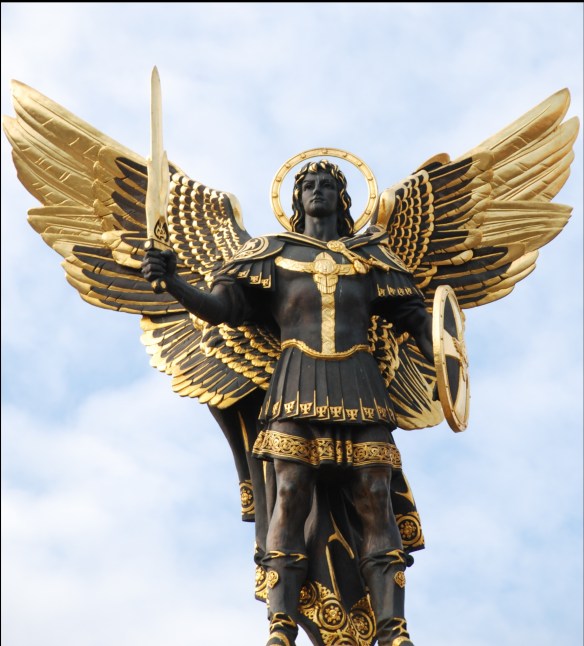
The purpose of an appearance of this angelic being was to help Daniel understand the signs and things of the future. Daniel 10:14 clearly states that he came to make him (Daniel) understand “WHAT IS TO HAPPEN TO YOUR PEOPLE IN THE LATTER DAYS.”

The argument against this strikingly dressed man-like being as possibly describing Jesus in verses 5 and 6 is Daniel 10:11. It is highly doubtful that whoever is the *(bad guy) angel of Persia, he could not hold Jesus back for 21 days.Jesus would not require the assistance of the angel Michael. [See Daniel 10:12 and 13]

.

There is one to consider regarding Christians today and our prayer life. This is the fact that the three-times-a-day prayer life of Daniel still required a wait of 21 days before hearing back from God. This gives us insight as to the two powers of today; God and Satan. How many times have we prayed expecting an answer from God on our timetable, not God’s? This means that Daniel did not stand up from his prayer beginning in Daniel 9:3, go for a walk along the river banks (chapter 10) that afternoon or evening and find his prayer answer and understanding.

Daniel 9:16 is very telling. Daniel states to the angel or messenger… “Then I opened my mouth and spoke. I said to him who stood before me, “O my lord, by reason of the vision pains have come upon me, and I retain no strength.” [ESV]. Daniel must have seen more than his physical body and mind could handle. He was “LEFT WITHOUT STRENGTH.”  

We close this article with a bit of insight or perhaps theological speculation. Our motto at ahabiblemoments is: We Teach – You Decide. It is up to the reader to challenge one’s self as to his or her bible knowledge and this following connection.

The “manlike being” asks Daniel if he understood. Daniel does not answer. This “angel” is about to depart to assist angel Michael in the battle with the evil and Satanic “prince of Persia.” So what is the connection? The Jews who remained in Babylon and did not return to Jerusalem when released by King Cyrus, were not now going to be without challenges against their very existence. This takes us to the Book of Esther. Esther, Mortdecai, King Ahasuerus often identified in history identified as king Xerxes I (reigned 486–465 BCE) and Haman the Agagite. In short, the angel of the Israel is Michael [Daniel 12:1] who is holding back the evil angel of Persia at this time in Daniel [10:13], but he will require help for a very near future event and continuing for well over 2500 years to this present day.

NOTE: King Ahasuerus and Esther appear on the scene within 50 years of this event in Daniel 10. Daniel had remained in Babylon after the departure of some Judeans back to Jerusalem (536ish B.C.). The overlap of Zerubbabel, Ezra and Nehemiah all fall within this time period in history. They very possibly knew each other and Esther knew of them.

We do not know who is the “manlike being” who appeared in Daniel 10. The evil angel of Persia withstood him from coming to Daniel to address his chapter 9 prayer for 21 days. This unknown being then returns to continue this angelic fight. The evidence is that the battle between Israel and Persia, today’s Iran, still exists. Iran and those like Haman of Persia vow(ed) to drive Israel into the sea. The battles in the heavens above and upon this earth over God’s Holy City of Jerusalem are present to this very day. The hate of Satan against the People (God’s chosen) of Israel has not retreated.

WHAT’S NEXT? CONCEPT

Next Articles:

Chapter 11 is very far-reaching in  history and history yet to be played out. By necessity of these prophesied future events (chapter 11) will be broken down into several articles. It is one of the most challenged and challenging prophetic chapters of the bible. We will as best can be done, name names as these historical and end time events are foretold in Daniel 11.

Rev Dr. Jstark
January 2020

Article #28 – Daniel 9

And his 70 7’s Verses 24 -27

We are devoting this section of our Book of Daniel Study to a much misunderstood prophecy; i.e. Daniel’s conversation with the angel Gabriel per the end of Judean Babylonian captivity, End Time, and an end time future Israel. We begin by clarifying to whom this message is referring. This is answered in verse 24 of chapter 9.

Dan 9:24 “Seventy weeks are decreed about your people and your holy city, to finish the transgression, to put an end to sin, and to atone for iniquity, to bring in everlasting righteousness, to seal both vision and prophet, and to anoint a most holy place.

“Seventy WEEKS are decreed…” This is in stark contrast to the number 70 mentioned earlier in this chapter. Daniel 9:2 states “seventy YEARS.” It is not a switch of words but a switch in times prophesied. This use of years in early chapter 9 and weeks later in chapter 9 is the fork in the road of the same main road of prophecy. Daniel 9 is talking about the people of Judah in the early verses; the people of all Israeli Tribes in the latter few verses.

“…about YOUR people” This targeted [as explained in a previous article] message/prophecy of Daniel 7:4 to the end of the chapter, is written in Hebrew. Why? It is to and about the Hebrew people called Israelites. This in no way suggests this includes the Church. Gabriel is talking to DANIEL and about Daniel’s (his) people. This does not include the generic mention of Gentiles or the Gentile churches. Keeping within the context of chapter 9, Daniel just finished an incredible prayer (Article #27) regarding the “people of Israel.” Gabriel is telling Daniel about a future Israel, a future Jerusalem, a future Kingdom of the world.

“AND (about) your Holy City (Jerusalem)” This holy city is not about some other city in the world where there is a center of debate, power, or global focus, past or present. It is Jerusalem! It is easy to see that this city has consumed much of history even since this Gabriel-to-Daniel revelation up to this present day. Only God has the rights to Holy. Only he is sovereign. Only he can proclaim a city as Holy. Gabriel is not talking about the city of Jerusalem but the Millennial Holy City of Jerusalem.

“…to finish the transgression” What is transgression? Interestingly in the Lord’s Prayer the word transgression is also used in some translations; i.e. “forgive us our transgressions”. Transgression means in both the Book of Daniel’s Hebrew (peh’-shah) and the Greek (debts, transgressions, sins; of-i’-lay-mah or par-ap’-to-mah) error of its ways. Daniel 9:4 is specific…TO END or FINISH THE TRANSGRESSION. The 70 year Babylonian captivity was about over but the errors of Israel’s ways still exist to this day. Can anyone even suggest Jerusalem is now without error or conflict? Gabriel is telling Daniel that an end time is coming when it too will end in Jerusalem.

“…to put an end to sin” Now in verse 24 we read that not only will the transgressions of and in Jerusalem be ended, but so will the way of (all) sin. In order for this to be even partially true, Satan must be handicapped or bound in such a way as to have no influence over man [see Revelation 20:1-10]. This should end any debate or question per the millennial reign of Jesus IN Jerusalem. This is not to be some other god by another name. That is blasphemy and violates the second commandment.

“…and to atone for iniquity” Atone? “Religious believers are known to atone for their sins, but even students can atone for past failures by acing a later exam or two. But, even if this “supposed” student aced every exam thereafter, s/he still has the blemish of the failed exam. The word atone came to the English as a contraction of the words at and one. This verb means to “make amends or reparations for an offense or wrong doing” [Google search]. However there is a difference with our earthly definition of atone and that of God. Jesus atoned for our sin at the cross of Calvary. But! It is conditional atonement; “If we believe Jesus is the son of God and is the resurrected Messiah”. That will be atonement, but not as suggested in the above student exam example: as if we never failed a previous exam.” Only God can do that. This should give a better understanding of our sins being cast as far to the east from the west [Psalms 103].

JIV NOTE: Mark 7:6-9 is paramount to our denominational ways of worship, multiple doctrines of faith, and the fallacy of denominational practices. This author has be questioned many times as to “which seminar did you attend and within what denomination were you ordained?” My answer is…I belong to the same denomination as Matthew, Paul, Mark, Silas, Barnabas and the Roman jailor who accepted Christ. Half of the time I am then asked, which denomination is that?

“…to bring in everlasting righteousness” Everlasting? Is there any question as to the meaning of everlasting? O-lawm’ in the Hebrew means: “properly concealed, the point of vanishing.” Back up one paragraph in our discussion of atone[ment]. Human atonement suggests that a couple of aced exams atone for a previous lower test grade. Everlasting or o-lawm’ means there will never be another oops on an exam (Romans 8:10-12). Sin will then be put to death. Satan is no more. To even think one can atone for a bad grade is too much like works equal salvation.

Now for the down-side to this article and Daniel 9:24 if in fact it is a down-side. Gabriel tells Daniel to NOT record some of what he is told. It is to be sealed up as regards what he saw and heard. This means much of the specifics are not recorded by Daniel.

Verse 25…(NIV)Know and understand this: From the time the word goes out to restore and rebuild Jerusalem until the Anointed One,[a] the ruler, comes, there will be seven ‘sevens,’ and sixty-two ‘sevens.’ It will be rebuilt with streets and a trench, but in times of trouble.”

This moment in history.

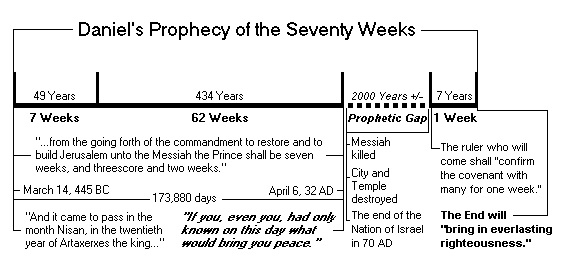
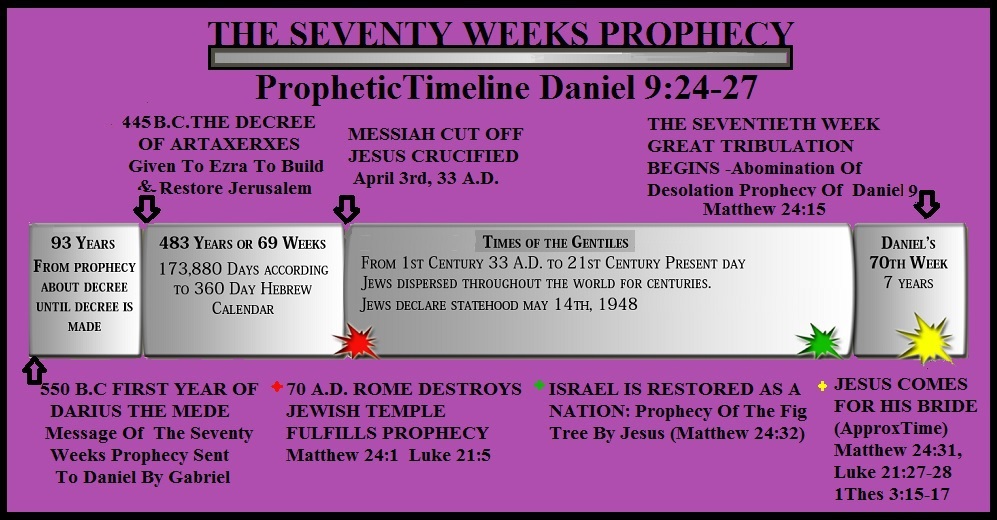
Between this moment in history (chapter 9) with the soon Babylonian supported restoration of Jerusalem, to the coming of an anointed one… we have a defined period of time. “There shall be seven weeks.” This means 70 sevens or 70 X 7 = 490 years; each identified but not necessarily concurrent periods of time. Not concurrent? Not probable per the wording. Each of three segments identified is self-contained. First is a period of 7 sevens. Next will be a period denoted as 62 sevens. This adds up to 69 prophetic years of two specifically identified as periods of time; 7 + 62 = 69. The math leaves one of the 70 sevens still unidentified. This is addressed in the final verse of Daniel 9…

Verse 27 And he shall make a strong covenant with many for one week [7years], and for half of the week [3 ½ years] he shall put an end to sacrifice and offering. And on the wing of abominations shall come one who makes desolate, until the decreed end is poured out on the desolator.”

This (he) is the anti-Christ in this final or 70th week. No wonder Daniel was told to seal it up. Only the Father knows. Matthew 24:36 “But about that day or hour no one knows, not even the angels in heaven, nor the Son, but only the Father.”

To keep this less confusing than other commentators often make it, let’s look at it as it is intended and as it is written; in three sections of non-concurrent or overlapping events. It is three identified periods of time that of themselves add up to the number 70.

7 weeks times 7 equals 49 prophetic years. This is how long it took to rebuild the Temple in Jerusalem AFTER King Cyrus released the Tribe of Judah to return to their homelands and rebuild the Temple. This extended period of time is discussed in the books of Ezra and Nehemiah. Zerubbabel brought the first of his tribe back to Jerusalem but they only laid the foundations for the Temple. Then they ceased that work in order to rebuild their own homes. They hadn’t even bothered to rebuild the walls around Jerusalem.

62 additional weeks times 7 equals 434 prophetic years. This year-count does not begin when the people under Zerubbabel’s leadership returned. It begins when the Temple is completed and rededicated.

*The missing and final week of Daniel’s 70 sevens is 7 equals 7; one prophetic week; this is the 7 years of the Tribulation, anti-Christ, and the last or final desolation of Jerusalem.

*We are told in Daniel 9:24 that this final 7 prophetic years will be troubled times; time period often identified as Jacob’s Trouble. Once again, Jacob is the progenitor of the twelve Tribes of Israel. These are the Israelites. This is not the Church as some wish to associate the event. Jacob fathered the Tribes of Israel. God through Jesus gave birth to the Church.

To graph these events on a calendar only subjects the entire scripture in the final four verses of Daniel 9 to human speculation. Take scripture for what it says. These are three identified periods of time. Currently are in what the bible refers to the “Time of The Church” or sometimes called the time of the Gentiles. This is true up to the final 70th week. Scripture is explicit; this (final week) is the time of Jerusalem, Israel, Jacob’s Trouble. NOT the Church. That is theological and denominational speculation.

Rev Dr. Jstark
February 2020

Daniel’s Seventy 7’s


Part of this Daniel Study series.

It has been and continues to be a frustration to find something other than False Biblical Histories and interpretations of Daniel’s 70-7s prophecy. This is a time to take the bible literally. Do not create mathamatical “fits” for the numbers. This leads to all sorts of interpretations, deductions, and denominational theological planks. Just read it and believe. The facts in the below graphs are the simplest and likely the most practical. Some of the dates may be in question of precise year but NOT the sequence of the events. Certainly not the facts of the prophecy.

These charts are provided for the 39% (=/-) of people in this world who are visual learners. It is to help us put Daniel’s (chapter 9) seventy 7s into a pictured perspective. We are not giving specifics of speculator dates; time of year, year, or even decade or century. This is God’s and God’s only choice. He is patient, longsuffering, caring and allowing but…his judgement is coming just as scriptures tell us. Even Jesus states that he does not know the time. His disciples asked him this question in Matthew 24. At best Jesus gives his disciples and us the conditions that will exist; a list of warnings and events of circumstances prior to his return and the Tribulation of the anti-Christ.

There are many theological “authorities,” especially multiple denominational doctrines that have alternate interpretations. Some even believe we are already in the tribulation since we “make it for ourselves” in our daily living. We Teach – You Decide!

Rev. Dr. Jstark

Daniel 9 – Article #27

Contrary to some who have a basic grasp on the Book of Daniel, the “70 weeks” mention in this chapter has only some to do with the 70 year captivity of the Judeans from Judah. Once again be very cautious about trusting misleading information found on Wikipedia per almost anything scriptural.

Example: Here is what this “supposed authoritarian resource” says:

“The consensus among critical scholars is that chapters 1-6 of the Book of Daniel originated as a collection of folktales among the Jewish diaspora in the Persian/Hellenistic periods, to which the visionary chapters 7–12 were added during the persecution of the Jews under Antiochus IV in 167–163 BCE. The authors of the tales apparently took the name Daniel from a legendary hero mentioned in the Book of Ezekiel, and the author of the visions in turn adopted him from the tales.”
[From Wikipedia, Daniel 9, the free encyclopedia; emphasis mine]

Wikipedia uses dogma and misleading “authorities” trying to make a point that the Bible is A BOOK OF STORIES. Fundamentalists do a major disservice that inadvertently supports this Wikipedia philosophy by also identifying historical Bible events as “stories.” Call scripture for what it is…FACT, not a series of cute religious bedtime and Sunday school stories.

When speaking to true believers, those who strive to BE and LIVE (believe) a Christian life, we understand. But to the unbeliever, the unequally yoked church attender, or the church-only so-called Christian, the word story leaves much territory to wonder, rationalize, and justify wrong personal actualities.

Now to Daniel 9:

Daniel 9:2 is very specific about who the author is. Not some distant or future “add-on” to this incredible book. “I Daniel, understood the number of the years by books, which came of the Word of Jehovah to Jeremiah the prophet,…” [NKJV]. Daniel is a student of scripture. He is well read, especially of Jeremiah. In Daniel 9:2 he is probably referring to the passages found in Jeremiah 25 (*11 & 12) and chapter 29 (10-12).

*…this whole land shall be a ruin and a waste. And these nations shall serve the king of Babylon seventy years. [NKJV]

Daniel is specifically referring to the 70 year captivity of the Judean Jews. At the end of this chapter, we get a beginning glimpse of s future Jerusalem even today has yet to be fulfilled as a promise of God the Father.

At this point, Daniel goes deep into a prayer session with God. His prayer content and context references other bible scriptures (*future outcomes contained in past conditions put upon Israel by God) but that is not the discussion goal of this Daniel 9 article. Let’s look at Daniel’s prayer specifics. It is something we should learn to pattern. Not a prayer life of the Lord’s Prayer quoted in Matthew 6 and Luke 11. In these passages we are specifically instructed to go into our prayer closet, alone; not to stand or sit and pray aloud yet alone in unison. This would make for a very crowded prayer closet.

*EXAMPLE: Leviticus 26:40 – 42 This is a specific precondition for the redemption and return of Israel, not just the Judean Jews, but include from the “four corners of the earth” where Israeli Tribes and offspring now live. Most of these folks have lost contact with their chosen people identification given to them by God through Abraham, Isaac, and Jacob.

Gabriel

If we jump forward to 9:21 we read that Daniel’s prayer was so earnest and intense that God sent the angel Gabriel to speak with Daniel…directly! But, let’s not stray. In Daniel’s prayer he includes…

  1. Fasting
  2. Persistence
  3. Israel not listening to God’s Words
  4. The unrecognized shame of Israel. Note that Daniel is not praying about the Jews of Judah but of his entire family of scattered Israeli Tribes.
  5. Rejection of the prophets sent by God to both the northern and southern kingdoms of Israel and Judah.
  6. He calls Jerusalem “the city that bears HIS (God’s) name.”
  7. Daniel pleads for God’s wrath against Israel (Jerusalem) to cease
  8. It is not a request (petition) owed to Israel but it is for the sake of God’s name.

We so often miss one of Daniel’s major prayer points. He is not asking this for the sake of Israelis, but according Daniel 9:18b…”For we do not present our prayers before You on account of our righteousness’s, but because of Your great mercies.” [NKJV] . Note the “WE” in Daniel’s prayer. He is not praying for himself but for his entire people of Israeli descent.

In verse 19 Daniel lists priorities…

  1. “For your sake (God);
  2. …on account of your righteousness;
  3. …for your city (Jerusalem);
  4. …for your people called by your name.”

Let’s back up for a moment to verse 19. Daniel says and pleads with God that He answer his prayer petition for “the city Jerusalem AND for ‘those who carry His name’.” Give serious consideration for those who call themselves Christian today. There are many who identify as Christian but do little to “carry His name” in his or her daily walk in public and in worship.

From verse 23 forward (Daniel 9:23+) we arrive at a fork in the road of prophecies; two roads (context) but the same content. This is somewhat scriptural speculation but consider this. We know that the Tribe of Judah (Jews by a shortened inference name) was in their 69th or 70th year of captivity in Babylon. It was about to end and King Cyrus of Persia (modern day Iran) would release them to return to their original homeland. Verse 25 no longer is talking about the 70 year Babylonian captivity but of a future yet to be completed return and building of Jerusalem; i.e. Daniel’s 70 7s.

The future of Jerusalem is now identified in Daniel’s prayer to be “built unto the Messiah the Prince.” God is never identified as the Messiah; Jesus is. God is never referred to as a Prince. Only Jesus is. So the parallel or fork in the road of prophecies is obvious. Judeans would be release after 70 years of Babylonian captivity but Jerusalem is destined to be the Kingdom of the Messiah Prince; Jesus. This is a reference to the future millennial reign. We will discuss that in part, in our next Daniel article. Prior to this verse, the Jerusalem under discussion was for the right of the captured Jews of Judah to return home.

Daniel 9:25 in the ESV puts it this way:

Know therefore and understand that from the going out of the word to restore and build Jerusalem to the coming of an anointed one, a prince, there shall be seven weeks. Then for sixty-two weeks it shall be built again with squares and moat, but in a troubled time.

The very next verse identifies (anti-Christ) as one who will destroy the city and the Temple. Bear in mind, Nebuchadnezzar had already done this several decades earlier.

The prince identified in verse 26 is lower case; not Prince as written earlier in chapter 9, but as prince of the people. We will pick it up at verse 26 in the next article. It is a discussion in and of itself.

Article #26 Daniel 8

“Bible History IS Secular History when given the truth, whole truth, and nothing but the truth.”

Following is a quote from Wikipedia; a reference source ahabiblemoments.com seldom encourages and often discourages as a reliable source for knowledge, total truth and research information. They are obviously changing their historical perspectives at the expense of bible facts. In some resource reference they go so far as to simply call the bible a book of stories that at best are half-truths, not historical reports. In this case (below quote) the reader is initially given historical facts and future reality perspectives on history and theology. Keep in mind that the bible is not a religion and history is not the truth, whole truth and nothing but the complete truth. The Bible is part of secular history; not separate to or removed from the annals of history.

Daniel 8 (the eighth chapter of the Book of Daniel) tells of Daniel‘s vision of a two-horned ram destroyed by a one-horned goat (a possible allegory for the transition from the Persian to the Greek eras in the Near East), followed by the history of the “little horn”, which is Daniel’s code-word for the Greek king Antiochus Epiphanes.

Oppression

The subject of the vision is Antiochus’ oppression of the Jews–he outlawed Jewish customs such as circumcision, Jewish monthly/Lunar calendar, dietary restrictions, and Sabbath observance, made ownership of the Torah scroll a capital offense, and built an altar to Zeus in the Temple (the “abomination of desolation“). His program sparked a popular uprising which led to the retaking of Jerusalem and the Temple by Judas Maccabeus (164 BCE). [Wikipedia, opening paragraphs]

Note: Beginning in this chapter through the end of the book, Daniel is written in Hebrew… TO THE HEBREW (Israelites) people. Daniel 2:4b – 7:28 is written in the language of Babylonian Gentiles at that time; Aramaic sometimes called Chaldean. The reason for the switch from Aramaic to Hebrew is a modern day marketing rule-of-thumb. “Write to the intended target market even at the expense of those not part of the targeted market.” From here to the end of Daniel it is all about Jerusalem, Israel, Israelis, anti-Christ and the second coming of the King of kings; Jesus. Also often missed is the fact that up until now, Daniel was involved in dream interpretation (Chapters 24b-7:28). This chapter is called a “VISION”…a view into the future. Daniel had a dream (7:1). Within it was a vision.

What was this vision? It was of a ram (two horns) and a goat (one horn). There is an abundant amount of historical evidence for these animals being representative of Greece and Persia. Most simply is the fact that the Ram “did not touch the ground.” This refers to the rapidity of Alexander’s army conquests. The ram had two horns; i.e. the Medes and Persians. The goat had but one horn; i.e. Alexander’s Greek/Macedonian army. It moved with the speed of a leopard. Daniel 8:3 states:

(NIV) I looked up, and there before me was a ram with two horns, standing beside the canal, and the horns were long. One of the horns was longer. than the other but grew up later.

Simply put… The Medes had been an empire far longer then had the Persians. However, the Persians turned on their Mede allies after defeating Babylon, conquered them, and with combined powers of both became the larger (longer) of the two horns. Verse four describes its growth as a power…until it bumped up against the Greek city-states (Sparta and Athens) and Macedonia (490’s B.C.). It was with regards to this history in which Aristotle taught his student Alexander, son of Macedonian King Philip; i.e. Alexander the Great. He grew up and was well trained as a military leader. He sought revenge on Persia but had to conquer many other kingdoms while in-route.

JIV NOTE: Xerxes, son of ‘Darius the Great’ is one of the Persian kings identified as Ahasuerus in the biblical Book of Esther. In contrast, the 62 year old Darius who initially conquered Babylon was “made king” over Babylon, not the Babylonian Empire. That ruler was Cyrus, king of Persia. He appointed Darius as a satrap-king over Babylon, but not the entire Persian Empire.

Ray C. Stedman wrote back 1969:
[https://www.raystedman.org/old-testament/daniel/the-great-propagandist]

The eighth chapter of Daniel contains a different kind of little prophecy than any we have seen before. In the other prophetic sections of the book we have had a more or less direct view of future events brought before us Chapter 2 was a long-range telescopic view, looking down the whole range of time beginning with Daniel’s own day and running on down to the end beyond our own day. Part of it is now fulfilled and part of it is yet unfulfilled. In Chapter 7 we had what we might liken to a zoom camera approach, which moved in to the events of the last days before our Lord’s return, wherein we saw the condition of the earth politically, and especially centering around the Mediterranean Sea. We were stirred to note that events of our own day were perhaps beginning to produce the final shape of things.

But now, in Chapter 8, we see events which were future as far as Daniel was concerned but have and have yet to be fulfilled in history. Some three hundred years after the prophet Daniel uttered these words, they were, for the most part, fulfilled….we have an historic fulfillment which in turn becomes a prediction of another event. That is exactly what we find in the eighth chapter of Daniel.

Now that we have identified the ram with two horns and the leopard-like speed of the goat with one pointed horn…out of the west (8:5), consider another unique factor per Daniel 8.

(ESV)”…a male goat came from the west across the face of the whole earth, without touching the ground. And the goat had a conspicuous horn between his eyes.” This verse begs the question: might this also represent a missile fired from across the Atlantic? The one horn perhaps between the eyes of the missile guidance or painted on the missile itself? “…across the face of the whole earth???? Hmmm? Fired from afar across the FACE OF THE EARTH!

Let’s pause here for a moment and look more closely at verses 5-9.

We use the YLT [Young’s Literal Translation] in the following as it is very close in context, content and verbiage of the original Hebrew. Note the highlighted text.

Dan 8:5 `And I have been considering, and lo, a young he-goat hath come from the west, over the face of the whole earth, whom none is touching in the earth; as to the young he-goat, a conspicuous horn is between its eyes.

Dan 8:6 And it cometh unto the ram possessing the two horns, that I had seen standing before the stream, and runneth unto it in the fury of its power.

Dan 8:7 And I have seen it coming near the ram, and it becometh embittered at it, and smiteth the ram, and breaketh its two horns, and there hath been no power in the ram to stand before it, and it casteth it to the earth, and trampleth it down, and there hath been no deliverer to the ram out of its power.

Dan 8:8 `And the young he-goat hath exerted itself very much, and when it is strong, broken hath been the great horn; and come up doth a vision of four in its place, at the four winds of the heavens.

Dan 8:9 And from the one of them come forth hath a little horn, and it exerteth itself greatly toward the south, and toward the east, and toward the beauteous land ;

In the time following Daniel’s vision and in verse 8 we read that the GREAT HORN of the goat was broken off being replaced by “four horns.” Alexander the Great had many Generals. After his death and after some infighting, the Alexandrian conquered lands were divided between four of his generals; eventually becoming the empire of the Seleucides (Kings of the north) and Ptolemy’s (Kings of the south primarily Egypt). Judah, today’s Israel, became the battle ground of these wars and conflicts between these kingly empires and future leaders of the north and leaders of the south [study Daniel 11]. Armageddon? The valley and lands of Megiddo is only 60 some miles north of Jerusalem on today’s modern maps.

Daniel 8:9 begins a transition from a historical time to a future prophetic time that closely relates to the yet unfulfilled time of times with anti-Christ; the small horn that comes up from one of the four. He throws down the worship and sacrifices in Jerusalem and sets himself up to be the center of worship. Verse 14 tells us this will be 2,300 evenings and mornings. Angel Gabriel, in 8:14 – 26, explains to Daniel precisely what this vision means and that it has a double interpretation; one that followed in the next 300 to 400 years of history and one that refers to End Time. The final verse assures us that this is a spiritual battle with earthly subjects. The rise of the “power” against God is not defeated by human hands. Verse 25…And he shall even rise up against the Prince of princes, and he shall be broken—but by no human hand. (emphasis mine)

As we move through the remainder of Daniel, keep in mind this has to do with Jerusalem. Not Washington D.C., Moscow, London or any other center of power. They, as was Nebuchadnezzar, may well be the pawns that play out a history yet to happen, but this boils down to the original problem on earth that began with the fall of Adam and Eve. It is between God and Satan.

Daniel 7 Article #25

Aha Moment –

Chapter 7 is a major switch for several reasons therefore we will also switch from a verse-by-verse article discussion to an analysis of the recorded historical events that follow in the remaining chapters of Daniel.

  1. It is the last chapter in Daniel that was originally written in Aramaic (yup…not Greek or Hebrew)
  2. This is the beginning of Daniel having the visions instead of those in charge of Babylon where he is asked to interpret.
  3. We switch to a narration and prophecies designated to the world of believer but specifically to the Hebrew people; i.e. Israelis and Jerusalem.
  4. We are getting very close to the end of Judeans’ 70 year captivity in Babylon.

Introductory Note: Daniel describes four beasts coming up from the sea. What did Daniel’s vision represent, and what does it mean for us today? No, this is not a sequential chapter according to history playing out, but this is the order in which the Book of Daniel is recorded. How do we know this? Regent king Belshazzar (555B.C.?) was discussed and ended back in chapter 5. This dream or vision of Daniel came to him during the first year Belshazzar’s reign. Why isn’t it recorded back in chapter 5? Daniel 7:28 tells us that at this time Daniel “kept this matter (vision) to himself” (Daniel 7:28).

This vision of Daniel “while he lay in his bed (ESV) appears to parallel chapter 2 when King Nebuchadnezzar had his statue dream made of gold, silver, bronze, Iron legs and feet toes of Iron and clay mix. Daniel saw in chapter 7:3 “four great beasts that came out of the *sea.”

*SEA: This word has been translated differently by commentators. Two transliterations are thal’-as-sahandyawm. Without going into a deep theological discussion, the word sea can refer to a body of water OR a body of people; i.e a sea of people.

Dan 7:4 The first was like a lion, and had eagle’s wings: I beheld till its wings were plucked; and it was lifted up from the earth, and made to stand upon two feet as a man, and a man’s heart was given to it.

Dan 7:5 And behold, another beast, a second, like unto a bear, and it raised up itself on one side; and it had three ribs in its mouth between its teeth; and they said thus unto it: Arise, devour much flesh.

Dan 7:6 After this I saw, and behold, another, like a leopard, and it had four wings of a bird upon its back; and the beast had four heads; and dominion was given to it.

Dan 7:7 After this I saw in the night visions, and behold, a fourth beast, dreadful and terrible, and exceeding strong; and it had great iron teeth: it devoured and broke in pieces, and stamped the rest with its feet; and it was different from all the beasts that were before it; and it had ten horns.

Dan 7:8 I considered the horns, and behold, there came up among them another, a little horn, before which three of the first horns were plucked up by the roots; and behold, in this horn were eyes like the eyes of a man, and a mouth speaking great things.

Take note that the 4th beast (7:7) is not given an identity, only a description.

The lion in verse 4 represents a description of an historical event which had already been prophesied in Daniel’s earlier life in Babylon. This verse (7:4) is a brief referring to King Nebuchadnezzar. He was a mighty and unchallenged KING OF BABYLON and his conquered lands. He lifted himself up above all his court and subjected peoples. Then his “wings were plucked off.” This explains when he was reduced by God to a common beast. As we studied in chapter 4, and in Nebuchadnezzar’s own Chaldean words, he became like a beast of the wild (insane). Time pasts before Nebuchadnezzar regains his sanity, stood up like a man, is restored to his throne and accepts the God of Daniel as the only true God.

Daniel 7:5 says, “And suddenly another beast, a second, like a bear. It was raised up on one side, and had three ribs in its mouth between its teeth. And they said thus to it: ‘Arise, devour much flesh!’” This event will parallel text from the next chapter of Daniel but not today. Some commentaries suggest the three ribs are conquered lands; the Lydian Empire of Asia Minor, the Chaldean Empire being Babylon itself, and Egypt (525 B.C.). This author respectfully disagrees. The bear (Persia) being turned on its side (7:5) had turned on its Mede ally after the Babylonian conquest thus uniting the two Empires into one kingdom.

Since Daniel mentions THREE RIBS in the mouth of the bear and before the bear is instructed to “rise up and devour much,” the three conquered territories or empires had already been conquered; three ribs in his mouth. At this time, Egypt had not been conquered by Persia and it didn’t happen until the rule of Darius I also known as Darius the Great.

To keep historical/biblical records straight, the Persians tried unsuccessfully to conquer Greece around 490 B.C.; i.e. parts of Macedonia. They failed. This was also an event that Alexander the Great, son of King Philip of Macedonia, was taught not only by his father but by his tutor Aristotle. Alexander had it in mind to “pay back” the aggression of the Persians; i.e. Darius I doing so in 331 B.C. Alexander is represented in Daniel’s vision as a Leopard; quick and agile. The four wings and heads of this Leopard represent the four empires that evolved out of Alexander’s empire; i.e. (1) Greece and Macedon, (2) Thrace and Asia Minor, (3) Middle East-Asia and (4) Egypt-Palestine.

From this we get the two dominant kingdoms back then and in prophecy representing the King of the North and the King of the South; Ptolemy’s of Egyptian fame and the Seleucids of Assyrian/Syrian fame. We would roughly identify Seleucus’ kingdom as modern day Iraq, Persia, and Afghanistan. The Ptolemy’s and Seleucids battled each other over and over. We have discussed this in other articles written for ahabiblemoments.com so will only touch upon it at this time due to space limitations.

JIV NOTE: For the aha wonderers and New Testament buffs, the capital of the Seleucid empire was the Antiochus of New Testament Apostle Paul fame.

The 4th beast of unknown name or identity is a two-fold prophecy. First it is the Romans. They swept through all of the territories of Alexander’s divided empire.

ANTICHRIST

Second, it represents a picture of the yet to come antichrist of End Time and the battles between him (Norther Kingdom Europe?) and the Southern Kingdom (Arabs and Muslims). A simple consideration is that the antichrist will demand he be worshipped and Muslims will not easily, if at all bow to a non-Muslim “king.” The antichrist is represented by the “little horn” that sprouts up amongst the ten original horns of the unidentified 4th beast.

THE ANCIENT OF DAYS (Daniel 7:9-14) https://biblehub.com/commentaries/gray

“While these events are culminating on the earth others are transpiring in heaven. A great judgment scene is before us (compare Psalms 2; Matthew 25:31-46, and Revelation 19:19-21). “The Ancient of Days” is identified by some as the first and by others as the second person of the Godhead (Revelation 1:12-14; John 5:22). The slaying of the “beast” (Daniel 7:11) means the destruction of the world-powers are represented in their final form of the revived Roman Empire”…but there is no peace on earth. I believe the northern nations and ¼ of the earth’s land mass dominated by the king of the south are still at battle with each other.

In verses 21-22 and 25, this little horn makes war against the saints, speaks pompous words against God, intends to change times and law, and persecutes the saints for a “time and times and half a time” (literally three and a half years, but using the day-for-a-year principle of Numbers 14:34 and Ezekiel 4:6, 1,260 years); https://lifehopeandtruth.com/prophecy

Article #24 – Daniel Series

The deal is sealed! The appointed King of Babylon, King Darius, has followed his decree and the rules of the Medes and Persians. The pit or den of Lions was sealed with Daniel in it. It is a bit of encouragement to Darius, one might conclude, that Daniel is in with the lions, a stone is brought to seal it, and Daniel is still alive. This is in a huge contrast to what happened the next day with those that deceived Darius.

Daniel 6:17-18

17 And a stone was brought and laid upon the mouth of the den; and the king sealed it with his own signet, and with the signet of his lords; that the purpose might not be changed concerning Daniel.

18 Then the king went to his palace, and passed the night fasting: neither were instruments of music brought before him: and his sleep went from him.

There are few mental traumas worse than remorse, for there is nothing that can be done to change the circumstances – unless of course one knows the one true God who, being outside of time, entered into His creation at a specific point in history and paid once and for all for every wrong thing we have ever done, said or thought thus wiping the slate clean. Here is no need or gain to keep reminding one’s self of his or her transgression.

“And he is the propitiation for our sins: and not for ours only, but also for the sins of the whole world.” (1John 2:2)

Daniel 6:19-20

19 Then the king arose very early in the morning, and went in haste unto the den of lions.

20 And when he came to the den, he cried with a lamentable voice unto Daniel: and the king spake and said to Daniel, O Daniel, servant of the living God, is thy God, whom thou servest continually, able to deliver thee from the lions?

It is a curiosity of how long a pause Daniel may have left before answering?! How anxious Darius must have been waiting for the other shoe to drop or the climax of anxiety at the steepest part of the roller coaster.

Daniel 6:21-22

21 Then said Daniel unto the king, O king, live forever.

22 My God hath sent his angel, and hath shut the lions’ mouths, that they have not hurt me: forasmuch as before him innocence was found in me; and also before thee, O king, have I done no hurt.

How incredible it must have been for Daniel to have spent a night in safety knowing that God had sent His angel and that the loins couldn’t harm him.

How incredible also for us to know that our adversary, who roams about like a roaring lion seeking whom he may devour, cannot harm us because we too are protected by the angel of the Lord (Hebrews 1:14 and 13:5). Was it the same for the three in the furnace? Throughout the Old Testament the Angel of the Lord is no mere angel but the commander of the armies of the Lord – i.e. possibly Jesus Christ himself although he is not an angel, but part God.

Why would or might Jesus be identified as “the angel of the Lord” in the Old Testament? Simple! He had not yet taken on an earthly body to go to the cross in bodily form; half human and half God head. He was not yet the Christ Messiah. He had a role and it may be that of “the angel of the Lord God.”

Jesus said in Luke 10:19 “Behold, I give unto you power to tread on serpents and scorpions, and over all the power of the enemy: and nothing shall by any means hurt you.”

Daniel 6:23

Then was the king exceeding glad for him, and commanded that they should take Daniel up out of the den. So Daniel was taken up out of the den, and no manner of hurt was found upon him, because he believed in his God.

For the eyes of the LORD run to and fro throughout the whole earth, to show himself strong in the behalf of them whose heart is perfect toward him.” (2 Chronicles 16:9)

There is someone else who was faultless yet betrayed, handed over to death, went down into a pit, a stone was rolled into place and sealed to stop someone from taking him out, yet He was taken ‘up out of the den and *no manner of hurt was found upon Him, because He believed in His God’ * Except for the nail prints in His hands & feet, which will serve as an eternal reminder of His love and sacrifice for you and I.

Daniel 6:24

And the king commanded, and they brought those men which had accused Daniel, and they cast them into the den of lions, them, their children, and their wives; and the lions had the mastery of them, and brake all their bones in pieces or ever they came at [to] the bottom of the den.

We should not be envious of the workers of iniquity for their day is coming. David wrote: “Fret not thyself because of evildoers, neither be thou envious against the workers of iniquity. For they shall soon be cut down like the grass, and wither as the green herb…… fret not thyself because of him who prospereth in his way, because of the man who bringeth wicked devices to pass. Cease from anger, and forsake wrath: fret not thyself in any wise to do evil. For evildoers shall be cut off: but those that wait upon the LORD, they shall inherit the earth.

This is exactly what happened to the wicked ones who plotted against Daniel; their ‘sword’ did indeed enter their own heart.

Regarding this verse, Robert Wilson says the following:

“The possibility of the destruction of the one hundred and twenty satraps and their families by lions is shown from the fact that the monuments of the kings of Assyria say that they had menageries containing “all the animals of the mountains and of the plains,” including elephants, panthers, and lions. Further, it is shown that lions at that time were the pest of the Euphrates Valley, hundreds of them being killed in a single hunting expedition, and that in one case mentioned by Ashurnasirapal, king of Assyria, fifty young lions were captured alive and shut up by him in the city of *Calach.” (Robert D Wilson – Studies In Daniel) Once again, the Bible is not a collection of quaint stories; it really is His-story. So why do we continue to say “the Bible stories?”

Historical JIV NOTE: Another name for Calach, sometimes spelled Kalhu is the ancient City of Nimrud (Nimrod), a son of Ham who was a son of Noah on the Ark.

Daniel 6:25-27

25 Then king Darius wrote unto all people, nations, and languages, that dwell in all the earth; Peace be multiplied unto you.

Male a Decree

26 I make a decree, That in every dominion of my kingdom men tremble and fear before the God of Daniel: for he is the living God, and stedfast forever, and his kingdom that which shall not be destroyed, and his dominion shall be even unto the end.

27 He delivereth and rescueth, and he worketh signs and wonders in heaven and in earth, who hath delivered Daniel from the power of the lions.

So just as with Nebuchadnezzar, Darius now acknowledges and gives glory to the God of Daniel, who is steadfast and whose kingdom is without end! This may have also been a JIT…just in time event. He did not reign in Babylon for very long. Recall that he was 62 years old when appointed king over the realm of Babylon by King Cyrus of Persia.

Daniel 6:28

So this Daniel prospered in the reign of Darius, and in the reign of Cyrus the Persian.

JIV NOTE: Darius was a Mede and Cyrus was Persian; i.e. Medo-Persians. The Persians of then are the Iranians of today. They are NOT Arabs. What changed their attitude about the Jews since it was their ancestors who set them free from 70 years of Babylonia captivity?

Just as Joseph had prospered because he trusted his God regardless of the circumstances, so Daniel did prosper. Both also paid a price for that commitment. Jesus said in Luke 16:11“If therefore ye have not been faithful in the unrighteous mammon, who will commit to your trust the true riches?” He also told us to be as wise as serpents but as harmless as doves (Matt 10:16). Paul tells us that Christians should work even harder for their employers than the world does because we should work as unto the Lord (see 1Tim 6:1; 2 Tim 4:9-10; Titus 2:7-10)

And so ends the first (historical) section of the book. Chapters 7-12 will see Daniel having breathtaking visions that foretell the future of the Medo-Persian, Greek, Roman and final world empire influence on the Jews and Israel proper. We will be introduced to the ‘little horn’ speaking great things, and we will see some of the most incredible prophecies in the Bible that help to unravel the days that we are living in right now and prove beyond doubt that Jesus Christ is the Messiah of Israel who is destined to return and rule on the throne of David and establish an everlasting kingdom.