Isaiah 4 (1-7)

And in that day seven women shall take hold of one man, saying, “We will eat our own food and wear our own apparel; Only let us be called by your name, To take away our reproach.” (Rev David Guzik; KJV).

To better understand this 1st verse in Isaiah 4, one can do him or herself good by reviewing the first three chapters in this infamous Old Testament book; the book that the early church depended upon to understand the facts of after the cross salvation. Women usually expect marriage. The problem within Israil, at “that Day”, the wars of others against Israel will have depleted the available men. There won’t be enough men to go around. They will have died from warfare, disease, or still in battle (see Isaiah 3:25).

In that day: This does not mean that the Messiah would appear when these judgments are taking place on the daughters of Zion. It means that the promise of the Messiah would be all the more beautiful and glorious to them in the midst of their suffering. People who claim to know the day of Christ’s return cannot be correct. The Bible in the Book of Matthew, (New King James Version). “But of that day and hour no one knows, not even the angels of heaven, but My Father only.” Such people who make such claims of knowing are, simply put, evil and without scriptural support.

The judgments of the LORD are detailed in Isaiah 3:16-26.

Isaiah 4:2 is the beginning of the renewal of Zion. Map of Old City, Jerusalem

Often Zion and Jerusalem are claimed to be one and the same. Beyond its physical location, Zion also represents a symbolic idea. Zion is often used as a *metonym for Jerusalem.

* Metonym: a word, name, or expression used as a substitute for something else with which it is closely associated but distinct.

Verse 2 needs clarification. “In that day the Branch of the Lord…” When one thinks of a branch, a tree limb usually comes to mind. However, The Hebrew for “Branch” is tseh’mach. This means a seedling, a sprout, a bud. The renewal of Zion is part of the “all new” promise. An understanding of this helps us better understand 2 Corinthians 5:17.

Verse 4:4When the daughters of Zion…”  If not taken in context, one can very easily misunderstand this verse. The word “when” makes it a given. However, the Hebrew word that is translated “when” is ‘im [eem]. There are over 25 English translations for the Hebrew ‘im [eem]. We say this only to advise those who seriously study the Bible must use wisdom and caution in the word[s] translated to English.

Verse 4:5 alerts us to the fact that this is about Israel. Romans 11:26, for instance, speaks of “all Israel will be saved,” suggesting a future restoration or turning back to God. It (Bible) does not say that all people (gentiles) will get a second chance. This is a hot and debated topic. We have addressed this topic in previous posts to this site. Daniel 9:20-27 Bible Study Commentary - 70 Weeks of Daniel ...

Verse 5 “…then the Lord will create above every dwelling place of Mount Zion…” Mount Zion? Hmmm?

NOTE: Daniel 9:27 is interpreted as a prophecy about a future seven-year period (the final “week” of Daniel’s prophecy) during which a powerful leader (the “prince who is to come“) will confirm a covenant with many but will ultimately break the covenant and cause desolation. This period is often associated with the tribulation and the rise of the Antichrist. This covenant does not state all peoples, but it says “SOME”.

In verse 6 of chapter 4, the word rain means rain. It does NOT mean God will once again flood the world. People seek refuge in a rainstorm.

Rev. Dr. Jstark – 8/2025

Isaiah 3

Studying Isaiah provides a deeper understanding of the gospel and God’s character. Remember that the early church did not yet have the New Testament. They relied mostly on what the prophet Isaiah wrote.

The main messages of Isaiah 3:

  1. Judgement on their leadership in Judah and Jerusalem
  2. Isaiah describes a people on the verge of collapse and a disregard for God’s law
  3. [v16+] God says, “Zion women are stuck-up, prancing around in their high heels,
    Making eyes at all the men in the street, swinging their hips, Tossing their hair, gaudy and garish in cheap jewelry.”
  4. “Behold the Lord (‘adon: to be a ruler), the LORD of hosts (Yahuwah: (self-existing)) …” Two forms of the titles Lord and LORD.
  5. God will remove from Judah/Jerusalem) men of war, police protection, judges and courts, pastors and teachers, captains and generals, doctors and nurses, even repairmen by trade, and those who are capable of ruling will refuse the role.

Verses 8-9: This is where today we get the statements “down for the count” and “they have made their bed now sleep in it”. Verse 9 is of particular interest. The appearance of their faces witnessed against them, And their sin, as Sodom, they declared, They have not hidden! Woe to their soul, For they have done to themselves evil (YLT; Young’s Literal Translation).

Verse 9: Have you or someone else ever said … “the look on your face tells us differently. Read verse 9a … The look on their continence (pânı̂ym; face) witnesses against them”

Verse 10-11: The righteous, will be rewarded, disaster to those who fall away or reject God’s will, doom to the wicked, what one has done to others will be done to them.

NOTE of CAUTION. This is why the Lord’s Prayer (as we call it) is for individuals, not a congregation… “forgive us our (my) trespasses JUST as we (I) forgive those who have trespassed against us (me).

Verse 12: We at ahabiblemoments did NOT write this verse. We are quoting the Bible.

As for my people, children [analogues] are their oppressors, and women rule over them. O my people, they that lead you cause you to err” (American Standard Version). This verse points out the surrendering of male leadership (Adam and Eve).

Verse 13,14: Have you ever hear it said that someone is acting as Judge and Jury? The Lord makes this claim in 3:13,14. “Jehovah stands up to contend and stands to judge the peoples.” He will be judge and Jury over all Israel [and mankind].

Verse 15,16: The accusations made.

Verse 15-24: The punishment here on earth to those accused in verses 15 and 16. Look closely at verse 24… (KJV)Instead of a rich robe (WELL DRESSED) a girding of sackcloth; branding instead of beauty.Branding is kee in the Greek. A synonym for branding/kee is tattoos. Hmmm? Wearing tattoos instead of things of beauty.

The context of verse 25 & 26 continues in the next chapter (4:1). This will be in our next article.

Isaiah 3:25  Your men shall fall by the sword, and your warriors in battle. 

Isaiah 3:26  And her gates shall lament and mourn, and she shall be banished; she shall sit upon the ground.

Rev. Dr. Jstark – 2025

Punishment for sin as preparation for glory – The Day of the Lord – (Isaiah 2:5 – 2:22)

Question: What will earth be like once Christ sets up his throne on earth?

This is the question many ask of themselves without finding and answer the excludes man’s thoughts and only includes God’s. This passage in Isaiah is specific to the Tribes of Israel. How do we know that?

Isaiah 2:5 O house of Jacob, come and let us walk in the light of the Lord” (NKJV). This is Israel meaning all the Tribes even though the Tribe of Dan is not included in Revelation 7:4-8.

NOTE: We discussed this absence of Dan being named in Revelation in a previous article. The quick of it:

  1. Israel (Tribe of Dan) failed to be that light to the world
  2. God will change this heart attitude during the Millennial reign after the Tribulation
  3. Dan outright rejected the walk and commandments of God.

Isaiah 2:6-8 The physical wealth of other nations has drawn Israel away from their worship and dependence of their God. Verse 8b says it well …”They (foreigners) worship the work of their own hands.” In short …they did it THEIR way.

Isaiah 2:9 “People bow down” to or seek to hold as eternal values things of this world. God is not one of these perceived fabulous things of value. As it states in verse 8, it is the things made, collected, or manufactured by their OWN HANDS.

Isaiah 2:10 Here we find defaulted instructions for people to seek refuge in rocks and dust (hole in the ground), hiding from the “terror of the Lord” and the “splendor of his majesty”. This verse is part of a larger passage that describes the day of the Lord, where pride will be humbled and God alone will be exalted.” It appears again in verse 2:19.

Hide themselves from the TERROR of the Lord. Will the Lord be some type of terrorist or bad guy the stalks those who try to hide from his appearing? Not so. It is a terror of the truth being unfolded with full disclosure. Man will attempt to hide to possibly be overlooked by God.

Isaiah 2:11 Anything man attempts to exalt himself will be revealed in the truth. God will reveal man’s self-centeredness exposing what was little more than man exalting himself. On that day ONLY GOD will be exalted. People will know the truth. This time the truth will not set all mankind free.

Isaiah 2:12 This verse tells us that there will be no exceptions. From the mightiest to the lowest, man will be exposed for what he is. This verse says it strait …”The Lord alone will be exalted in that day. No man or for that matter, no creation will fail to recognize the creator is on earth.

Isaiah 2:1317 The great cedar, the mighty oak, the high mountains, great hills, high towers, the great defensive walls built by man, the great ships of the seas, and the haughtiness of all mankind will be brought down. Only the appearance of the Lord will be acknowledged as worthy of recognition and celebration.

Isaiah 2:19 is a valuable verse. God will be known and entered even in the crevices on and within the earth. Nothing ever created will be able to hide, even in the heavens above earth i.e.: the moon or mars.

Isaiah 2:20 This verse has subtle insights. We think of the Millennial Reign as two things, perhaps three. First, it is considered by some as a time of “Christians Only”. “In that day a man will cast away his idols of silver and gold.” This sentence says man will have idols or possessions to cast away. It also means he had idols or treasured items going into “THAT DAY.” Man made them for himself. This verse may suggest that there will be mankind who have not been a believer prior to or in “THAT DAY.” Perhaps even after “THAT DAY.” But this verse is also part of verse 21…

Isaiah 21 These forbidden idols [possessions] will “go into the crags of the rugged rocks, (to hide them) for the terror of the Lord is great. During *“THAT DAY” It will resemble many church attenders of today. *People will be more rigorous in their attempt to hide their personal and desired items to look or appear Christian like but not Christ like. Yes, some will truly be converted becoming true to Christ. Remember that the Great White Throne judgement [Revelation 20:11-15] does not come until after the thousand-year reign.

2 Corinthians 5:10: “For we must all appear before the judgment seat of Christ, so that each one may be recompensed for his deeds in the body, according to what he has done, whether good or bad“.

Isaiah 2:22 How do we know that the above comment per verse 21 is fact? Read verse 22. We are told to sever/break our relationship with such people. Isaiah 2:22 instructs believers to stop trusting in humans and their limited lifespans, emphasizing that true strength and security come from God alone. This verse highlights the transience of human life, comparing it to breath in the nostrils, and urges reliance on God’s eternal and sovereign nature. 

Rev. Dr. Jstark – 2025

Punishment for sin as preparation for glory           

Isaiah 2:1 – 2:4

Isaiah speaks to many things as concerns his fellow Israelites. His focus in Chapter 2 says much about not only Israel’s future but the future in this world …and one might include “this world and universe.” As believers, we are to reflect Jesus just as the moon reflects the sun’s brilliance. The moon has no light of its own and neither do we. Israel was supposed to be that light on the hillside. A light to the world. (see Isaiah 49:3; Exodus 19:6)

Isaiah begins chapter 2 by prophesying about Judah and Jerusalem. Verse number 2 begins, “Now it shall come to pass in the latter days…” The latter days? Isaiah wrote in the 700’s B.C. yet he speaks of a very distant time yet to come [Isaiah 11:4-9]. A time of absolute justice. A time referred to as the Millennial Reign of Jesus. Micah 4:1 also refers to this time yet to come.

But, what are the last days? The wording here might be a bit confusing. It sounds or reads like the end. The end of days? This is a good time to rid our minds of what we know as days or time since both were created in Genesis 1:5. Too often our minds associate the last days with some type “end to all things.” This is partially true. Revelation 21:5 states, And he who was seated on the throne said, “Behold, I am making all things new.” Also, God said to the Apostle John, ‘Write this down, for these words are trustworthy and true.’” The last days refer to the end of the old with the beginning of the new.

  • Isaiah 2:4 is where we find the statement “They shall beat their swords into plowshares.” During the reign of the Messiah, there will be no more war. There will still be conflicts between nations and individuals, but they will be justly and decisively resolved by the Messiah and those who reign with Him. He, “Jesus Christ”, shall judge between the nations, and shall rebuke many people. This probably conflicts with many peoples’ thoughts of the millennial reign and those who believe we are already in it. Yes, there will still be people, decision making, conflict, nations, and some form of rivalries. The difference? True justice will be served and conflict resolved. Both verses speak about Israel, but from different perspectives. Isaiah 49:3 focuses on Israel’s purpose as a servant of God and the display of God’s glory. 

Exodus 19:6 emphasizes the covenant relationship and the special status of Israel as a holy nation and a kingdom of priests. This was God’s intent when He made them His people through Abraham, Isaac, and Jacob.

As our title for this paper states: Punishment for sin as [the] preparation for glory, is the constant theme in Isaiah. We as people will move from this world to His (God’s) new setting for life, land, universe, and atmosphere. We will gradually rise above, or better said, return to God’s original Adam and Eve setting but without the influence of evil, sin, and Satan. The punishment and preparation for glory, Heaven [Revelation 21].

Rev. Dr. Jstark – 2025

Rebellion confronted with judgment and grace Isaiah 1:1-31

Isaiah served as a prophet for about 40 years, from approximately 740 to 701 BC, during the reigns of Kings Uzziah, Jotham, Ahaz, and Hezekiah of Judah. He lived and prophesied primarily in Jerusalem. Isaiah was married and had at least two sons, Shear-jashub and Maher-shalal-hash-baz, whose names were symbolic and related to his prophecies.

NOTE: Imagine trying to fill out a formal form of blank blocks with a name like Isaiah’s second son.

The Northern Kingdom of Israel existed for approximately 208 years, from about 931 BCE to 722 BCE, before being conquered by the brutal Neo-Assyrian Empire. Isaiah prophesied mostly to the southern Kingdom of Judah. The capital of the Northern Kingdom was initially Tirzah, but later shifted to Samaria under King Omri. King Omri is historically known as the northern kingdom’s greatest king. Was he honorable? Not in God’s eyes!

The setting is approximately between 740 B.C. and 680 B.C. The Northern Kingdom of Israel fell to the Assyrians in 722 B.C. Isaiah prophesied in both the northern and southern kingdoms of Israel and Judah. After the fall and dispersing of the northern Kingdom by Assyria, Isaiah continued to prophecy in Judah. What many do not connect is that Micah and Hosea were contemporary to Isaiah. Egypt, Assyria, and Babylon were the super power nations during this time.

Reverand David Guzik writes: in his commentary on Isaiah that “The New Testament quotes Isaiah by name more than all the other writing prophets combined.” Isaiah was the primary book for the original New Testament Christian Churches. Dr Ross of Beeson Divinity School writes: “The first chapter of the book serves as a general introduction to all the writings in the collection, including it in most of the themes of the book. The chapter falls into four sections: the indictment of Israel’s sin, the rejection of their hypocritical attempt at reconciliation, the gracious invitation of Yahweh, and a lament over the state of the nation.”

The book begins as Isaiah accuses the city’s leaders …

Isaiah 1:2… Here we find the words “heavens” and “earth”. Then Isaiah mentions Israel in verse 3. This narrows it down to both the northern and southern kingdoms. It means God’s chosen people whether it was the breakaway tribes of the nation of Israel or the remaining people of Judah. God focus on His chosen but does not exclude to world He created.

Isaiah 1:4… God identifies the world as a sinful people; a nation. Isaiah uses the Hebrew word go’-ee (a foreign people). This means the messages of Isaiah extend well beyond the twelve Tribes of Israel. This suggests that one can take God’s blessings and judgements of His chosen People (Israelites) to be applicable to the Church which Christ is the head.

Isaiah 1:10… Isaiah calls the leaders of the people of Israel “rulers of [Sodom and] Gomorrah. This is a huge condemnation. The story of Sodom and Gomorrah during the time of Abraham’s rescue of his nephew Lot, it is often used as a cautionary consequence of sin and the importance of righteousness. Isaiah refers to around 2,300 B.C, in the history of His chosen people. This is during the time of Abraham.

Isaiah 1:11 is a fascinating verse. God tells His people through the voice of Isaiah that he is “fed up” with the meaningless burnt offering sacrifices. This parallels Gods attitude of the sacrifice of attending church that changes nothing in the attendee’s life. It is little more than appearance in many cases. It is not true discipleship (Bible study) or worship. It also underscores the New Testament church and why they used Isaiah as their initial primary text.

Isaiah 1:12 – 15 [click on] is a true indictment of the whole of Israelites, AND the world of nations. There are a few true followers, followers for the sole purpose of identity by association, rejectors of God (Jesus/Holy Spirit), and false worshippers (see verse 15a).

Isaiah 1:16-20 could fit into the New Testament without contest. (click here to read this passage

Isaiah 1:21-28 is a reference/inference to Israel, Judah, and End Times.

Rev. Dr. Jstark – 2025

Christianity: One’s Reality or Actuality

This is a tough article (blog) to write. It isn’t that I don’t know the answer to my own question, but that theory itself has been so entrenched with partial truth that “the truth, WHOLE TRUTH and nothing other than the truth” has been diluted to one’s reality and politically correct actuality. I fear many will someday stand before a judge and claim to have lived a politically correct social life, but by whose definition are they calling politically correct?

Perception Vs Reality Fact Fiction Proving Truth Versus MythThe hot topic today, but not the purpose of this blog is the bible and homosexuality. A reader recently wrote to me: “I threw out my bible.” I asked why? He stated, “It is full of lies and it doesn’t fit [my] reality.” Wow! Does he even have a clue? Reality is one’s perception; not necessarily actuality. There was a time when then modern science claimed the world was flat. That was their reality until some guy proved actuality… it is round. Let’s leave this paragraph with Adam and Eve (actuality); not Adam and Steve (perceived and preferred reality). You go figure.

The question is, “what is Christianity?” This is such a loosely used word it defies definition and is seen as religions that have multiple versions or guises of being Christian. Giving a single definition to or trying to lump one’s perception of what Christianity is into a finite statement is impossible; that is, as far as the world goes.

Let’s go back to some very basic precepts. In Islam there are two primary documents that define Islam and a Muslim’s way of life; the Koran (Quran) and the Hadith. The first is their written word of rules for life. The second is, as define by Wikipedia, “the collections of the reports purporting to quote what the Islamic prophet Muhammad said [and did in life] verbatim on any matter.” (emphasis mine)

Islam Explained in Layman’s Term

Here is a perspective by Dr. Peter Hammond, a former Muslim. Dr Hammond’s doctorate is in Theology.  He was born in Cape Town in 1960, grew up in Rhodesia and converted to Christianity in 1977.  Adapted from Dr. Peter Hammond’s book: Slavery, Terrorism and Islam:  The Historical Roots and Contemporary Threat:  Islam is not a religion, nor is it a cult. In its fullest form, it is a complete, total, 100% system of life. Islam has religious, legal, political, economic, social, and military components. The religious component is a beard for all of the other components.

The synoptic Gospels, Matthew, Mark, Luke and John in the Holy Word of God (bible) are somewhat similar to what a Muslim calls the Hadith. The Gospels show and record what Jesus did while on earth and what he said. The difference is that the Gospels were written over 600 years before Mohammad was even born. This makes the bible actuality and Islam someone’s new reality; just a perception of what is the truth, whole truth and nothing but the truth. True Christianity, per living a life patterned after Jesus in the Gospels is the same thing… a way of life; not a religion or a cult. Anything less than a way of life is one’s preferred definition of a religion s/he wants to call Christianity.

This is why and where some confusion and modern day deception of end time comes in. The first Seal [beginning of End Time or end of time as we now understand it, described in Revelation is “a great deception” of mankind. If the world is allowed to (re) define what Christianity is or for all that matters, what so-called Christian religion is supposed to be is to ignore what Christ said and did as recorded in the Gospels. To ignore what Christ DID in life and what He taught is not an alternative option to actuality, but a position against Christ’s teachings. We are to live a life patterned after that of Christ. Islam claims that Muslims are to do the same thing but pattern it after Mohammed. That being true, he was as much a military man as a preacher of death to infidels (i.e. America in modern day terminology; anyone who is not a Muslim).

Many religions that identify, as often the world tries to re-identify as so-called Christian, (a very generic term in modern days) are anything but. True Christianity is a way of life, not a religion of on-again and off-again practice usually reserved for and limited to any given Sunday and being politically correct according to the rules of man. TV shows, as is in the news reports today are on the increase trying to point out the evils or misguided practices of “Christian churches and ministers; the extremist or inferred lunatic.” To the casual observer, this puts a brand on the Christian that is not actuality; it is their reality though. I taught a marketing principle in my college marketing classes that one’s perception is their reality even when that is not the facts of actuality. Therefore in the mind of someone with limited information, s/he takes it as actuality.” How wrong but s/he will then make a broad judgment based upon partial truth.

Bottom line: Is Christianity one’s perception of reality or one’s actuality in living? One’s answer to this is also the answer to his or her life in Christ and the promised eternity with God and Jesus Christ.

PS; Muslims practice their beliefs 7-days a week. This is precisely why they cannot and never will assimilate to any other way of living even at the cost of his or her life. It is their reality AND their actuality. The world and most religions simply don’t understand this. It is a way of, not an exception to one’s way of life. This is not negotiable. Neither is God’s actuality.

jStark3

Revelation Study

A studyRevelation Study: Chapter 4jStark3

Link to additional PowerPoint Notes                               Revelation 4 & beyond

Chapter 1 of Revelation is about the past; chapters 2 and 3 are about the present. (John’s Day) From Revelation chapter 4 through 22 it is all about the future; the Tribulation and the 2nd advent of Christ. Recall that the seven churches in chapter 2 and 3 are Messianic churches of John’s time. The guidance offered in each letter also is for one wanting to live a Christ-like life; one that is approved of God.

We have completed our in-depth study of the seven churches, now we see the door of heaven opened (4:1). Some believe and I can appreciate their view that this verse is also a parallel to the Rapture. If this is so, we will see or live through chapters 1 to 4:1 then taken up to meet Jesus in the clouds in the rapture.

When a Christian dies, his or her soul and spirit goes to be with Christ, that is, in heaven (2 Corinthians 5:8; also see Revelation 21:3-4). Our body remains in the grave until the resurrection of those who died in Christ (rapture). Later, those who die(d) without Christ will stand judgment at the Great White Throne after the Millennial Reign of Jesus in Jerusalem. For the Christian, judgment is at the end of the Church/gentile age, just before the Tribulation… the *Bema Seat Judgment of rewards. This is one reason I suggest locating events like the Rapture at this spot in the book of Revelation (4:1-2). There are at least 4 or 5 reasons for identifying it here.

*Bema Seat Judgment is often referred to as Christ’s Judgment Seat of Christians. This is the judgment of “the good and the bad done in the body”. This includes our promised rewards (II Thessalonians 2:19-20; Revelation 22:12; II Corinthians 5:9-10)

  1. The location or timing of this event as recorded in Revelation 4 is right for the Rapture. Chapters 4 & 5 present a vision in Heaven. Chapter 6 introduces the Tribulation period. John, the last of the 12 disciple of Jesus who was still alive, is a fitting symbol of the Church being taken out of the world just before the Tribulation begins. “Since you have kept my command to endure patiently, I will also keep you from the hour of trial that is going to come upon the whole world to test those who live on the earth“. (Rev. 3 v.10)
  2. The absence of any mention of the Church in the rest of Revelation indicates that it is no longer on earth during the Tribulation. There are 16 references to the Church in Rev. 1-3, whereas chapters 6-18, which cover the Tribulation, do not mention the Church once. Chapters 4 and perhaps 5 are departure chapters.
  3. The extensive use of *Old Testament language and symbols in Chapters 4-18 is an indication of Israel issues, not Church concerns or issues. This is understandable since the Church Age is the time of the Gentiles and that ends with the rapture. The Great Tribulation is the time of Jacob’s trouble also called the seventieth week of Daniel. Our Daniel bible study pointed this out. End Time is reserved by God for His final dealings with Israel. Some of these Old Testament symbols found in Revelation include the Tabernacle, the Ark of the Covenant, the altar, elders, censers, cherubim, seals, trumpets, and *plagues. *just as it was so of Israel in Egypt prior to their exodus from bondage and headed to their Promised Land so it will be at the rapture when Christians are taken to their Promised Land… Heaven.
  4. There is similarity between the events of Revelation 4 v.1-2 and other scriptural teaching on the Rapture, such as 1 Thess. 4 v.13-18.
  5. Perhaps another connection with the rapture is the fact that there are similarities with it and John’s many identities: A son of Thunder (God’s wrath poured out), John the beloved of Christ (as is His Church), and John was a part of Jesus’ inner circle of disciples plus, his name in Greek means “Jehovah is gracious.” So will Jesus be gracious by the rapture of His church BEFORE the Great Tribulation.

* JIV, the church age ends in chapter 3 with the messages to the 7 churches. It is now all Jewish (ick) history yet to happen.

None of the above reasons is sufficient in and of their individual selves to suggest that Revelation 4 v.1-2 refers to the Rapture of the Church. When, however, all of them are considered together, I am inclined to believe that this inference is possible if not probable. The Rapture of the Church is not explicitly taught in Rev. 4 but definitely appears logically and chronologically correct being at the end of the Church Age and before the Tribulation.

The 7 churches were ALL Messianic-Christians; established by former Judaism followers via Paul and Peter. From chapter 4 forward, the intent of Revelation is to explain and inform God’s chosen of the Tribulation i.e. Jesus revealed. It is not far-fetched to accept that this is a Rapture passage for the church then comes a time when the Israelites will finally recognize their messiah.

John is the seer and is writing about future events even in his day. What better way to allude to the Rapture at this specific time, particularly since it is located right after the description of the Church Age and just prior to the revelation of the Antichrist. Remember that John is called to heaven to witness these things, just as the church rapture will call believers to heaven and ‘perhaps’ witness these things yet to come.

I find it both comforting and definitive doctrine when I read Matthew 24:31 that the Book of Revelation is in reference to the reunited Nation of Israel and not the church: And he will send out his angels with a loud trumpet call, and they will gather his elect (Eklektos: by implication; his favorite, chosen, elect; Israel) from the four winds, from one end of heaven to the other (ESV). This may be the very same trumpet blast that calls Christians home to Heaven; rapture. Israelis will gather in Israel so that prophecy can be fulfilled when the nations of the world align themselves against *Jerusalem (*symbolic name for Israel and Israelis). To be fair, this verse could also mean the Christians from the four corners of the earth. I question this conclusion though because we are called to meet Christ in the clouds at the twinkling of an eye. No call goes out… just a meeting in the sky. (1 Thessalonians 4:16 & 17. Also see 1 Corinthians 15:52)

JIV: 4:17b states, “…and so ‘we will be with the Lord forever.’” If the Lord here is referring to Jesus Christ, this highly suggests we will return to earth with Him during His 1,000 year reign. We will be WITH HIM forever!

Also, look again at the opening words in verse 17. “After that, we who are still alive AND LEFT….” This specifically identifies those Christians who are left; i.e. those in Christ, not the entire world’s population. If it only read, “those who are still alive” it becomes a universal rapture of everyone. This just isn’t true. The Great White Throne judgment is their destiny.

On a third JIV (Jim’s Introspective View) note, the use of the word “behold” in Revelation 4:1 is an imperative. As a noun it would mean an essential or urgent thing. As an adjective it would be vitally important; crucial. This means Revelation 4:1 is a crucial turning point in what John sees. The Rapture???? The Tribulation!!!!! This is not a ‘behold’ that simply means to observe or look.

Might it also be feasible that the words “come up here for I have things to show you that are yet and must happen” will be true of the immediate 7 years after the rapture, things that are yet and must happen? Will we be able to see the rest of Revelation played out prior to the millennial reign but from the safety of heaven? This is something to think about, right? Don’t be too quick to conclude.

In Revelation 4:2 we read “in the spirit”. In the Greek this is πνεῦμα/pneuma. At first glance one might assume in the spirit means ‘apart from the body’. However, pneuma can also mean a mental disposition; a current of air. ONLY figuratively it means a spirit as one might conclude at first glance.

In Revelation 4:3 we once again see support for the Israel specificity of this book. It can easily be missed. John describes, in part, 4:3a “And he that sat was to look upon like a jasper and a sardine stone…”


Look at the two stones; jasper and sardine. What is their significance? They are the first and last stones in the breastplate of the High Priest. Why they are listed in reverse order, jasper (last stone) then sardine/odem/ruby (first stone), I do not quite grasp. Its significance may have something to do with ‘the last will be first and the first last’ (Matthew 19:30; 20:16). It may have something to do with reading Hebrew right to left. PS: Odem is also identified as sardine or ruby. Each name identifies the same stone. Also, Reuben (Sardine stone) was the first born and Benjamin (Jasper stone) the last born. Another symbolism: God is the alpha and the omega. Possibly in that the jasper is the last stone, this is significant in that this is also “the last straw” in God’s timetable for His created earth. The End of Time is then upon us? Remember that “time” itself is a creation of God (Trinity) back in Genesis 1:4.
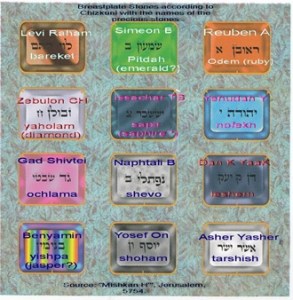
breastplate stones


Read right to left, top to bottom:
Reuben or the sardine stone is 1st. Benjamin or the jasper stone is listed last.


It would be easy to get lost in discussing the meanings of the different parts of the High Priest’s garb, but I will fight the temptation and stay in Revelation… (for now:).

Per the rainbow identified in Rev 4:3 we should be reminded of the covenants between God and Israel (his elect and chosen people; O.T.) and the Church (New Testament time of the gentile). After the deluge of Genesis 6-9, God made a covenant with ALL MANKIND; the rainbow covenant/promise. We find God beneath the rainbow council of elders John sees is seated in a semi-circle around the Great Throne in Heaven.

I hasten to take us back to the study of Bible Codes in a previous study and the meaning of each name within the Tribes of Israel; Reuben to Benjamin in birth order:

J.I.V. Reuben: Behold, a son will be born; He will love me but he will be unloved. Simeon: He has looked upon my affliction; He has seen my sin. Listen and obey him. Levi: Be joined together; share the Word of God over a great distance. Judah: Give praise to Yhwh, give thanks and confess sin [or] Dan: be judged of God. Naphtali: To struggle within [brings] self-inflicted wounds. Be swift. Gad: As a troop HE will come and prevail. Asher: [Be] blessed, happy in your good fortune. Dan: Be discerning in judgment, Issachar: There is a reward from God; Zebulon: a gift (zebed) or position of honor from God; (yizbeleni), redemption. [You will] Be paid your wage, be exalted. Your sins will be forgotten; Joseph’s two sons… Manasseh: forgetting the past; Ephraim: double will be your fruitfulness in this land of affliction; Benjamin: you will be on the right side of the Most High.

WOW! How much more direct need God be in His Holy Word and the direction he gave to His chosen people (and the church) via their very names put together as HIS statement and how things on earth will eventually end up. Note that there are 13 tribes as Joseph’s two sons added to the 11 brothers of Joseph equals 13.

JIV HUH moment. Might I be venturing too far off the coast of reality and the safe haven of the beach to think about the 13 original colonies; the 13 stars and stripes on our original flag; the war of separation between the North and the South with a President in both territories; the dollar bill with a pyramid on the left and a faint Star of David with 13 stars within it on the right; the fact that the eagle holds 12 arrows in its left claw and an olive branch in its right claw; the fact that the original colonies were semi-independent with State powers (confederacy) just as were the tribal territories of Israel under the judges; the fact that manifest destiny; i.e. predestination was the undercurrent driving American policy and philosophy per settlement of this land; that America was founded upon Christian principles and has now drifted far away?

Again, after chapter 3, the Book of Revelation is a pronouncement and revelation for and warning to the Nation of Israel, not the church. Perhaps the above possible bible code using the definitions, meanings and expressions of the 13 Tribes of Israel nails it as Revelation being about and for Israel AND the church.

Palestinian Covenant is in seven parts.

(1) Dispersion for disobedience, Deu_30:1; Deu_28:63-68 (See Scofield on Gen_15:18).

(2) The future repentance of Israel while in the dispersion, Deu_30:2.

(3) The return of the Lord, Deu_30:3; Amos_9:9-14; Act_15:14-17.

(4) Restoration to the land, Deu_30:5; Isa_11:11; Isa_11:12; Jer_23:3-8; Ezk_37:21-25

(5) National conversion, Deu_30:6; Rom_11:26; Rom_11:27; Hos_2:14-16

(6) The judgment of Israel’s oppressors, Deu_30:7; Isa_14:1; Isa_14:2; Jol_3:1-8; Mat_25:31-46

(7) National prosperity, Deu_30:9; Amo_9:11-14

NOTE: For readers of this article who do not or did not know, there was no such thing as Palestinians people prior to 1963. Before the collapse of the Ottoman Empire and the rise of nationalism in the Middle East, the Arab inhabitants of Palestine primarily identified with their religion or local affiliations rather than a unified Palestinian identity. 

The Palestinian Liberation Organization (PLO), led by Yasser Arafat, played a significant role in fostering a unified Palestinian national identity.

When the northern ten tribes of Israel were dispersed by the Assyrians, they migrated voluntarily or by force to the four corners of the earth. Sometime by choice. Many times by force or oppression. There is no record of their return to their northern kingdom of Israel other than stragglers who were truly dedicated to worship in Jerusalem but not in Dan or Bethel. These places of worships were established by King Jeroboam. He chose these sites to avoid his people traveling south to Judah for worship, potentially leading to their loyalty to the Southern Kingdom. 

So what is the Palestinian Covenant?  (Deuteronomy 30:1-9) The Palestinian Covenant sets conditions to Israel’s possession of the Promised land.  It does so until Israel comes to the experience of the truth of divine mercy in the last days. This has yet to happen therefore the continual debate of today over the land between the Jordan River and the Sea of the Mediterranean. It is an End Time promise. MOST Israelites have not yet returned to their Promised Land. Nations will continue to exert pressure for the destruction of what we currently call Israel. Initially in 1948, President Truman expected the newly established lands for the Jews to be identified as Judah. Much to his surprise, the liberated lands of Judah took the name of Israel.

Refer to the above chart of the sequence required before this Promised Land to actually be completely fulfilled. It was NOT fulfilled in 1948 as many try to teach. It was just the beginning. #7 – The judgment of Israel’s oppressors, Deu_30:7; Isa_14:1; Isa_14:2; Jol_3:1-8; Mat_25:31-46 has not yet been fulfilled. These are the nations apposing Israel today. Look at the streets on major American campuses. This judgement of those opposing this unification of Israel …see Item #3 in our introductory sequence chart. Today a huge chunk of Israel is under the ownership of Jordan. The swath of land in and around Jerusalem itself is Jordan ruled.

What does this mean to us? In 1948 only “some” of the Promised Land was returned to Jewish governance and ownership. It isn’t until step #7 that the promise to Abraham, Isaac, and Jacob will be fully fulfilled.

Rev Dr Jstark – 2025

Deuteronomy 28

Have you ever had a book that upon reading the first few pages, you put it down never to visit it again? It somehow fails to catch one’s attention or interest. It is a book that is easy to reject its value or has little interest or grab. The Book of Deuteronomy can be put into this category. Why? It is often referred to as the second book of laws”. Only a lawyer can find a book of laws to be of interest. Deuteronomy is comparable to the Book of Leviticus as value added in one’s library. However, It has value in that this book primarily addresses Israel and closely resembles End Time consequence for being Christian.

Chapter 28 is very specific to Israel. This verse in part (28:1) says … “If you obey the LORD your God and keep his commands that I am giving you, the LORD your God will set you high above all the nations of the world…” This is how many people read it. It appears to be easy to understand. But we left out a couple of significant words in this part of 28:1… fully, carefully, and all. It reads, “If you fully obey and carefully keep.” These two simple words are powerful to God’s words of caution and promise to Israel.

Verses 28:3-6 tell us what God promises Israel.

  1. Blessed in city and country
  2. Their crops will be great, abundant with all the rain they need
  3. Their calves and lambs will be abundant
  4. Their baskets will be full
  5. Will be blessed when they come in and go out
  6. Their enemies will fall in battle and flee in chaos (plural)
  7. Everything they touch will overwhelmingly be blessed
  8. They will be seen by the world as God’s People
  9. People of the earth will recognize that Israel is blessed of God
  10. Rain will fall on their lands in season as needed
  11. They will loan to others but will have no need to borrow
  12. They will be at the head and not the tail of the world

Read 28:9-12 for a summary of God’s promise to Israel; His chosen people. It is noting short of awesome. However, and there is always “the other side of a coin”, go back to verse #1. “Now (these promises) it shall come to pass, IF YOU DILIGENTLY OBEY THE VOICE OF THE LORD…” “…God will set Israel high above the other nations.” Now listen to the news about Israel and the world’s attitude today. Does it even come close to Isreal being high above with the full respect of other nations?

There is but one conclusion. Israel is trying to be great by their own wisdom. God is not their guidance and Israel’s actions lack a total devotion to G-d. This same passage has application to our lives as born-again believers. In America, their coins say, “In God We Trust.” Question. Is this true? Does the USA as a nation trust in God? Do the people worship God without compromise? Does it follow the first sentence in Deuteronomy 28:1?

The answer is very simple…NO!

As we review verses 15 forward, we find the consequences of not being diligent in our worship of God Almighty. Diligence isn’t being faithful in attending church services. It means 24/7. Did I mean 24 hours a day? YES.

Verse 15 of chapter 28: Here is a long list of the consequences for not seeking God and totally obeying His commandments. There are but 14 verses in Deuteronomy 28 instructing us as to what God expects in return for His total blessing. There are 54 verses listing the consequences for Israel (in a way this includes the Christian) if there is failure in dedication to God. “If we fully obey the LORD our God and carefully keep all his commands that I am giving you today, the LORD your God will set you high above all the nations of the world.”

Satan wants us to believe that God is expecting far too much of us as “frail” human beings. Well hold on. Did we create God or did God create us? This too is a strong feeling amongst mankind. We create a god (lower case g) that better fits our life. Not necessarily a god (lower case g) of wood or stone, but a god (lower case g) of wealth, position, status, etc.

Even if one could possibly live a life of total worship of God, common sense tells us THAT is hopeless. It cannot be done.

Rev. Dr. Jstark – 2025 (April)

* Deuteronomy 18:11

The necromancer might also surround himself with morbid aspects of death, which often included wearing the deceased’s clothing and consuming foods that symbolized lifelessness and decay such as unleavened black bread and *unfermented grape juice.

Huh? This is the definition of a necromancer according to the dictionary. A necromancer consumes *unfermented grape juice??? Is unfermented juice a beverage of a necromancer? Re-read Deuteronomy 18:11 once again. Am I reading this incorrectly?

Here is what may be confusing.

KJV: Deu 18:11 Or a charmer, or a consulter with familiar spirits, or a wizard, or a necromancer

LITV: Deu 18:11 or a magic charmer, or one consulting mediums, or a spirit-knower, or one inquiring of the dead. 

ESV: Deu 18:11 or a charmer or a medium or a necromancer or one who inquires of the dead.

ASV: Deu 18:11 or a charmer, or a consulter with a familiar spirit, or a wizard, or a necromancer

It seems quite unusual, doesn’t it? Several translations use necromancer yet do not list or use this word in other translations?

The association of unfermented grape juice with necromancers might be perplexing at first glance. Deuteronomy 18:11 mentions practices that are forbidden, including consulting the dead, but it does not delve into specifics about dietary habits. Perhaps this imagery was created to evoke a sense of the uncanny and the otherworldly, using symbols that are starkly different from everyday life.

Many have been instructed since childhood to avoid consuming fermented juices (wine). However, this verse and dictionary suggest otherwise. The dictionary mentions that drinking unfermented grape juice is associated with necromancy, as referenced in Deuteronomy 18:11 (KJV, ASV, ESV, etc.). It is noteworthy and raises a question about drinking unfermented juices.  Does this mean drinking unfermented juices aligns a person with necromancy? The simple answer is… of course not. Like God intended from creation, he gave mankind CHOICE.

Often a sin can be “excessive or overindulgence” of, or in anything. How can one know the Word of God if his or her Bible sits on a shelf or table collecting dust. This article is NOT intended to give allowance to what some fundamentalists call “drinking.”  It is a brief discussion of Deuteronomy 18:11. In the Bible, “looking” at something often means choosing to consider or dwell on it. In the Bible, “looking” at something often means choosing to consider dwelling on it. Rev. Charles Stark often stated in his messages or counseling, “If in doubt, don’t.”

Look not unto the wine when it is red to the eye (Proverbs 23:31). This means grammatically that the eye is beginning to react to the wine. Mark 7:18- 19, “Nothing that enters a man from the outside can make him unclean, for it does not go into his heart, but into his stomach and then out of his body. And saying this, Jesus declared all foods clean.” Paul said the same thing about food.

Rev Dr. Jstark – 2025