Oh, say, can you see


The Star Spangled Banner

In 1814, Francis Scott Key wrote the poem, Defense of Fort McHenry. The poem was later put to the tune of (John Stafford Smith’s song) The Anacreontic Song, modified somewhat, and retitled The Star Spangled Banner. Congress proclaimed The Star Spangled Banner the U.S. National Anthem in 1931.


Oh, say, can you see, by the dawn’s early light,
What so proudly we hail’d at the twilight’s last gleaming?
Whose broad stripes and bright stars, thro’ the perilous fight,
O’er the ramparts we watch’d, were so gallantly streaming?
And the rockets’ red glare, the bombs bursting in air,
Gave proof thro’ the night that our flag was still there.
O say, does that star-spangled banner yet wave
O’er the land of the free and the home of the brave?

On the shore dimly seen thro’ the mists of the deep,
Where the foe’s haughty host in dread silence reposes,
What is that which the breeze, o’er the towering steep,
As it fitfully blows, half conceals, half discloses?
Now it catches the gleam of the morning’s first beam,
In full glory reflected, now shines on the stream:
‘Tis the star-spangled banner: O, long may it wave
O’er the land of the free and the home of the brave!

And where is that band who so vauntingly swore
That the havoc of war and the battle’s confusion
A home and a country should leave us no more?
Their blood has wash’d out their foul footsteps’ pollution.
No refuge could save the hireling and slave
From the terror of flight or the gloom of the grave:
And the star-spangled banner in triumph doth wave
O’er the land of the free and the home of the brave.

O, thus be it ever when freemen shall stand,
Between their lov’d homes and the war’s desolation;
Blest with vict’ry and peace, may the heav’n-rescued land
Praise the Pow’r that hath made and preserv’d us a nation!
Then conquer we must, when our cause is just,
And this be our motto: “In God is our trust”
And the star-spangled banner in triumph shall wave
O’er the land of the free and the home of the brave!

posted by Murphy James

Foundational Beliefs

Why are Believers so hesitant to examine their foundational beliefs?  What are we afraid of Rev Paul Hoffmasterfinding?  Could there be a flaw in our adopted theology?  What if what we believed for so many years has contradicted Scriptural intent?  What if what we have been taught has been a human interpretation instead of Divine presentation?  What if the denominational or independent church has been wrong in its doctrines?

subfloorWe should not be afraid of examining the sub floor of our house of belief.  If it is intact, our confidence should rest in the assurance that what we are building shall never fall.  If, on the other hand, there are cracks in our tenets of faith, should we not address the issue and secure our foundation?  Whenever there are flaws in our basic beliefs, it will affect our Christian walk.  Maybe one of the reasons we fluctuate so much in our faith walk is because something in our “belief” system is out of order.

There are so many split decisions when it comes to Biblical interpretation.  Almost every major Scriptural truth has at least two different or opposing views.  Through the persuasion and numerical support of other Christians, many teachings are accepted and adopted by the new convert.  Unable to understand the meaning of so many of the Scriptures, they simply endorse what is being taught.  The quickness at which they receive these teachings depends on the charisma and boldness of the teacher.  When a Pastor is established in the community and supported with a large number of followers, who is to doubt his presentation?  God uses human instrumentality to convey His message, but we must ALWAYS confirm the spoken word with the written Word!

I believe that every Believer needs to have an annual checkup.  We need to take our “Bible Pressure” and see if our study habits are consistent.  We need to check our “Prayer Rate” reflecting the reality of our communication with God.  We need to check our “Spiritual Weight” to see if we are gaining spiritual muscle.  We need to check our “Hearing” to see if we are hearing what is being presented by God’s representatives.  We need to check our “Eyesight” to make sure we are focused on the Kingdom and not the fleshly enticements of the world.  We need to check our “Vocabulary” to make sure what comes out of our mouth is pleasing to God.  We need to check the freshness of our “Fruit.”  If after carefully analysis we find our spiritual condition worthy of God’s pleasure, let us press on as a walking example of Jesus Christ.  If a red flag appears, let us check our foundational beliefs and see where we may have missed it.  When our foundational beliefs are built on the sand of public opinion, our Christian walk will sway with inconsistent behavior.  When our “sub floor” is incorrect, we will have a greater tendency to go by feelings rather than by faith.

While knowing one’s spiritual condition is imperative to spiritual growth, there are some who are content to live out their lives with a simple affirmation of whom Jesus is.  Their attitude is that life goes on and when the heart stops beating, they will be with Him.  They have been taught that Faith alone is all that is necessary.  Attend and pretend is their motto.  Deep down they desire a living faith, but they have been inoculated from the Truth.  They ride the waves of change, oblivious to where it takes them.

Do not be afraid of checking out your foundation, it may be a life altering experience!  “And you shall know the truth, and the truth shall make you free.” (John 8:32)

A Wandering Tale

Have you ever had a day, a week, or a month when you simply “dragged tail?” Though I bytheShadowdon’t have much of a tail to drag it feels like it’s dragging. I can’t quite put my nose on it but something is missing. Sometimes I don’t feel right, but I don’t feel wrong. I get real whiny and my mom doesn’t understand me. To be honest as a dog can be; I don’t understand either. nose

My mom looks at me with concern. I get stuck in this zone of “The Wandering Tale,” going nowhere but wanting to be everywhere. Doing nothing but longing to accomplish something.  You think dogs don’t wanna work? We do. My mom will tell you I do much better with structure and boundaries. Most of the my wandering tale is just because I lost focus of that One thing I am to do.

I think I found the cure for the wandering tale. It is to stay focus on my Master and her will for me. If I start looking at squirrels, chasing the cat, bark excessively because I feel like it,  I end up losing focus on my real purpose. This actually makes me more anxious and out of sorts.  A distracted Service dog who wanders in thought or deed is a potential danger to the Master’s Service. One of my commands is to “look” which is the same as focus.

Don’t waste your time stuck in a wandering tale whether in thoughts or deeds -going nowhere. There is a great purpose for you that will impact your world for the good. Stay focus on your Master’s will  and just do it. Life is short, especially for a dog. Why do cats have 9 lives, life just isn’t fair! So live your life with laser like focus, fiery passion and a sole purpose. I know my Master deserves no less.

The Powerful Little Word

Rev Paul HoffmasterMany of the Biblical promises rest upon the action of the reader or hearer.  The little word “if” plays a big role in experiencing the Word.  In the Bible, this two letter word contains the option to either accept or reject the Word.  The Word of God is limited to man’s response.  The Scripture lies dormant until man responds to its content.  If man chooses to ignore the Word, it becomes nothing more than a conglomeration of phrases and sentences hidden under a book cover.

Reading a glowing book

The Living Word of GOD -Connecting the dots of the history of mankind

If it was not for the Bible, we would have no knowledge of God and His love for mankind.  If it was not for the Bible, we would not be aware of Jesus and His earthly ministry.  If it was not for God’s Word, we would never come to the knowledge of what Calvary was all about.  Without the Scriptures, man would be like a ship without a rudder, a car without an engine, or a plane without wings.  Without His Word, man would flow with the tide of changing opinions and life styles.  Without the Bible, mans’ hope for purpose will never be achieved.  Sixteen times in the book of Hebrews, this powerful word highlights the responsibility of the individual.  In chapter three, verse six, the Believer is likened unto a house that is built by Jesus; but if, by the actions of Christians, the world sees a creation that is no different from its own life, what would draw it to seek our building Contractor?  There are a lot of “prefab” Believers that build their faith around convenience and self-fulfillment, and, as a result, turn off prospective “buyers” of the Faith.  The problem is many treat the salvation experience as an “upgrade” to their lives instead of as a total rebirth experience. Continue reading

How To: Reject Rejection

Do you remember singing “sticks and stones may break my bones, but names will never hurt me?” That is half truth. Stick and stones may break our bones but names can and they do hurt us. No matter how we cut it, rejection hurts and even when we get over it seemingly, a flash back of a bad memories will flood our hearts with the intense pain of rejection and hurt.abuse

I was “married” once long ago for a short time. I won’t go into many details as they are not important. The only reason I am sharing this is to help those who think you can not overcome the rejection of one who is suppose to love you. The physical abuse/beating  actually hurt the core of my being more the bruises and injuries that healed eventually. The names I was called still echo in my heart at times and can bring the deep hurt back to my soul.  I forgave him before I left him the final time. Learning how to allow God’s love to wash away the hurt of rejection was a process.

I heard the words “you are no good,” “no one will ever love you,” and “you are just a worthless cripple,” then  moments after getting punished for being no good I’d hear “I love you.”  This made me feel like I was living in a night mare or the feature star of the “Twilight Zone.” The GOOD NEWS is my soul had an anchor in Christ and it held through those years and the few years it took to learn to reject – rejection through knowing the truth. This truth will set YOU free as well. The Truth is His Word. God loves YOU!  I am so thankful He loves us with His amazing love.

You will find in the pages of the living Word of God that God sent His Son to die for our sins. We all have sinned. No one is without sin, especially me- I know me and God knows me better. In the “marriage” I just sin differently than the X did. I wished he’d run off with someone and leave me alone. I started dreaming that someone would love me. During this whole time Jesus never left me or forsook me. He Who is the example of LOVE Himself, was loving me through this whole time. I was just too messed up to focus on the Greatest Love of my life. But I experience His protection.  The day came when I knew I needed to use common sense and leave. Praying for protection is wise but when things continued to get worse, it was time to run for my life literally. I needed to refocus my life to Living to love instead of living in fear.

So I left him. He stalked, balked, cried and pleaded. I finally got wise and all his antics went unheeded. Now, the hard part was to get past the past.  I started walking and listening to music. I walked for miles.  The one song I listened to over again and again was Don Henley’s “GET OVER IT.” (Beware! it is not a Christian hymn but still the LORD used it in a powerful way in my life.)

I knew I had to “get over it” and asked the LORD to help me, show me how…and He did. This was key and is key to rejecting rejection in my life.

Step One: Remember Who was beaten beyond being recognized, betrayed by the world He came to save, and rejected by His Father.  God had to turn His away from His Son when our sins were laid upon Jesus as He died on the Cross. The death, burial and resurrection is the key to freedom for all mankind. All we have to do is  accept the free gift of salvation and we become a new creation in Christ. Being a Christian doesn’t mean victory over the challenges of life are dropped into your lap and you never struggle with the hurt and rejection. It does mean we have the power in Christ to reject rejection because Christ made the way. Sin was defeated. To experience this life one must pursue knowing Him through His Word and prayer. As long as we are in the world we will have trouble but Jesus came so we can overcome. It is a fight of faith and takes diligence on our part. In other words, living a truly victorious life isn’t like going through a drive thru for a quick fix lunch. It is a life style make possible by the One Who loves us most- our Father Who is in Heaven through the Power of the Blood of Jesus Christ imputing to us His righteousness. It is a free gift.

Step 2. Focus ahead and don’t look back.We all have things in our lives we rather not remember. God remembers our sin no more so why should we dwell on it? I should have not of married the man I did. It took me longer to forgive myself than to forgive him for what he did to me. Forgiving him was easy. Forgiving myself took time. It did not need too.  God forgave me the first time I repented. That was the day of the wedding. But I had to live in the consequence of my choice. Sometimes we pay dearly for bad choices in this life BUT by His grace I not only got through it; I got over it! So can you!

Isaiah 43:18-19 English Standard Version (ESV)

18 “Remember not the former things,
    nor consider the things of old.
19 Behold, I am doing a new thing;
    now it springs forth, do you not perceive it?
I will make a way in the wilderness
    and rivers in the desert.

Philippians 3:14 English Standard Version (ESV)

14 I press on toward the goal for the prize of the upward call of God in Christ Jesus.

The root cause of rejection is selfishness. No matter who has rejected you or hurt you there is the hope of breaking the chains of rejection off your life. The pain of rejection is like a prison we put ourselves in if we don’t learn to reject rejection. Those who hurt us don’t care that we are hurting. As long as we are in this world rejection from others, even those who love us may happen. But God sees every hurt and He cares. He has given us the key  and His power to reject rejection. As a believer we always have the power to reject rejection and dwell on the Love of God who gives true value and self worth.

If you don’t know Christ yet, will you accept the ONE Who will accept you just as you are? He loves you unconditionally and will bind up your broken heart. Words of rejection that come back to haunt me at times have lost their power. I remind myself of the One Who accepts and values me. I know I am loved by the Best. So are you.   stilllove2laugh

Questions? Please contact me or go to http://www.peacewithgod.net 


Selective Hearing

How can two individuals sit in the same church service and hear the same sermon, but share two different responses to the message?  One hears it as a positive homily while the other sees it as condemnatory.  I believe the problem is not with the Rev Paul Hoffmasterpresentation, but with the reception, not with the verbal, but with the hearing, not in the giving but in the receiving.  The key to understanding this dilemma is found in John 6.  Jesus had been talking about drinking His blood and eating His flesh.  To many these were difficult words and, as a result, they walked with Him no more (John 6:66).  What Jesus was saying was meant to be heard with the spirit, not the mind (John 6:63).  The problem with hearing today involves the same issue.  We listen to a sermon with our minds instead of with our spirit.  We attempt to grasp the Word with our intellect and then sort it out, accepting what we are comfortable with and rejecting the rest; by doing this we will not endure sound doctrine.  Tragically, many pulpits are reflecting people’s mind sets by preaching people pleasing messages instead of the Truth of God’s Word (II Tim. 4:3,4).  The writer of Hebrews stated that he had many things to say to them but it was “…hard to be uttered, seeing ye are dull of hearing” (Heb. 5:11).  Many church goers today are just punching in their “time cards”, fulfilling their Sunday obligation, and then leaving the church basically the same way they were when they came in.

It is interesting to note that when Jesus told His disciples about His upcoming crucifixion, He always included His resurrection.  Yet His followers only heard the first part.  That was one of the reasons no one was at the garden tomb to welcome Him on the third day.  One day Jesus shared with Peter about this same issue and Peter, hearing  only what he wanted to hear, took Jesus aside and rebuked Him, saying “…this shall not be unto thee” (Mt. 16:22).  Peter did not hear Him say He would rise again on the third day.  How much of a sermon today is heard?  Do we listen only until our comfort zone is penetrated?  Do we engage our “defense reactive mechanism” so that we are ready to reject anything that exposes our short comings?  Are we armed and ready to attack the presenter of the Gospel, if we feel exposed and vulnerable?

Some time ago I was talking to a pastor of a large evangelical church and asked him what was he disliked the most about pastoring.  Without hesitating, he said his greatest weakness was preaching!  I had a young lady tell me how the Holy Spirit had moved in their Sunday service and they “didn’t even have time for the preaching”.  I believe the preaching of the Word is the supreme purpose of ministerial leadership.  I believe in the moving of the Holy Spirit, but there must always be time for God’s Word, even though the service goes beyond the magical hour or hour and a half.

My prayer is that “dull hearers” will let the Word bypass their minds and let their spirit drink of the living water, which, in turn, will flow out of their spirit and wash their minds of their self centeredness.  I pray also that the pastors will spend time with God and hear what He wants them to say to His people.

144,000

miniJimThis is a number that has scientific, historical, and religious connections. It also has applications in literature and music. From a religious point of view, it is as significant as the 666.

Examples:
1. To the Mayan civilization 144,000 days equaled a baktun. A baktun is 20 katun in the Mayan Long Count Calendar.
2. Authors Scott Bakker, Bernard Werber and John DeChancey use the number 144,000 in their writing of books as symbolic or proposed counts to fit the characteristics of their books.
3. In music there are many songs written using this number as its theme; 144,000 voices is the maximum contrapuntal expansion, a musical expression, of Baroque music theorist Pier Francesco Valentini’s 96-voice composition Canone nel modo Salomonis (1631). Contrapuntal music is two different songs that are performed at the same time within the same piece.
4. In broadcast TV, the population of the eponymous town in the 2013 Fox TV series Sleepy Hollow is 144,000.
5. In the Book of Revelation one will find this number three different times; Revelation 7:3-8, Revelation 14:1, and Revelation 14:3-5.
a. Side Note: Jehovah’s Witness, the Unification Church, New Age movements, Skoptists of Russian and Islam are additional religions that give different meanings to this number. We will not elaborate on these at this time but perhaps in a future blog…..?
Revelation 7:3-8 presents the 144,000 as 12,000 people from each of the 12 Tribes of Israel. We will not discuss at this time the fact that the Tribe of Dan is not mentioned, Joseph is mentioned instead of Ephraim (Joseph’s son),while Manasseh, also a son of Joseph, is named as one of the twelve.
Revelation 14:1 “Then I looked, and behold, on Mount Zion stood the Lamb, and with him 144,000 who had his name and his Father’s name written on their foreheads.”
Revelation 14:3b … “…No one could learn that song except the 144,000 who had been redeemed from the earth.”

Before moving forward and unless someone think there are only 144,000 redeemed per the bible, read Revelation 7:9…

bunch of peoplw…”After this I looked, and behold, a great multitude that no one could number, from every nation, from all tribes and peoples and languages, standing before the throne and before the Lamb, clothed in white robes…”

We can easily see in verse 14:9 that the number redeemed or saved far exceeds the 144,000 as a fixed number of limitations. Salvation is an individual choice of accept or reject (purposefully or by doing nothing) the offer of salvation through belief and then following the teachings of Jesus Christ.

The question begs of itself, are the 144,000 set aside, or specially identified in chapter 7, the same who are mentioned in chapter 14? A great question, and one that should not be passed over so as to simplify its understandability, implications or applications. Context, context, context! Always consider the context. Context is the setting within which one is trying to understand a principle, meaning or discussion. Many times one will walk into the middle of a discussion. There is a pertinent need to find out what the discussion is all about in order to contribute or follow the context of that discussion. The same is true when reading a book. Starting in the middle does little for one’s understandings of the characters, setting or direction the author is taking his or her book theme.
In Revelation 7 we have four possibilities per the 144,000:
1. John T. Hinds argues that the number refers to those who are saved from the physical nation of Israel (p112); i.e. Israelis themselves; God’s chosen people from the Old Testament.
2. J. W. Roberts, argues that this company is spiritual Israel, i.e., the church (p71) but fails to completely explain why only 144,000.
3. Others suggest this group represents the martyrs who have given their lives for the cause of Christ during the Tribulation period.
4. Some try to spiritualize everything and say the number is simply symbolic and means little as a factual, real number count of those redeemed.

The danger is in reading then accepting as fact those theologians or wanna-be bible scholars who extrapolate, then forget context; often in defense of one’s preconceived religious doctrines rather than God’s Word. We should take literally everything in the Bible that is obviously NOT needed to be spiritualized to fit a doctrinal statement. At ahabiblemoments.wordpress.com we fully understand that to spiritualize too much of what the bible says is to make it something that is not to be understood. A favorite passage to counter this argument is Ecclesiastes 3:1-3:22. But a much more pointed passage is when Jesus tells of the consequences for misleading the listener; James 3:1. One cannot be a teacher in good faith if s/he can only spiritualize scripture. Understanding is essential and swatting at imaginary flies is expending energies that mean little to nothing to listeners concerning destinies and eternity.

II Timothy 2:15 commands us to study and learn, not theorize the Word of God. A great quote from http://www.learnthebible.org/the-command-to-study-2-timothy-215.html says:

“Every believer ought to faithfully read the word of God, but there is another command that is not to be neglected. According to 2 Timothy 2:15, believers can show themselves approved unto God by studying the scriptures. One can read through the scriptures on a daily basis without ever truly studying the scriptures. In order to study, one must delve into the words and phrases of the Bible and consider their meaning both historically and doctrinally” [and within context]. Emphasis mine.
We add… one can also discard facts through hyperbola; i.e. rejecting what the bible states as fact by not closing the loop between what God/Jesus states and what we take as meaningful and direct. We call that spiritualizing what is said instead of accepting within context what God’s Word specifically tells us.
In Revelation 7 we read specifics… the names of twelve Tribes of Israel; the 12,000 specifically identified in each case. In verse 4 they are “sealed as servants of God” and in 7:13, 14 when John asks who are these folks. He is given a straight and specific answer, “These are the ones coming out of the great tribulation. They have washed their robes and made them white in the blood of the Lamb.”

This is information-specific and not intended to be spiritualized. These 144,000 are to be identified with God. They are set aside; the remnant of Israel after the Great Tribulation. Perhaps this is the count of those who escape Jerusalem and flee to Petra where they are under God’s direct protection during Jacob’s Trouble; i.e. the 2nd half of the Tribulation.
No one could learn that song except the 144,000 who had been redeemed from the earth.
Note that Jesus is not mentioned in chapter but is in chapter 14. Also recall that God made Old Testament covenants with Israel (Abraham, Isaac and Jacob) that are unique to them and Jesus made covenants with his believers and followers that are distinct from those made with Israel but universal to mankind.
Let’s go back to Revelation 6 to better grasp these meanings and probabilities. We recall from a previous blog that there are “souls under the Throne of God waiting for Him to avenge their wrongful deaths” (5th Seal). The Bible states in 6:10, 11…
They cried out with a loud voice, “O Sovereign Lord, holy and true, how long before you will judge and avenge our blood on those who dwell on the earth?” [11] Then they were each given a white robe and told to rest a little longer, until the number of their fellow servants and their brothers should be complete, who were to be killed as they themselves had been.” [ESV]

Until the number of their fellow servants and their brothers should be complete, who were to be killed… this is the 144,000 discussed in chapter 14 of Revelation; [v4] those redeemed from the earth, not the Tribes of Israel. They are slain during the Tribulation, are under the same Throne waiting to be avenged, and are together as one group of specified souls. This is not true of any other Christians or what Jesus identifies as “his church; body of believer.” AND, they appear with JESUS upon His return; i.e. 2nd Advent. They follow Jesus wherever he goes. These are one’s who accept Jesus Christ as Lord and Savior DURING the Tribulation. These are slain by the anti-Christ for their belief and refusal to accept the Mark of the Beast (666).

We also have a passage in Ezekiel that should be considered. Ezekiel 9:4 states: “Pass through the city, through Jerusalem, and put a mark on the foreheads of the men who sigh and groan over all the abominations that are committed in it.” Might these also be a description of the 144,000 from each Tribe of Israel who are marked as described in Revelation 7 and reserved for God?

contxtWhen taking what scriptures tell us and keeping it within context, it is relatively easy to discern their differences and similarities. Do not waste one’s time spiritualizing what does not need to be. Even the parables of Jesus were earthly stories with heavenly meanings. Those who have man made religious platforms (we call them church doctrine in today’s language) that conflict with bible specifics will usually spiritualize the meaning of passages in the Holy Word of God that conflict with his or her preferred religious doctrine. The Bible is not a mystery book. God reveals to the human mind facts and understanding when one demonstrates an openness and wisdom in his or her studies.

666: the Mark of the Beast

What number is more intriguing than 666; 13? Perhaps, but for those who like miniJimmental puzzles 666 is one of the best and almost universally known. Standing in line at the check-out one time, the cashier handed me a receipt that totaled $6.66. She handed it to me and said, “Good luck today.” Yet, this is not a game. Neither is it a vain pursuit. The book of Revelation instructs us: “Let him who has understanding calculate the number of the beast” (13:18).

Sadly, when it comes to wild ideas, it may be difficult to surpass the absurdities finagled into the public domain as are solutions to the enigma of 666. Popular ultra-modern views include concepts of a cashless society, the universal use of bar codes, the implantation of computer chips and biochips in each individual for identification and control, and the most recent “face imaging” via those hidden cameras throughout society. It is easy to see how the anti-Christ might control commerce, even private lives through technology. We have television sets that are voice activated and don’t ever totally shut off. They are capable of recognizing voices in the room or house.computerchip

At the other extreme, many commentaries on Revelation assert that it is useless, foolish, or even dangerous to attempt to discover a specific name with a fulfillment of 666. They treat 666 and most items in Revelation as if they were parables devoid of specific predictions with only historical significance. Many even write articles that are well worded and convincing to those who are not founded in bible study; that Revelation has already played out and we are now in some type of ozone territory.

It was no one less than the Holy Spirit, the real author of Revelation, who directed John to write: “Here is wisdom. Let him who has understanding calculate the number of the beast, for it is the number of a man: His number is 666” (Rev. 13:18). We are instructed to “calculate” or “count,” as some translations translate it. We are dealing here with a mathematical computation. The Greek word means “count,” as illustrated in the only other text where it appears in the New Testament: “For which of you, intending to build a tower, does not sit down first and count the cost, whether he has enough to finish it”(Luke 14:28). This parable also has a spiritual application. It is talking about a man counting his money. This brings to mind the number of people who don’t count or budget what s/he has and then will have in disposable time, energy, or money before making a commitment or taking on a project. Seldom if ever do people when personal energies or ambition exceed what it will take to complete the race.kidcounting

Seldom does Revelation directly tell us to apply understanding to grasp the meaning of a particular symbol. It does not tell us to try to figure out who the lamb-like beast is. It does not tell us that if we have wisdom we can figure out the meaning of the third trumpet or many other symbolic representations. It only hints at the identities of the beasts from the sea and earth. However, when it mentions 666, it specifically tells us to calculate or count.
There is a view that Rev. 13:18 should not be translated “the number of a man,” but rather “the number of man” (without the indefinite article “a”). The reason given is that the indefinite article “a” is missing in the original. Of course, it is missing; Greek has no indefinite article. For this reason, one must examine the context to determine if the translation into English should include the indefinite article or not; “a” versus “he, she or it.” Better yet, use a proper name when identifying a person, place or thing. Revelation 13:18 says to calculate this name, but not everyone will be able to.

Some theologians and I use this term liberally, Give distant historical dates when this all happened. This leaves us in a bible void time today. If one thinks this all happened in the distant past, then where are we biblically referenced in the here and now?

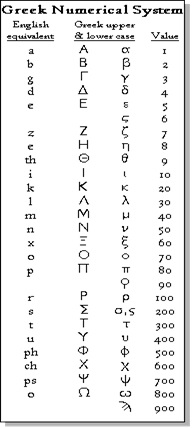
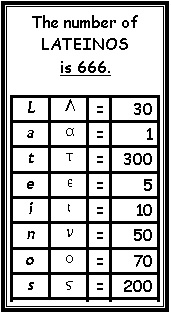
The following tables are included so the reader of this blog can venture down this trail of “calculating the name” of this man. It has already been done dozens if not hundreds of times and to little absolute avail. In Bible times primary languages included Greek, Latin (in Rome) and Hebrew as concerns commerce and common communication. On the table to the right, find the equivalent numeric number for Greek letters and their number value. On the right find an example of doing this. Caution: English was NOT a primary language at this time when John wrote Revelation. English does not have a numeric equivalence.


greeknumber

latios

The above is but one example of the meaning and identity of 666; i.e. the Roman Catholic Church and its leadership. For those who are old enough to recall, the Catholic Church said mass in Latin for hundreds of years.


In order to include all possibilities, we would need to include the Hebrew letter-to-number equivalence and include the use of Roman (Latin) numerals. We can only deduce that John means to use the Greek since Revelation and most of the New Testament was written in Greek. However, Revelation 13:18 is after the Rapture of the church so perhaps it is intended to be “calculated” in Hebrew… those chosen as God’s special people. Remember or know for the first time that a sign was posted over the cross of Jesus that said “He was the King of the Jews.” It was written in Greek, Latin and Hebrew.

Ecclesiastes Chapter 12

underthesun(Last in a series of 12 insights into Ecclesiastes) by Gene Whittum

SoWhittumlomon continues his warning about death. He has spoken of it many times in his journal and again is imploring the readers to avoid severe judgment by calling to mind their duty to “remember their creator” while they still have the strength, mind and will to do so. The call to recollect has more significance than to just bring something to mind—it involves embarking on a course of action. It is the same as the association between the words “obedience” and “trust”, or “belief” (faith).

When one is presented with the Gospel, there is an interaction between the belief, or faith in the word and the acceptance (obedience) to the word. Obedience is the effect of the presentation of the gospel. Hebrews 4:2 illustrates this principle: “For we also have had the gospel preached to us, just as they did; but the message they heard was of no value to them, because those who heard did not combine it with faith.” This principle is also reflected in the parable of the sower in Matthew 13 and Luke 8. For this reason, many who call themselves Christians and who have no evidence to support it, may not be true believers. The Epistle of James emphasizes this throughout the book. Much more could be said about this but we will leave it to your own personal study.

Bear in mind that Solomon, here, appears to be approaching the end of his life. When we read of his history, with his hundreds of wives and concubines, we can conclude that he was a very gifted man with untamed passions. He never had any recorded contact with a prophet (as his father David did with Nathan), and as a result, had no accountability with anyone. He was the king, after all. His testimony is given, in part, in chapter two. His experience of life is recorded in much of the remainder of the book and his wisdom concerning righteous living is delineated in the Proverbs, some of the Psalms and the book called the Song of Songs.

So what does one say when facing the end of life? Death is nothing new to the human race and, here, Solomon is about to expire but he has some final things to say to us. He is telling us to fear God today because old age and death come upon us quickly. He uses the word “before” three times (12:1,2,6) and then he says “when” several times and closes with “then” (verse 5), which appears to be the time of death.

In these verses he mentions several bodily ailments which, collectively or singly, are enough to cause one’s death. Scholars differ somewhat on what these verses mean in the progress of dying, and I can only attempt to sort them out knowing that others may disagree with the conclusions. That is okay. Some of the best scholars disagree with each other. One thing can be said as being certain: it is a description of a body dying. I shall number the verses and offer a brief comment.

Verse 1. “Remember your Creator in the days of your youth, before the days of trouble (difficulty) come and the years approach when you will say, ‘I find no pleasure in them.’” Old age is debilitating to say the least and many pleasures are no longer pleasurable because they are not possible or worth the effort. Verses 1 through 7 consist of one long sentence which is difficult to break up into an interpretation of the whole passage—therefore the semi-colons interspersed in our descriptions of the passage.

Verse 2. “Before the sun and the light and the moon and the stars grow dark, and the clouds return after the rain;” Many dark days come with a note of the reality that the past is past, emphasizing the transitoriness of life. The dark days may also include some amount of depression. In any case, there is a contrast between the vigor of youth and the incapacitation of old age, life lived in a minor key.

Verse 3. “When the keepers of the house tremble, and the strong men stoop, when the grinders cease because they are few and those looking through the windows grow dim;” Here the arms and hands begin to tremble, perhaps with palsy or feebleness; the legs become weak and unsteady; the back begins to stoop over; the teeth (usually molars) are few and chewing becomes difficult; and finally, the eyes begin to lose their sight and simple tasks of years gone by become arduous. The picture of the teeth is of female mill-grinders in the ancient world. The literal meaning would refer to the teeth.

We begin to observe the approaching frailty of old age. Because of these impending weaknesses of getting older, the author encourages the young to learn and practice godliness before the onset of advanced years. The habits formed in earlier years, become hardened and in later years are difficult to remedy without great deliberation.

Paul writes about this condition in Ephesians 4:18 where he states: “They are darkened in their understanding and separated from the life of God because of the ignorance that is in them due to the hardening of their hearts.” The verb ‘darkened’ is in the perfect tense—‘being darkened in the past with results that they are presently darkened’. It is a process of life that culminates in their hearts being ‘hardened’ by ignorance and carnal practices (We get our word ‘sclerosis’ from this Greek word). It results in a sad spiritual condition and robs old age of much happiness and spiritual peace, hope and satisfaction.

Verse 4. “When the doors to the street are closed and the sound of grinding fades;” “The lips (to quote Walter C. Kaiser Jr.) swinging or folding doors, as the jaws of leviathan are called the ‘doors of his face’ in Job 41:14 fall into the mouth for lack of teeth. (A street is a cleft between two rows of houses.)” The ancient world did not have dentists as the modern world does, so teeth were missing (or all gone) and chewing does not make much noise, thus, the ‘grinding fades’.

The next phrase: “when men rise up at the sound of birds, but all their songs grow faint” indicates the inability to get a full night’s sleep due to being awakened by every little noise. It seems that the hearing is also included when “all their songs grow faint”. The person, or persons, described here do not have all the infirmities mentioned in this passage. Every individual will have different ailments with which to cope. Authors differ in their interpretation of these verses. However, the context indicates that there is a slow or fast disintegration of the body and each of us can fill in our own disabilities as we age.

Verse 5. “When men are afraid of heights and of dangers (terrors) in the streets;” Many elderly people are afraid to go outside or walk along the streets and consequently remain inside. Ladders, also, are a common phobia. “When the almond tree blossoms (white hair) and the grasshopper drags himself along.” This would describe the hobbling walk of one with a cane.

The last part of verse 5 requires some additional translation. The NET Bible renders it “and the caper berry shrivels up”; the ASB reads “and the caper berry is ineffective.” The Complete Jewish Bible says “and the caper berry has no (aphrodisiac) effect”, and the Tanach (another Jewish translation does not mention the phrase. Another Jewish translation expresses it “and the caper berry shall fail.”
The significance of the verse is similar to Genesis 30:14-15 where mandrake plants were commonly thought to be an aphrodisiac in the culture of the time. Here, in old age, sexual virility may become a distant memory and even aphrodisiacs fail; the caper berry shrivels up as it remains on the branch beyond its period of ripeness.

An interesting series of words and phrases lead up to the conclusion of verse five that we mentioned earlier. Four times the word “before” is used in verses 1, 2 and 6; six times the word “when” is used in verses 3-5, and then a concluding word “then” is given at the end of verse five. “Then man goes to his eternal home and mourners go about the streets.” The ‘eternal home’ is an idiom for the grave as one’s final resting place and the “mourners (who) go about the streets” are referring to the common practice in funerals of that day. Mourners were often hired to advance before the funeral procession.

Verse 6. Solomon is not yet done with his description of the hazards of old age. He once again gives an admonition to “remember him”– the Creator mentioned in verse one. He wants to emphasize again the theme of the passage that it is always best to serve the Lord when one is young, fresh and able. The word “before” appears again to introduce more conditions that attend the elderly.

The occurrence of death is, as the prior verses, explained metaphorically and commentators differ as to what is meant by the silver cord, the golden bowl, the pitcher and the wheel. One thing is certain—it is a reference to the dissolution and the frailty of life. The “silver cord” seems to refer to the spinal cord; the “golden bowl” may be the skull or brain; the “pitcher”, which is used at the well and drawn up by a rope, may refer to the heart or stomach; the “wheel” at the cistern perhaps refers to the heart or circulatory system that transports the blood continuously throughout the body. When that breaks down, it is then terminal as mentioned in the following verse.
Verse 7: “and the dust returns to the ground it came from, and the spirit returns to God who gave it.” To interpret the prior verses, different translations do not help a great deal in the unraveling of the meaning. Authors differ and what I have written seems to be more of a common thread of agreement with many writers. In this verse, however, it is much easier to discern what is being said. Solomon is referring to the death of a person who has grown old. The life has been lived, admonitions and examples have been given, and now the individual must await the judgment of God as to how the life was spent.

Verse 8. “Meaningless! Meaningless!’ Says the Teacher. ‘Everything is meaningless’ “. This is a strange conclusion to what he has just said regarding “remembering” and “death”. This was the theme of his introduction in chapter one. In the context of the chapter, he seems to be saying how vain it is to have lived a full life and not learn the meaning and solution to righteous living. We can all say that to live and die without having the joy of life and the fellowship with God is indeed meaningless—a great tragedy.

Solomon now gives the conclusion to the matters of life. He has told us to enjoy life in spite of all the hurdles we may face. He has looked toward the God who is above the sun and who is intimately involved with His creation. Life is seldom free of various kinds of obstacles and problems and mysteries.

What qualifies a person to set down a dissertation such as this? He was certainly wise and throughout history has plainly taught many, especially those who take time to contemplate his words. He has not trifled with his readers; he researched and wrote thousands of proverbs and anyone who spends time in what he has written elsewhere (Proverbs and Psalms), receive much benefit from learning and observing his counsel and exhortations.

In his admissions in this journal, he too has learned right from wrong. Therefore he can say–verse 10, that “what he wrote was upright and true.” It is wisdom that has withstood the ages, and we still acknowledge that fact because what he has written became a part of our Scriptures. It has been written for our admonition. If we are honest in our assessment, we will have to agree that he was wise.

Verse eleven is critical to his conclusions. He writes: “The words of the wise are like goads, their collected sayings like firmly embedded nails—given by one Shepherd.” Shepherd is capitalized and therefore refers to one much superior to Solomon, the teacher. In Genesis 48:15 Jacob, in blessing his sons, says: “May the God before whom my fathers Abraham and Isaac walked, the God who has been my Shepherd all my life to this day, the Angel who has delivered me from all harm—may he bless these boys.” God was Jacob’s Shepherd. We all know Psalm 23 “The Lord is my Shepherd . . .”and Isaiah 40:11 “He tends his flock like a Shepherd; He gathers the lambs in his arms and carries them close to His heart; He gently leads those that have young.” See also Jeremiah 31:10 and Ezekiel 34:11-12.

Solomon in effect is giving credit for his words to the “Shepherd” when he notes that they were “given by one Shepherd.” He is not necessarily calling himself wise—his words were ‘given’ by the Wise One. He is using the third person (the Shepherd) rather than the first person, himself. The revelation of the book came from God. The words he sought were “delightful words” but they were also like prods to make the individual think. His work was not that of a pessimist or defeatist; he did not advocate artificial happiness nor did he deny the existence of God. He learned, perhaps too late, the same lessons that he is trying to help us to learn.

We must believe that his sincerity was real, albeit very difficult in places. Goads and nails are designed to prod and fasten—prodding towards righteous living and fastening us onto truth. Much of life is still enigmatic and puzzling, but with the guidance of the Shepherd, we are under gracious, tender and merciful care. The “words of delight” are words that he (Solomon) took delight in. Recall verse nine where he tells us that he “taught, heard, investigated, and put in order” his writings.

Verses 12: “Be warned, my son, of anything in addition to them. Of making many books there is no end, and much study wearies the body.” Moffatt translates this to read: “My son, avoid anything beyond the scriptures of wisdom.” I believe he is speaking of anything beyond the scriptures as being a final authority for life. All true bible teaching, hearing (others), investigating (checking them out) and putting in order (writing it down) is truly a wearying process.

Verses 13 and 14 are his concluding exhortation: Fear God, and obey His commands. “Now all has been heard; here is the conclusion of the matter: Fear God and keep his commandments, for this is the whole duty of man. (14) For God will bring every deed into judgment, (see 3:17, 11:9) including every hidden thing, whether it is good or evil.” He has been inserting just enough warning throughout the book to keep us obedient.

The word “fear” has many connotations. It means to fear from an understanding of who God is and from a sense of our own weakness and dependence, joined by trembling in certain instances. It is to venerate God, praise and worship him in the knowledge of him. The more we know about God, the more we are able to worship “in spirit and in truth.” In this verse, the word is an imperative—a command, not just a suggestion (Moses did not go up on the mountain just to get a few suggestions from God. They were the Ten Commandments).

The word “evil” has many connotations in Scripture, everything from hating God to being mean to someone. It is always a negative word, meaning that anything that is not righteously based, may be said to be ‘evil’. As far as the judgment is concerned, the first line of judgment is the written word, the Scriptures. They should be the ‘goad’ that spurs us on to further investigate the Word of God.

There are several judgments in the bible and we cannot deal with them all here. Just one passage will be dealt with. It is 2nd Corinthians 5:20, a passage that deals with the judgment seat of Christ, or the Bema Seat. The verse reads: “For we must all appear before the judgment seat of Christ, that each one may receive what is due him for the things done while in the body (that is, while living), whether good or bad.” The Greek word is kakos, which essentially means ‘worthless’ as does the Hebrew word rah, or rawah–to spoil or be good for nothing. The words do include sinful activity of many sorts but when dealing with the judgment of believers, the deeds we perform will be either “good” or “bad”.

In 2nd Corinthians, Paul is speaking to believers about pleasing the Lord and exhorting the believer to fear the Lord while working for him in the vineyard. When the believer appears before Christ at the judgment seat, our sins will not be an issue. All sin will be left in the grave and our deeds done in the body will be judged—whether good or bad (worthless). Are the things we do motivated by our love of Christ, or are they just out of a sense of duty? Are we filled with the Spirit as we live and labor, or are we carnal? When we worship in our churches, are our minds focused on the Lord or on ‘carnal’ things?

As an illustration: There is nothing wrong with a wheelbarrow of sand but you do not take a bucket of sand to the grocery store to pay for groceries. The sand is worthless. It is the same with our ‘spiritual’ deeds—are we motivated by the flesh or the spirit? It is a thin line at times as we gather together or walk around in the market place of life. Do we serve the Lord with a pure motive to honor him?
This does not answer all the questions that may be raised about these verses, but my desire is that we stop playing games with God and begin to get serious about our spiritual state. I think that when we appear before the Lord and he ‘wipes away all tears’, I believe the tears will be tears of sorrow, regret and shame that we did not do all that we could and should have done for the Kingdom while alive on earth. All that we have and all that we have done will seem insignificant as we stand in His presence.

These words on Ecclesiastes are from my heart; they are in no way complete or perfect. I trust that the reader will have received some instruction from this difficult book along with a blessing or two and that your own study of the Word will be enhanced and encouraged.
May the blessing of the Lord be with you.this old house

May I add one thing to this chapter. Some liken the description of the ailments of old age to an old house falling apart. Following is the song written by Stuart Hamblen in 1954 which he named “This Ole House”. Note how it fits someone who is becoming decrepit.

“This ole house once knew his children This ole house once knew his wife. This ole house was home and comfort as they fought the storms of life. This old house once rang with laughter This old house heard many shouts Now he trembles in the darkness when the lightnin’ walks about.

Chorus: Ain’t a-gonna need this house no longer Ain’t a-gonna need this house no more Ain’t got time to fix the shingles Ain’t got time to fix the floor Ain’t got time to oil the hinges Nor to mend the windowpane Ain’t a-gonna need this house no longer He’s a-getting’ ready to meet the saints.

This ole house is a-gettin’ shaky This ole house is a-getting’ old This ole house lets in the rain This ole house lets in the cold On his knees I’m getting’ chilly But he feel no fear nor pain ‘Cause he see an angel peekin’ Through a broken windowpane.

This ole house is afraid of thunder This ole house is afraid of storms This ole house just groans and trembles When the night wind flings its arms This ole house is getting’ feeble This old house is needin’ paint Just like him it’s tuckered out But he’s a-gettin’ ready to meet the saints.”

I just thought many of you would appreciate the subtle (or not so subtle) truth of this old classic.


Ecclesiastes Chapter Eleven

Copy right to the author-Posted with his permission Gene Whittum

Gene Whittum

How does one get through life when very little is guaranteed? Solomon has been telling us that the one thing that is guaranteed, is death. And after death, there is a judgment. He also talks about the God who is above the sun and that He is able to give wisdom in this “meaningless” life we experience. He never leaves us in a deplorable condition, but tells us that the hand of God is with us (2:24-26) and that we can distinguish ourselves from the “sinner” by being fulfilled and happy in life.

He also tells us that we will have difficulty understanding the providence of God and how to navigate the circumstances we may find ourselves in. In chapter ten he advises being industrious and involved in all of life. We are here, so let’s make the best of life in the confidence that God will provide strength and wisdom for all that we do. Discouragement is a course of little resistance and must not be the pattern of one’s life.

Chapter eleven continues the proverbial pattern of ten but without the pressure and involvement of the government, fools and their foolishness. It starts out with a perplexing verse which reads: “Cast your bread upon the waters, for after many days you will find it again.” Solomon’s intellect doesn’t reduce this to feeding the ducks on the pond. A better rendering reads: “Send your grain overseas, for after many days you will get a return.” (The NET Bible, LXX, NEB et al). Solomon was in the maritime business as well as many other trades. First Kings 9:26 tells us that he “also built ships” and sent them out. His businesses encompassed everything from agriculture to gold.

Further advice is given in verse two: “Divide your merchandise among seven or eight investments, for you do not know what calamity may happen on earth.” (NET Bible) What he is saying is comparable to one of our common sayings of “do not put all your eggs in one basket”. Diversity of capital is being advised here since we cannot predict what will happen in the future. Common sense is the issue, just as in chapter ten. Again, there is no assurance given that anything we do will succeed. We do have to deal with those above us, all around us, and those below us. Much of the Bible deals with money. The admonition in James 4:17 can be applied here.

uncertainityThe next few verses reflect the same uncertainty of life. We do not know when certain things will occur in our individual journeys through life. Solomon is approaching the end of his journal and the conclusion that judgment and death is certain so we are admonished to “remember your Creator . . .” With all the uncertainties of life, our attention to the details of life are important. The phrase “you do not know” is pertinent to the passage and is further warning to us to be observant, diligent and wise.

The fall of rain drenching the earth is inevitable. But when will it rain? When will the tree fall? When it falls, it will be a random act of nature—unchangeable and final. If we are inordinately fixated on trying to predict future events, we may never get anything done. Clouds come and go; the wind is fickle. We cannot control either and we can only live with the effects. Solomon lived in an agricultural society and the wind and rain could be beneficial or contrary. Also, being overly cautious may be hazardous to what we are trying to accomplish in this life. Sometimes nothing appears to be “safe”, but we cannot stand around and do nothing.

Verse five repeats the phrase “as you do not know . . .” This passage extends the analogy of the wind and rain to the development of a fetus in a mother’s womb. We must learn to deal with what actually is and at the same time, learn to live with it. It is God who makes everything.

Verse five is a difficult verse. Verse four talks about the wind, which is literal. “Wind” can also be translated “spirit” and mean something entirely different. Craig Bartholomew translates is thus: “Just as you do not know the way of the spirit (in) the limbs in the mother’s womb, so you do not know the work of God, who does all things” (page 337). Psalm 139:13-16 speaks about a child in the womb—“I am fearfully and wonderfully made . . .” The Psalmist lends credence to the interpretation of “wind” to read “spirit”. How does the life breath of the mother pass into the life of the infant inside her?

(With all of the modern wonders in the science of reproduction, we must still stand amazed at the development of a child in the womb. We do not know the character of the child, the health, the intellect, the future, and a host of other issues about the child, but we know the Creator. The beauty and wonder of the formation of a human being makes the problem of abortion all the more hideous and evil).
Whatever interpretation one takes, the idea of uncertainty in the passage is the same. The conclusion is also the same—that God is the Maker of all things and our faith and trust in Him must be grounded in His Sovereignty. We are to find our meaning of life in the knowledge that He is true and good—not always safe, but good. We do not always know how He works, or why. He does not always reveal the details to us. If He did, we would no longer need faith.

Verse six continues the theme of uncertainty and diligence. Since we do not know, we must be watchful of what we do and plan and expect. It is like the return of Christ; we do not know when it will occur, but we are enjoined to be vigilant. I John 3:3 says “Everyone who has this hope in him purifies himself, just as he (Christ) is pure.” In this verse, all of life comes into its sphere. Both morning and evening are in view here and “you do not know” whether success or failure will follow. We find, however, in the mercy and grace of God, that much of what we do is good. A song I love repeats the phrase “fear not tomorrow, God is already there.”

In verse seven, Solomon begins the conclusion to his “journal” of life. We noted earlier that the colors of his diary began with very dark colors (chapter one), but as he poked holes in the “canopy” under the sun, he began to reveal the God Who is above the sun. While life was “meaningless”, his perspective of existence was to enjoy all that God had provided; he ultimately saw God as Providential in the life we live.

Here, he notes that “Light is sweet, and it pleases the eyes to see the sun.” It is as if he had been feeling his way through life with scales on his eyes that gradually fell off to allow him to see life clearly. He does not deny that there will always be dark days, but the apparent absurdity, complexity and paradoxes of life will always have a silver lining when one acknowledges the attendance of God to all of our pilgrim experiences. The ultimate “dark day”, the day of death, it ahead of all who walk the face of the earth.

He has learned that the journey is serious and fraught with dangers, but it will be rivaled with great joy and gladness and peace of mind. Verse 8 tells us: “However many years a man may live, let him enjoy them all. But (a conjunction of contrast—a warning and caution) let him remember the days of darkness, for they will be many. Everything to come is meaningless.” If we do not face these facts, we will be fragmented by it all. (A better translation of the last phrase would be “all that is about to come is obscure”, not “meaningless”. It harks back to the idea of the uncertainty of life spoken of earlier.)

The Teacher has brought us along through many experiences of living and much admonition. The peril of it all is if we do not heed what he has been saying, our final conclusion will be that “everything to come is obscure,” (NET) or “nothingness” (Jewish Study Bible). To not learn the lessons of life is risky.

This section of the discourse involves one’s youth and its demise all in a few verses. His caution spans the whole of one’s life, and gives a final counsel to enjoy life but be aware of the pitfalls because there will be a judgment of all activity. Hidden behind all this admonition would be his teaching that one must pursue godliness in all of one’s endeavors.

Quoting from the NET (New English Translation) we read: (Verses 9-10) “Rejoice, young man, while you are young, and let your heart cheer you in the days of your youth. Follow the impulses of your heart and the desires’ of your eyes, but know that God will judge your motives and actions. (10) Banish emotional stress from your mind, and put away pain from your body, for youth and the prime of life are fleeting.”

The passage is one of mixed feelings and emotions; of good news/bad news; joy and sorrow; rejoicing and dismay; expectancy and disappointment—an entire gamut of the emotions of one’s biography. Where does one go for solace after the course of life has been run? After everything has been said and done, what is there, by way of substance, left? Everything tangible will be left; everything insubstantial must be sent on ahead to the care of our Redeemer. Rewards for our activity will be given out by the One Whom we have honored with our lives.

A poem by William Laud expresses it well:

“Grant, O Lord, that we may live in thy fear, die in thy favor, rest in thy peace, rise in thy power, reign in thy glory; for thine own beloved Son’s sake, Jesus Christ our Lord.”

Also, I Cor. 15:54 & 58: “When the perishable puts on the imperishable, and the mortal puts on immortality, then shall come to pass the saying that is written: ‘Death is swallowed up in victory.’ (58) Therefore, my beloved brethren, be steadfast, immovable, always abounding in the work of the Lord, knowing that in the Lord your labor is not in vain.”
We must all carefully evaluate our own lives, not someone else’s. Do you ever wonder where all the past years have gone? What was accomplished? Was it worth the effort? Time can be a friend or an enemy. It is what we do with it that gives it value. I’m afraid there will be many who will go into eternity with great fear of what it holds for them. That need not be the case because provision has been made for us all—it is the Gospel of our Lord Jesus Christ, Who both left us an example, and provided and escape for all who would confess Him.