Jeremiah – Chapter 11

If someone says to another, no longer go here, do this or that, it can be taken two different ways. One might be a punishment of the individual being told to NOT, the other may be a boycott of the here, this, or that. The latter is what God is telling Jeremiah in 11:14. He says to him, [ESV] “Therefore do not pray for this people, or lift up a cry or prayer on their behalf, for I will not listen when they call to me in the time of their trouble.”

The “this people” to which is referred in verse 14 is those living in Judah. Jeremiah loved his Tribal people and had previously begged God to overlook their sins ONE MORE TIME. The people of Judah had pushed God to the end of his patience. His judgement was pending and almost upon them. He knew Jeremiah’s love for them and his attempts to get them to do away with their idolatry. Matthew 10:14 is similar to God telling Jeremiah to “let it go.” “If anyone will not welcome you or listen to your words, leave that home or town and shake the dust off your feet.”

[Oddly enough both verses in Jeremiah and Matthew are V14. There is no scriptural implication by this but it will help the bible student to remember the verse addresses].  

book of lifeGod is giving Jeremiah the same marching instructions in chapter 11 that Jesus gave his disciples in the book of Matthew chapter 10. It is not our job as Christian witnesses to bring people to the Lord as much as it is our responsibility to bring the Word of God to them. Every decision for Christ is a personal one. Brow beating is never suggested by God (O.T.) or Jesus (N.T.). This is the job of conviction and that is part of the job description of the Holy Spirit.

The first few verses of Jeremiah 11 are reminders of what God had done for Israel as a whole. This includes by default a consequence for not recalling God’s intervention on multiple occasions on behalf of Israelis. The covenants or promises God made with Israel (and the Christian Church) always include an “If you do______, then I will do _____.” Of course, this also means if Israel or today’s Christian (church) does not fulfill his or her end of the covenant-promise, God is no longer obligated to fulfill His end, thus a consequence is in order.

Verse 4 specifically tells Jeremiah that God is talking about the agreement I (God) mane with Jeremiah’s ancestors when He brought them out of bondage in Egypt 1,000 years before Jeremiah’s time. ‘Listen to me and obey all the commands I give you. Then you will be my people and I will be your God.’ We would be wise to continue doing the same today…obeying his commands. However, if one does not study the commands of God and Jesus we will not know them. In secular terms, ignorance of the law is not a defense in court.

Verse 5 is the fulfillment of God’s promise to Abraham. Abraham, Isaac and Jacob fulfilled their end of the covenant as did Moses and ultimately Joshua. This resulted in several million Israelites ending up in a fertile and Promised Land. God said to Jeremiah, “You are living in that land today!” many Christians today think us immune to punishment if we do not follow the prescribed “way of living” in the Christian life. This is the message of Satan, not God. Two examples:

Proverbs 3:11-12 (NIV) My son, do not despise the Lord’s discipline and do not resent his rebuke, because the Lord disciplines those he loves, as a father the son he delights in.

Proverbs 15:5 (NIV) A fool spurns his father’s discipline, but whoever heeds correction shows prudence.

We can add a third example in Hebrews 12:11… “For the moment all discipline seems painful rather than pleasant, but later it yields the peaceful fruit of righteousness to those who have been trained by it.”

Jeremiah 11:9-11 is the consequence. God is no longer going to listen to their cries. In a modern way of thinking, it is similar to making a promise for reprieve or safety but once that is gained, we forget our end of the promise. It is the basis of the saying, “foxhole Christian.” God says I will no longer listen to their pleas. This then takes us up to our opening statement when God commands Jeremiah in verse 14 to NOT PRAY FOR THEM. But we must not skip the meaning of 11:13. It is saying that Israel has as many different gods as are the cities and villages in Judah. The streets in Jerusalem number fewer than the number of idol alters in that city alone. It is the final straw for God.

Earlier in Jeremiah we discussed that the people of Judah felt safe because they had the Temple in their city. God is telling Jeremiah that it isn’t the temple (sanctuary in modern terms) that will save and redeem, but it is God alone. This may help one to understand. If one carries a picture of Jesus on his or her person or carries a bible to church, somehow this is good enough? Even asking this question begs of silliness.

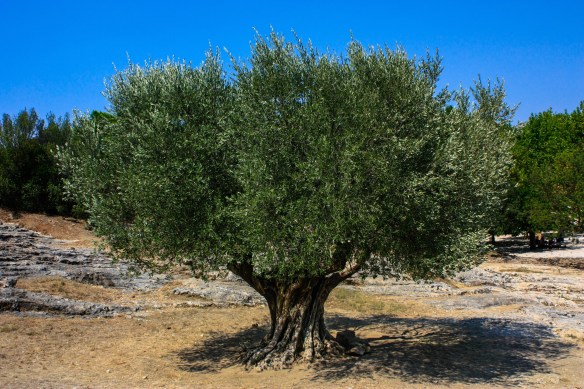
olive tree.jpgAt verse 16 God makes a comparison with a young, strong Olive tree that is nourished by its planter. God had fulfilled one of his covenants by planting the offspring of Abraham in the Promised Land. The blessing of the olives was plentiful but by this time in history, Judah was taking all this for granted. God therefore is going to pull them out of the Promised Land (garden of plenty) and transplant them in a foreign land. The analogy continues when Jeremiah discovers his fellow villagers in Anathoth are out to kill him. He becomes the tree they wish to cut down.

By verse 20 Jeremiah is no longer defending his people of Anathoth, Jerusalem or Judah. He is calling for God to fulfill his promise of a consequence for not obeying; refusing to rid the kingdom of idols, confess their sins to God, and worship only him. Specifically, those men of men of Anathoth who connive to kill Jeremiah will be punished. They will be left with no heirs. Not all of Anathoth, but those who threatened Jeremiah will pay for their threats.

Behold, I will punish them. The young men shall die by the sword, their sons and their daughters shall die by famine, [v23] and none of them shall be left. For I will bring disaster upon the men of Anathoth, the year of their punishment.” [ESV]

Preview of our next study article

Jeremiah 12 brings a very interesting question to the study table. Why does it seem that the evil people prosper while those who wish to follow God-Christ seem too often to come up short? This is very much contemporary today. We will see this in full in our chapter 12 discussion.

miniJimRev. Dr. Jstark
January 2017

Jeremiah – Chapter 9

Late night Bible Study

STUDY THE WORD for yourself!

In Jeremiah 1:1 we find him in such agony for his people he wishes he could cry away the pain of watching Judah and its people dissolve into nothingness; to personally disappear into the wilderness. Somewhat similar to the Ostrich hiding its’ head in the sand. But, he can’t as he is called of God to point out these evils and foretell of the impending captivity by the Babylonians. The punishment is coming and Jeremiah agonizes over it. He knows, but his people deny. Jeremiah suggests there is more peace and safety living among the wild beast of the forests and wilderness.

The Tribe of Judah and its entire leadership from the king down to the head of each family clan is in total denial. As we discussed in the Jeremiah 8 website article, they are in such denial they don’t even realize it. To the people of Judah, from the highest officials to the local neighborhoods, people have come to believe that s/he is a better deceiver-liar therefore it is to her or his advantage to continue living such lives.

JIV NOTE: Remove the v from lives, as in victory, one ends up living lives [lies]. Hosea 4 is the brutal truth of what God sees in his people, especially with their priestly leadership. It is only 19 verses but well worth the quick read. It paints a vivid picture of what Jeremiah is discussing in Jeremiah 9. http://biblia.com/bible/esv/Hos%204.1-19

The reader should be reminded or note that the prophet Hosea lived during the time when the Northern Kingdom still existed, but…. What he said about the Kingdom of Israel to the north was about to happen to the Kingdom of Judah in the south but now through the prophecies of Jeremiah.

God warns through Jeremiah that neighbors should beware of each other; brothers should not trust the tongue of their own kindred; no one should trust the leadership of Judah. 9:1-8… http://www.biblestudytools.com/jeremiah/passage/?q=jeremiah+9:1-8

In Jeremiah 9:9 he gets very specific. He tells the evil priestly clans that God will not only punish the people of Judah, but He reserves a punishment for the priests. They have used the name of religion (not God) to commit all sorts of evils [v14].

9:16 is a reminder to those of Judah that the Lord has provided many times over for them, even when they were a nation and not a divided kingdom north and south. Even though Israel to the north is no more, Jeremiah combines their sinful ways with that of all 12 tribes. In a sense, this may be the same path Israel of today will follow in their denial of the true Messiah (Christ) and their God Jehovah.

Jeremiah 9:14 and 19 pretty much sums up the entire chapter: [ESV]

V14…My people are asking pieces of wood for advice. They think those sticks will answer them! They have chased after those false gods like prostitutes and have left their own God.

V19…They went to those gods for safety, and they have lost their ability to think. Their altars will bring them shame.

There is more news today about political leaders and businesses using deceptive advertising, politicians lying, cheating, living personal agenda driven lives, and calling wrong a political correctness okay or right of the individual than in previous history.  This does not excuse the clergy either. Remember that Jeremiah points out that even the Levite priestly clans were doing the same thing. It is getting very difficult for a person to know who or what to trust.

Do not become overly concerned my friends. God can be trusted to keep His word and covenants.  Fact is, He will fulfill each one with or without man doing his part. Israel and Judah had made gods to their liking. After all, if one can say that stone or stick idol told me it was okay, do this, do that, then the person is no longer to blame. It is that stick idol, right? It is amazing how the reader of this article probably gets it but the people of Israel and Judah did not.

There is an old saying, perhaps a proverb, that if one hangs around a fire too long, eventually s/he will get burned or become fuel for the fire. This is what is dreadfully wrong with the compromising church today. In order to “get along” with others, standards are compromised; doctrine is shallow; hope is in the masses not God; sin is only a perception of right and wrong; what counts is Political Correctness.

WRONG!

Rev. Dr. JstarkDr. jStark

December, 2017

Jeremiah – Chapter 8

time.jpgThis is a very unusual chapter in almost all of scripture. Jeremiah is telling his countrymen what to expect in the immediate and end time future in and around Jerusalem and Judah. The Babylonians are coming! Not just this, but the almost cannibalistic marauding they will do in this Kingdom of Judah.

The Babylonians will be grave robbers!!! As did happen 1,500 years later when the Spanish conquistadors invaded and conquered the Inca, Aztec and other South American Indian cultures and civilizations, their [Babylonians’] thirst for treasures and gold simply could not be satisfied. Jeremiah is telling the people of Judah that the Babylonians will even defile the graves of the average citizen of this  kingdom. Why? A two-fold reason.

  1. The graves being defiled will be the graves of those of the Tribe of Judah who worshiped, as it states in verse two, the sun, moon, stars and unseen and imaginary heavenly hosts (not God however).
  2. All this in the quest for hidden or buried treasures in these graves.

Contemporary English Version (CEV): These bones will be scattered and left lying on the ground like trash, where the sun and moon and stars can shine on them.

A side note gives additional insight. This passage is probably from where we get the statement, make no bones about it.”

The God of Israel is allowing this to happen because of his disgust with the very people he has rescued over and over again. He took them from the edge of defeat many times. He blessed them when they didn’t deserve it. He called them HIS CHOSEN PEOPLE. We should note that God also promises in Isaiah 13 and *Habakkuk 2 that he will punish the Babylonians for what we would call today – overkill; brutal actuality. The bones of these Judeans were NOT reburied but left to sit under the false gods they worshiped; that is the sun, heavenly beings such as stars, and moon.  In a sense one might deduce that God is saying “their false gods won’t even care about this grave robbing and after-death abuse.”

* Habakkuk pleaded with God, asking Him to save Judah from her own wickedness. God answers, but not in the way Habakkuk expected.

To judge Judah’s wickedness, God says He will hand them over to the Chaldeans [Babylonians]: a nation even more wicked, violent, and corrupt.

Again, the CEV reads: Jeremiah 8:4, 5 The LORD said: People of Jerusalem, when you stumble and fall, you get back up, and if you take a wrong road, you turn around and go back.  v5 So why do you refuse to come back to me? Why do you hold so tightly to your *false gods? (of wood, stone, sun, moon stars…)

Deuteronomy 4:24 says that God is a jealous god. He will not have other gods put before him. Translation? Anything that comes before God in worship or importance is not acceptable in His eyes. Israel, Judah, today’s church, and its quasi-Christian membership, are guilty of this.

As powerful and descriptive as Jeremiah 8 is, verse 7 adds to it. God points out through Jeremiah that even the birds of the air know when to fly away from the impending winter. God’s chosen people hide behind things in their vain attempts to justify their ungodly actions and staying put in their ways. Remember back in Jeremiah 7:4 we have the Judeans pleading and hiding behind the fact that “we have the temple.”

To God this is not a safeguard. It is another obstacle to worshiping Him.  Later he promises to let the TEMPLE be destroyed in order to make this point. The Romans destroyed it for the final time in 72 A.D. What so many do not understand per Syria, the huge city of Aleppo and how the Levites treasure things more than God; Jews hid the “Aleppo Codex” in Aleppo for 6 centuries. Yes, the same Aleppo Muslims have conquered and destroyed in their attempt to wipe off the face of the map. They know things we Americans haven’t a clue.

Sarina Roff’e of JewishGen.org writes: “Few cities can match the glory of Aleppo, Syria, a city that spans Jewish history from the days of King David over 3,000 years ago. Aristocratic and noble, Aleppo was the crown of Jewish splendor in the Sephardic [Jewish] world.” 

The Book of Psalm [30:] and Samuel call Aleppo, Aram Soba. The New Testament sometimes identifies the same Aleppo of today as Ber[o]ea. The original settlement was called “Halab” which in Arabic (ﺣﻠﺐ) means: “where Abraham milked his cows.” Arab (Muslims) and Jewish tradition both state that Abraham first stopped in Halab (Aleppo) after leaving Ur, his home town.

SPECIAL BLOG NOTE: The Aleppo codex is the ONLY COPY of the entire text of the Bible. It is written on animal skins using a black iron ink. Hid and secretly protected for centuries by Levite priests.  Paul E. Kahle, when revising the text of the Biblia Hebraica in the 1920s, tried and failed to obtain a photographic copy of the Aleppo Codex. This forced him to use, believe it or not, the Leningrad [like in Russia] Codex instead for the [his] third edition, which appeared in 1937. This tells us something about where large dispersed communities of Jews, Levites and other Israelis from the Northern Kingdom must have lived for hundreds of years after the Assyrian and Babylonian dispersions; Aleppo and Leningrad. MY, my, my, how (secular) history IS [actually] all about God.

Why all this about Aleppo and Jeremiah? Jeremiah points out that Judaism of his time had become a religion of THINGS or religious items instead of God. We  need to know the significance of the bible being history, not a religious manuscript.

Judeans and the priestly Levites also hide behind the Laws of Moses but only when they are to their advantage. Jeremiah points this out in a backhanded way in Jeremiah 8:8 & 9. Again, the Israeli’s, in particular those of Judah (Jews), hide behind the teachings and laws of ‘the Lord’ rather than worshiping the God who created them.

Jeremiah 8:13 needs explanation. It reads as if God will wipe out the people of Israel and Judah. The translated Hebrew words “wipe out” are sûph in the Hebrew. It means to “snatch away” and be placed elsewhere but not as a country or kingdom. That reuniting of both the Northern Kingdom of Israel and the Southern Kingdom of Judah will not again happen until Jesus returns to the Mount of Olives. He will call his people from the four corners of the earth to return to Israel under his kingship (see this website: Book of Revelation series).

Once again and in reference to the birds that know to leave when winter is approaching, those of Judah simply say in V14, Let’s run and hide in a fortressed wall of another city. They never consider returning to God and confessing their sins to him. He did promise to not disperse them if they would. THEY NEVER DID! This confession of the sins of Israel happened about 70 years later. Daniel prayed a confessional prayer for his people, all Israel, from captivity in Babylon (Daniel 9).Admission of Guilt - legal concept

Jeremiah 8:17 is another step backward in their history and a parallel prophecy. It says in the CEV: Our enemies (plural as in enemies; so it is more than Babylon alone) have reached the town of Dan in the north, and the snorting of their horses makes us tremble with fear. The enemy will destroy Jerusalem and our entire nation. The northern kingdom by the time of Jeremiah was long dispersed as was this abode of Dan. This is either a reference back 120 years when the Kingdom of Israel still existed or a prediction of Armageddon in a history yet to be played out. This is an Armageddon or Har Megeddo where 200,000,000 troops from all nations gather to invade Jerusalem. (revisit our study on Revelation in the website).

Micah 3:11 puts the wrap in this deserved punishment of Israel and Judah. He writes:

Her leaders judge for a bribe, her priests teach for a price, and her prophets [prophecy] for money. Yet they look for the LORD’s support and say, “Is not the LORD among us? No disaster will come upon us.”

The vipers and snakes mentioned in verse 17 are symbolic of the invading enemy(ies). They will not be charmed or bought off either then or in End Time Armageddon. Neither will negotiation be available. Young’s Literal Translation (YLT) uses the past tense (have been bitten) meaning they are already determined to conquer. The wonderful promise in this parallel prophecy with Revelation 16:12-14, Israel will finally realize Jesus Christ IS THEIR MESSIAH when he destroys these invading armies of the nations. First is the invasion of Babylon; 597 B.C. Then comes the return of Jesus to the Mount of Olives where He proclaims himself as King of kings and the armies of the world gathered in Har Magiddo attack Jerusalem.

CLOSING STUDY NOTE: Jeremiah is not written in a chronological order. This makes it a little bit tougher to sequence events. One might out line this book in a broad way: the early chapters preview what is going to happen. Then the middle chapters and the bulk of them describe in great detail these events and how they will happen. Concluding the Book of Jeremiah is a summary of these same events and the prophesied destruction of Babylon, Egypt, Moabites, Philistines (today’s Palestinians; Jordan), judgment of Edom and the Ammonites (Jordon, Damascus of Syria and Kedar, Hazor, Elam in present day Islamic Iran but in End Time.

miniJimRev Dr Jstark
December 2016

Jeremiah – Chapter 7

Book of JeremiahIf a given people have the Temple of God in their midst, might they think that they are indestructible because GOD’S HOUSE is in their town? This is similar to a very big guy standing between you (us) and someone who wants to fight or defeat us. What we forget is the attitude and idea of the big guy. Is he going to do anything to prevent an attack? Does he even care? Might he be a person in who we put hope but it is not in his mind to protect those who had previously abandoned him? Have we previously given the big guy little recognition?

This is the opening scenario in Jeremiah 7. This chapter is full of “what ifs.” We will concentrate on them with this blog. Most quotes will be from the CEV and when not, the translation used will be identified. We strongly recommend one reads this chapter before delving into the blog review and study of chapter 7.

The Kingdom of Judah is on the verge of collapse yet no one in Judah, the king, synagogue leaders, and general population wants to acknowledge it. The previously ruling dynasty of the Middle East was Assyria. Babylon under the leadership of Nabopolassar through off the overlord of Assyria and began the road to Middle East dominance. His son Nebuchadnezzar finished the job his father began by conquering Judah and defeating Egypt.

Now that the reader is up to date, let’s look at the defiance and bad attitude of the Kingdom of Judah just before this time of Assyria’s fall and Babylon’s rise to power.

Jeremiah was told by YHWH – God to stand by the gate of the Lord’s house and announce: “Confess or be punished for 70 years under the rule of a kingdom where you do not even know the language” [paraphrased]. Recall in our chapter 6 study, the people and leadership of Judah, to a soul, did not live an honest life.

Pay attention, people of Judah! Change your ways and start living right, then I will let you keep on living in your own country.” [v3]

Here is another one of those promises that begins with an “If you will….” God can do anything as He is sovereign, but man has a free will. We opt in or out; God only offers. To stay neutral means to NOT TO OPT IN so the end result is the same.

Verse 4 is unusual for scripture. It is common to find “verily, verily I say unto you.” But, here is something repeated three times.

‘This is the temple of the LORD, the temple of the LORD, the temple of the LORD.’

God is not speaking here. It is the voice of the people of Judah and the leadership of false prophets. In modern terminology one might ask, who are you trying to convince? Me or you? Verses 5-7 list the prerequisite conditions God sets for preventing being overrun and dispersed into captivity by the Babylonians.

  1. Amend your ways
  2. Amend your deeds
  3. Execute justice
  4. Do not oppress the stranger or traveler, widow, poor
  5. Shed not innocent blood (child sacrifice)
  6. MOSTLY… get rid of those useless idols of stone, wood, wealth, position, influence

Verse 7 helps us to understand why in verse 4 screaming multiple times that “this is the temple of the LORD” is useless. The Lord is not IN THE TEMPLE TO SERVE THEIR PURPOSES handing out good enough certificates of protection. He has been abandoned by Judah for idols and other gods. It is just a building. This bothers me personally to realize the many churches where the LORD is not part of the service or worship and praise. They offer words to bounce off the ceiling but never get to the Lord’s ears. They sing catchy tunes with spiritually meaningless lyrics. They preach that God is Love and pass over the fact that He is also JUST.

Jer 7:9 You steal and murder; you lie in court and are unfaithful in marriage. You worship idols and offer incense to Baal, when these gods have never done anything for you.

Jer 7:10  And then you come into my temple and worship me! Do you think I will protect you so that you can go on sinning?

Ever hear the phrase NO BRAINER? It fits well with the above two verses. Somehow I think they people of Judah may be looking back at the Ark of the Covenant protection during times of battle and war. I like how Jon W. Quinn puts it… They were wrong about that [too]. It was at Shiloh where the Ark of the Covenant had been captured by the Philistines and the unfaithful people of Israel defeated (1 Samuel 4:10-11). It was as if they believed that the ark was like a lamp and God was a genie inside enslaved to whoever possessed the ark. That was certainly a mistake. What Jon is saying is that the Temple of the LORD is not going to protect an evil.

3d rendering words lie and believeJeremiah 7:8 reminds us of how some search the scriptures for support of whatever stance or issue for which s/he needs that third-person validation. “…ye trust in lying words that cannot profit.” In other words, we search or listen for that which supports our pre-desired opinion or outcome, then ignore the context or rest of the verse or chapter. As a 20 year college professor and Dean, I often saw this in papers from students. Instead of looking for the truth after stating a supposition, s/he only keeps that which supports his or her desired outcome. Commentators constantly say, “they believed lies.” We disagree. They desire it [lies] to be right as this is how they wish to live their lives.  People do the same thing today by taking scripture out of context in a way it supports his or her lies, or self-deceit.

In Jeremiah 7:11 God – Jeremiah puts it all on the table. “You are thieves, and you have made my temple your hideout” [CEV].

I guess standing in a garage does not make one an auto mechanic. Neither does attending college make one a scholar. This is verse 11 in layman terms. Showing up to church and tithing does not make one a Christian. We hasten to remind our readers of James 2:19 and Romans 10:9 & 10.

James 2:19 You believe that there is one God. Good! Even the demons believe that–and shudder.

Romans 10:9,10 If you declare with your mouth, “Jesus is Lord,” and believe in your heart that God raised him from the dead, you will be saved.

Jeremiah is not being unkind however today he would be crucified by the news and social media for being so very politically incorrect, discriminating and offensive of others rights to “shut him up.”

Dr. jStark


Jeremiah – Chapter 6

Verse 1 in Jeremiah 6 does not step outside of Judah. The Tribe of Benjamin was absorbed by Judah during the split of the 12 Tribes into two separate kingdoms. There were also remnants from the northern tribes who opted to live in Judah when the evil kings of the Kingdom of Israel to the north rejected God (YHWH).  The City of Jerusalem was part of the Benjamine territory when the land was divided by Joshua some 900 to 1,000 years earlier in history.

It is not uncommon to see different names in reference to the same people, place and thing. Not only in the Bible, but also the secular part of the same history. The King James Version is a bit difficult to understand when it comes to Jeremiah chapter 6. Following is the *CEV version; easier to understand and read. [*Contemporary English Version]

sound the trumpet.jpgJer 6:1  Run for your lives, people of Benjamin. Get out of Jerusalem. Sound a trumpet in Tekoa and light a signal fire in Beth-Haccherem. Soon you will be struck by disaster from the north. *

V2  Jerusalem is a lovely pasture, but shepherds will surround it and divide it up,

V3  then let their flocks eat all the grass.

V4  Kings will tell their troops, “If we reach Jerusalem in the morning, we’ll attack at noon. But if we arrive later,

V5  we’ll attack after dark and destroy its fortresses.”

V6  I am the LORD All-Powerful, and I will command these armies to chop down trees and build a ramp up to the walls of Jerusalem. People of Jerusalem, I must punish you for your injustice.

V:7  Evil pours from your city like water from a spring. Sounds of violent crimes echo within your walls; victims are everywhere, wounded and dying.

V8  Listen to me, you people of Jerusalem and Judah. I will abandon you, and your land will become an empty desert.

V9  I will tell your enemies to leave your nation bare like a vine stripped of grapes. I, the LORD All-Powerful, have spoken.

V10  I have told the people that you, LORD, will punish them, but they just laugh and refuse to listen.

V11  Your anger against Judah flames up inside me, and I can’t hold it in much longer. Don’t hold back my anger! Let it sweep away everyone-– the children at play and all adults, young and old alike.

V12  I’ll punish the people of Judah and give to others their houses and fields, as well as their wives. I, the LORD, have spoken.

V13  Everyone is greedy and dishonest, whether poor or rich. Even the prophets and priests cannot be trusted.

V14  All they ever offer to my deeply wounded people are empty hopes for peace.

V15  They should be ashamed of their disgusting sins, but they don’t even blush. And so, when I punish Judah, they will end up on the ground, dead like everyone else. I, the LORD, have spoken.

V16  The LORD said: My people, when you stood at the crossroads, I told you, “Follow the road your ancestors took, and you will find peace.” But you refused.

V17  I also sent prophets to warn you of danger, but when they sounded the alarm, you paid no attention. *

V18  So I tell all nations on earth, “Watch what I will do!

V19  My people ignored me and rejected my laws. They planned to do evil, and now the evil they planned will happen to them.”

V20  People of Judah, you bring me incense from Sheba and spices from distant lands. You offer sacrifices of all kinds. But why bother? I hate these gifts of yours!

V21  So I will put stumbling blocks in your path, and everyone will die, including parents and children, neighbors and friends.

V22  The LORD said, “Look toward the north, where a powerful nation has prepared for war.

V23  Its well-armed troops are cruel and never show mercy. Their galloping horses sound like ocean waves pounding on the shore. This army will attack you, lovely Jerusalem.”

V24  Then the people said, “Just hearing about them makes us tremble with fear, and we twist and turn in pain like a woman giving birth.”

V25  The LORD said, “Don’t work in your fields or walk along the roads. It’s too dangerous. The enemy is well armed

V26  and attacks without warning. So mourn, my people, as though your only child had died. Wear clothes made of sackcloth and roll in the ash pile.”

V27  Jeremiah, test my people as though they were metal.

V28  And you’ll find they are hard like bronze and iron. They are stubborn rebels, always spreading lies. *

V29  Silver can be purified in a fiery furnace,

V30  but my people are too wicked to be made pure, and so I have rejected them.

This is a powerful chapter defining Judah is at this time, and in general, what all of Israel, north and southern kingdoms became in the eyes of their God YHWH. We can see that Jeremiah is talking about what is about to happen to Judah and a bit of the events during the Tribulation period in a distant future.

The highlighted portions of the CEV verses above will be our primary discussion points in this chapter 6 study.

In Tekoa:  This is the birthplace of the prophet Amos. It is only a few miles south of Jerusalem.  The interesting note is that Tekoa, where the trumpet is to be sounded, is located south of Jerusalem but the enemy approaches from the north. Judah has become a dreadfully sinful place and Jeremiah cannot find a single soul through which Judah and Jerusalem will be saved from God’s punishment. Zechariah 3:9 is a future event not yet fulfilled but it addresses the sin of Israel. “God will remove their sin in a single day.”

…but shepherds will surround it: We see pictures on TV of what Jerusalem looks like today. The curse of God has left the surrounding lands lacking in water or much rain.  Desert is easy to see in and around the outskirts of Jerusalem. However, when the Children of Israel entered into the Promised Land under the leadership of Joshua, it was the land of milk and honey. The huge clusters of grapes hauled out of the countryside took two men to carry one cluster [Numbers 13:23]. The shepherds, the future occupants of this land, may be in reference to what Jeremiah writes in Jeremiah 1:15; kings of northern kingdoms.

Kings will tell their troops: Note that this is plural…KINGS. Babylon itself had but one king; Nebuchadnezzar. Close examination of scripture leads us to believe this prophecy is not only of the pending Babylonian invasion and Judah’s consequential 70 year captivity, but a future time when many from the north will come up against Jerusalem. In our Revelation study we saw that the gathering of troops from every nation in Har Megiddo; I.E. what we will call Armageddon, about 50 miles NORTH of Jerusalem, will be a combination of armies from every nation. All gathered to storm the gates of Jerusalem…200,000,000 men.

I must punish you for your injustice: God is love BUT, he is also justice. He is patient and longsuffering but will not be fooled. Israel is God’s chosen [wife] people. As does a good father, he does not spare the rod only to spoil his children [Proverbs 13:24]. Judah has been warned for by prophets since the fall of their northern cousin tribes in the Kingdom of Israel. At a time when Jeremiah is actually pleading with God to spare Judah and Jerusalem, he couldn’t find one single honest person in the country.

Evil pours from your city like water from a spring: The religious leaders had made a sham of the Law of Moses and used it only when to their advantage. Child sacrifice was a practice at this time; akin to our sacrifice of children via abortion. Lying, cheating, moral standards, and the fact that Judaism had become a religion instead of a way of life gave God his fill of tolerance. Jeremiah said “it poured like water from a spring.” That is abundant, not random sin. This is reminiscent of Genesis 6:5… “…every inclination of the thoughts of the human heart was only evil all the time.”

I will abandon you, and your land will become an empty desert: Recall that at one time this land was “milk and honey.” When my father visited Israel, he could see the difference between the cultivated lands of Israelis and the sands of the Arab territories. The point is what once was watered by God now has canals and irrigation ditches [2017]. Just as in the Garden of Eden where no labor was required to produce the fruits of the garden, after the fall of Adam, man had to cultivate to eat. Genesis 3:19 tells us just that. But the promise of God will still be a fulfilled covenant of God and Israel. This is described in the Millennial Reign of what Israel will be.

…bare like a vine stripped: Important note. God says in Jeremiah 6:9 that he will command the enemies of Jerusalem/Judah to strip the vines of their fruits. This is a twofold thought. To strip the vine of its grapes means to remove them from the garden. However, there is another more subtle point in this same passage. He, meaning God, did not say pull up the vines by their roots. This leaves the potential of future grapes/population. This is the future Kingdom of God-Jesus on the throne in Jerusalem; King of all kings; ruler of the earth; Satan bound in the pit.

V10 is the underlining statement of why God will punish his chosen people: “…but they just laugh at me” (Jeremiah that is). This was and is still true today of most prophets, evangelical preachers, teachers and witnessing testimonies of the Word of God. People do not take kindly to their sins being pointed out. The last four kings of Judah are prime examples of “in your face YHWH” attitudes. We will see in chapter 36 that King Jehoiakim burned the scrolls, the original copy of Jeremiah, in his heating pot at his winter room in Jerusalem. He not only laughed at but scorned both Jeremiah, through his scribe Baruch, and God. Very dangerous ground as it borders on the unpardonable sin. There is little doubt that King Jehoiakim will not be one singing the praises of Jesus on the great resurrection morning.

Let it sweep away everyone: This is actually Jeremiah pleading with God. He was very angry for the stupidity, rejection, and blasphemous statements of his fellow countrymen. Their self-confidence and cocky attitude was about all Jeremiah could take. If he could, he might have slaughtered them on his own. However, the Lord God follows up Jeremiahs pleading to destroy these people is found in the very next verse (V12).

V12  I’ll punish the people of Judah and give to others their houses and fields, as well as their wives. This verse needs little explanation. The punishment will be severe and total. The last half of this verse reads…”I the Lord have spoken.” From 72 A.D. to 1948, this vow was fulfilled.

Everyone is greedy and dishonest: In the ESV this same verse reads: “For from the least to the greatest of them, everyone is greedy for unjust gain; and from prophet to priest, everyone deals falsely. The word “everyone” in the Greek [kole] means NONE EXCLUDED. Once again we return to the pre-Noah days and the condition of the people’s heart. It is the fear and belief of this bible blogger that America is getting closer and closer to the same condition. The split and disrespect of peoples has never been greater aside from possibly the Civil War. Even back then it was mostly over principles and not hate and greed. Today it is hate and greed. What’s in it for me? Even ministers plead for more and more money’s to line the pockets of their own ministries. Huge churches have huge overhead. This tends to cause compromise of the scripture and appeal to those who are religious but want to attend a church with great chandeliers, huge auditoriums (not sanctuaries), professional bands to lead the music, and songs that sometimes are difficult to recognize as ones that praise or honor God. Catchy tunes but shallow lyrics.

In verse 14 I prefer how the King James Version puts it. Peace, peace; when there is no peace. This is what the priests and leaders offer the people of Judah; false hope in something that does not and will not exist until the Millennial Reign of Christ. This is a man’s peace; not God’s. Since the leaders of Judah at this time, secular and religious, were not in the foot prints of God, anything they did was in the foot prints of man.

They should be ashamed of their disgusting sins: Do you know anyone who is such a compulsive liar or evil (Stalin, Hitler, Mussolini, and others) that they don’t even faint back a bit, add a sheepish grin or blush when sinning?  This is similar to Pharaoh of Egyptian captivity times. The Pharaoh didn’t hesitate to withdraw or hold back his support for Israel slavery. His heart hardened each time it got a little bit soft. Pharaoh’s concerns never were for Israelis. It was always for him and his kingdom rule. Judah was the same at the time of Jeremiah. No shame; only lust for more.

Follow thweight of the world.jpge road your ancestors took, and you will find peace.” But you refuse: Even though history tells us that Israel of old had an on and off again relationship with God, there were times of a true peace for them. Let’s put it this way. Do you have a hidden sin? One that you must hide day after day in the hopes it stays hidden? There is no peace. This is what Jeremiah is talking about in this verse. Sin is more denial than hidden. I have often asked others when he or she is trying to justify a given action or hate: “Who are you trying to convince? Me or you? When it does happen and a wrong is made right, people feel a true peace. We identify it with the saying, “the weight of the world or a great weight has lifted from my shoulders.”

I tell all nations on earth: The word “ALL” is significant in this Jeremiah passage. When the bible says ALL, it means all! No exceptions. If anyone thinks America is exempted, s/he is all but right. What else might ALL THE NATIONS ON EARTH possibly mean? America, specifically the United States of America, is not mentioned in scripture. However, this verse is without exception and that does include the Americas. This verse is connected to the passage where God calls the Kingdom of Judah more evil than was their northern cousins, the Kingdom of Israel. Judah did not learn from what she saw happen to the ten tribes in the north. Jeremiah is telling us to learn from what we see. Yes, God is love, but he is also just.

“…the evil they planned will happen to them.” The word “evil” in Hebrew is rah which means naturally or morally. Since man cannot bring supernatural evil upon others, Jeremiah points out that God will use their own devices against them. Upon whom shall this evil be allowed? The answer is in the use of the word “Them, They or People.” It is “’AM in Hebrew meaning a specific tribe or group of people such as a given or multiple Tribes of Israel. In the King James 619 reads “even the fruit of their thoughts.”  Watch out ‘oh people,’ even their thoughts will materialize if it is bad.

You offer sacrifices of all kinds. But why bother? People today as back during this time of Jeremiah, have a lot to learn. It is not the value of the gift that God accepts as better or worse. It is not expensive spices or large checks that dazzle God or, in a sense, bribe his attention. It is how the gift is given. We can look at our own giving as see why it is we give. A minister once said “to give until it hurts.” I disagree. It is better to give until one is satisfied in his or her heart.” That is the value of the gift; i.e. the intent of the heart.

Look toward the north, where a powerful nation has prepared for war.

V23 Its well-armed troops: Jeremiah is not prophesying into the distant future at this point. He identifies the threat as ONE NATION this time. This is an imminent prophecy. God tells Judah and their leadership from which direction the enemy will come and probably identifiable by them per it being a power house nation; i.e. Babylon.

Verse 24 is somewhat a confliction. Jeremiah is saying one thing and the “tickle thy ears” prophets of Judah are saying “we are safe.” But then V25 says the Lord God says “don’t work in your fields.” This creates a dichotomy of interests and priorities. If the people of Judah don’t work their fields, there will be no crop; thus famine or starvation. Jeremiah has told the people of Judah to not fight the Babylonians when they invade. Their captivity is ordained of God. Jeremiahs primary message is, on’t make it worse by resisting. 

[Verse 26 begins a new paragraph in the this book but the same chapter] “ Wear clothes made of sackcloth and roll in the ash pile. V27 Jeremiah, test my people…” This set of instructions is not for Judah but for Jeremiah. Jeremiah is God’s tower and example for which HE wants the Judeans to emulate. Just as heat and boiling purifies lead, silver, gold, water and other metals, God identifies the entirety of Judah as bullheaded and hard as metal per being persuaded. They are [V30] “reprobate or mâ’as (Hebrew) skum at the top of the pot. They are NOT the purity God desired of them. However, God will purge their hearts and minds. It states in Hebrews 10:16 and he is talking about Israel at this time…

“This is the covenant I will make with them after that time, says the Lord. I will put my laws in their hearts, and I will write them on their minds.” 

miniJimJames W. Stark (M.M., Rev. Dr.)
December 2016

Jeremiah – Chapter 5

Jeremiah Study:

This week’s blog and the following picture graph is to help each to better understand that Jeremiah is not a stand-alone book per activities and participants. Five Kings of Judah, at least 5 other major prophets overlap the life of Jeremiah, the Judean exile of 70 years, the historical Battle of Carchemish between winner Babylon and loser Egypt, the fall of Assyria (Nineveh of Jonah and whale fame) to Babylon-Medes, the history of Nebuchadnezzar, Daniels’ dream interpretations in Babylon, Athens ends it rule of hereditary kings and becomes a democracy, Rome (Etruscans) begin a future Roman Empire but as a small city/village, and let’s not forget Obadiah in the later years of Jeremiah or Nebuchadnezzar’s Hanging Gardens… a wonder of the world; Shadrach, Meshrach, Abenego… all during the lifetime of Jeremiah. Fact and history.

Chapter 5 adds to this mix of history during the life of Jeremiah. Jeremiah is told of God in 5:1 to…

The LORD says, ‘Go up and down the streets in Jerusalem.

Look round you. Think about what you see.

Search through the market places.

Can you find just one person who acts honestly?

Can you find one person who tries to tell the truth?

If you can, I will forgive this city.

Does this remind us of something that happened about 1,500 years earlier? In Genesis 18 we find Abraham doing just what God told Jeremiah to do.  Abraham was pleading with God for Sodom where his nephew Lot was living. God told Abraham to find but a few believers in Sodom and he would not destroy it. Jeremiah was told a very similar thing in the opening verse of chapter 5. Abraham had to find ten persons; Jeremiah needed to find but ONE to prevent Gods judgment. Jeremiah didn’t find even one.

As amazing as it may sound, Jeremiah in 5:4 and 5 tells God it is because “these people are

entendre

They refused to listen.

Israel and Judah didn’t listen

poor and ignorant.” They simply do not know what God expects. Jeremiah tells God that he will go to the leaders and re-explain what God’s chosen people are supposed to be doing and who they are to worship. NOT TO BE! These people of Judah wanted a god created within their own image, not accepting that they were chosen of God, were once a dynamic nation of Israel under Saul, David and Solomon, and that Judaism was a life not a religion.to be followed. None listened.

Verse 7 of Jeremiah 5 is quite plain and blunt. It reads…

. “How can I pardon you? Your children have forsaken me and have sworn by those who are not gods. When I fed them to the full, they committed adultery and trooped to the houses of whores” (ESV)


JIV NOTE:
The harlotry and whores mentioned here means, according to Strong, “Jewish people being regarded as the spouse of God have chosen other gods to worship.”

God reminds Jeremiah that HE as the husband of [all] Israel supplying her every NEED time after time.  Yet, they seek and prostitute themselves to other gods of stone, wood, child sacrifice. 100 plus years earlier (8th century B.C.), Amos and Micah tried to appeal to the Israelis and their relationship with each other and to God. Israel and Judah didn’t listen to them either.

In Jeremiah 5:9 God tells Jeremiah two reasons for his anger. One reason is that the people of Judah, as did the dispersed tribes of the northern Kingdom of Israel, rejected the commandments of God given to Moses and have forgotten HIM. Second the people of Judah by this time were taking oaths in the name of foreign gods; not the God of Israel. God is simply asking Jeremiah “why should I hold back my anger?”

In verse 12 we see the true attitude of all Israelites and especially those in Judah. Since THEY were the children of God, they thought themselves to be exempt to punishment. God promised them this Promised Land. God had not destroyed Judah, yet they had witnessed what God had allowed to happen to their northern cousins 120 years earlier. Oh you stiff necked and uncircumcised people… [Acts 7:51]

Go through the nation’s vineyards and destroy them.

But do not destroy them completely.

Tear off their branches,

because these people do not belong to the LORD.

The people in Israel and Judah

have not been loyal to me at all’, declares the LORD.

Those people have lied about the LORD.

They said, ‘He will do nothing!

Nothing bad will happen to us.

We will never see war. We will never be hungry.
What a false piety and attitude of these people. God will NOT destroy us??? Who do they think they are? Truth be known, there were a great number of false prophets running around at this time in Jerusalem and Judah.  What was their message? We are safe and will never go hungry. In a sense and although defeated in wars and battles since they were established as Tribes in the Promised Land and governed by judges, they have already forgotten what happened to their northern cousins only a 100 plus years earlier. One can almost imagine their thoughts. “It happened to them up north but our king has always been a descendant of King David. It has been over 100 years and we are still here even though they are not. Nothing bad will happen to us. We have priests and the Temple.”

Elijah could destroy 600 priests of Baal and Jezebel [I Kings 19} but Jeremiah was just a messenger. He knew the eventual outcome. He also knew that God would not stay angry forever; just 70 years this time. We say this in anticipation of the next verse; i.e. v15. Other bible bloggers or commentators either don’t see this or they opt to not discuss it. In verse 15 Jeremiah goes from discussing Judah to “Oh house of ISRAEL.” [All Israelites are not of the Tribe or Kingdom of Judah] This is a leap forward in time to the books and contents of Daniel and Revelation; the future yet to be called history in the End Time events of the 7 year Tribulation. In a sense it is a parallel to what is about to happen [Babylon] and what is going to happen during the time of Jacob’s Trouble; that is the 70th week of Daniels dream; Tribulation period. For more insight to this, refer to the Daniel Study or the Revelation study found on this website.

V16, although it identifies “cases of arrows” it identifies these weapons as certain death or possibly weapons of mass destruction. This will be the machinery and weaponry of the 200,000,000 man army of Armageddon. Then in verse 19, just as it was asked when Babylon attacked Judah in the 6th century B.C., Israel will ask the same question at the time of the great tribulation (Revelation) when the antichrist attacks…”why is the Lord God doing this to us?”

Jeremiah 5:18 adds credibility to this thought of the THEN and again at the END TIME being parallel prophecies. Jeremiah writes, “But even in those days, declares the LORD, I will not make a full end of you. BUT EVEN IN THOSE DAYS??? This is a jump forward to what has yet to happen. Babylon is at their back door at that time, but the Great Tribulation [those days] is yet to happen to Israel and the world of Christianity.

Jeremiah 5:19 may also be a double application prophecy. Them that Judah will serve in a foreign land is/are Babylon. They know because Jeremiah is telling them. Those “foreigners” of End Time and to where they are now [current history] dispersed as a former nation of twelve tribes, then as a divided kingdom of North and South is yet to happen.

Jeremiah 5:23 to the end of this chapter describes a “Jew” as defined by the world today. They are stubborn; they do not fear God but are secular; they are deceivers or what many would call wheelers and dealers… mostly deceivers of themselves; (v26) they set traps to catch men (mostly off guard); (v28) they have grown greedy and wealthy; they are willing to listen to false prophets and those who wish to tickle their ears with only good news; not the truth.The end writing draw in sand

The end of chapter five is a powerful question for us today. It reads in the last sentence: “…but what will YOU DO when the end comes?” Hmmmm?

miniJim

Jeremiah – Chapter 10

Editor’s Note: We are posting chapter 10 of Jeremiah ahead of earlier chapters for two reasons. One is that Jeremiah in and of itself is not written in a chronological order. Second and most importantly is opportunity. We have just past the Christmas season and Jeremiah 10 is sometimes used as an anti-Christmas tree chapter. We want to explain the fallacy of such nonsense.

Jeremiah Chapter 10

This is the passage from which some so-called bible scholars claim that a Christmas tree in the home is significantly similar to a wooden idol. Specifically these men and women quote Jeremiah 10:3, 4 as their supporting bible evidence.

Jer 10:3  “Their [see v2] religion is worthless! They chop down a tree, carve the wood into an idol, [v4] cover it with silver and gold, and then nail it down so it won’t fall over.” 

“Chop down a tree? Cover it with silver and gold? Nail it down so it won’t fall over..?

This is a good example of OUT OF CONTEXT, highly spiritualized conclusion, and a slight of words. Every scripture must be taken within context. Verse 1 specifically calls to the attention of Israel to not be like their neighbors. Let’s take a quick look at the argument that Christmas trees are somehow included in this passage.julies-tree

If we put anything, yes, ANYTHING before God, it is called a god or idol in His eyesight. Most Christians have no problem separating a fictional Santa, Elves, and a form of decoration from the celebrated birthdate of Jesus. Fact is, He wasn’t even born on this date.

To chop down a tree… This in and of itself has no connection with the content and intent of this passage through the eyes of Jeremiah and many other prophets who discuss the wrongs of idol worship. The Ark of the Covenant was made from Acacia wood the covered with silver and bronze [Exodus 35:24]; massive amounts of cedar wood was imported from Tyre to construct Solomon’s Temple and parts covered with gold (1 Kings 6:19-21);

One researcher has noted, “This wood [acacia] is resistant to decay because the tree deposits in the heartwood many waste substances which are preservatives and render the wood unpalatable to insects making the wood dense and difficult to be penetrated by water and other decay agents.” (Source: http://ww2.odu.edu/~lmusselm/plant/bible/acacia.php)

In one sense this would make for the ideal wood from which to make a longer lasting idol. It is resistant to rot, insects, strong and long-lasting. Much of the acacia, cedar, and juniper wood used to build the Temple and the Ark of the Covenant was covered with silver and gold. Did the priests of Israel bring Israelis to the wood, stone and jeweled Temple to worship the building itself? There is no scripture to support such a thought yet alone make it a supposition.

Cover it with silver and gold We have already discussed the extensive use of silver, bronze, and gold in the building of the Temple and the Ark of the Covenant. Putting silver tinsel and shinning ornaments on a Christmas tree is the same as a person wearing decorative jewelry. That does not make it or them an idol. Ezekiel, Proverbs, 1 Peter, Job, 1 Corinthians, Zechariah, Psalms, Matthew, Lamentation (another book written by Jeremiah) all discuss gold and its use.

Nail it down so it won’t fall over… How else does one keep a piece of wood standing upright? The last house I built was nailed and bolted to the ground, concrete, and wood framing. This does not make it an idol as described in Jeremiah 10:2 & 3. Even if one stands around the Christmas tree and sings the song “Oh Christmas tree” does not make it an idol. Only when and if that replaces God in one’s heart as an item of their affection and is first in their heart does it border becoming a Christmas idol and a worship song. Even if we “nail it down” in some sort of a tree stand in our house, what do we do after the season is over? Throw it out!!!! Who throws out an idol of worship?

We must ask here, where in the bible does God or Jesus say to set aside ONE DAY a year to celebrate his birthday? There is no such passage. We are to celebrate Him every day, in every way, with all of our might [Psalms 100:1, John 4:24, Matthew 22:37]. This is not to suggest that a given day of SPECIAL HONOR is wrong. What is wrong is limiting it to this one time a year.

Now, for the rest of the history and future prophecies found in Jeremiah 10…

V6 & 7 proclaims the greatness of God. This is in contrast with the idols the people of Judah is now guilty of worshiping. Idols are made by man, carried by man, taken care of by man, put in place by man, and they do not listen or speak. As Jeremiah describes it in verse 5… “They are like scarecrows in a cucumber field.” This passage is not understood by many as it is two-fold. The scarecrow part is obvious. This is the scary thing that flops according to the wind and keeps out the birds of opportunity. But, why did Jeremiah use the cucumber as the vegetable of choice? This is symbolic of fools who prostrate before the scarecrow; cucumbers bowing before a scarecrow; the cucumber represents the people of Judah; any who bow before a worthless manmade thing.

We have stated it before in our studies of Daniel and Revelation. Today’s church is too often similar. People celebrate the catchy song and lyrics; the dancing around in the building; self-emulation; the experience more than the worship; the beverage spill on the vestibule floor is of greater concern than is the soul of their neighbor; getting out of church on time; political correctness over truth; making god to their liking instead of fearing God who created them giving them life and breath.

The Coffman Commentary on Jeremiah 10 is simple and a good overview of Jeremiah 10 siply put in one sentence. “The true God contrasted with idols.” We could leave it at that if we didn’t need to have Jeremiah’s words from 2600 years ago explained. So we continue…

Jeremiah 10:11 is a mystery or enigma, not in its message but in how it is written. This is the one verse in the Book of Jeremiah written in Aramaic. This verse stands alone as a “one-verse paragraph” in the Masoretic text. True and well-intending bible scholars have debated the reason for this for years. This website will only add a thought. We call it JIV: Jim’s Introspective View. We report; you decide.

Sometimes in a given language it is difficult to express one’s point using their native tongue. In English we often hear the phrase “Quid Pro Quo.” Why? The English version of the message being conveyed would be much longer explaining what is meant by using this Latin term. It is a great pre-verse 12 statement and exenterates the radical and necessary reason for removing idols (disembowel the home of idols). These “things” did not create the world as we know it. Only God created all things. Even the idols themselves are made from things God created back in Genesis. Verse 11 and 12 are opposites but the Aramaic in in Jeremiah 10:11 helps to contrast Jeremiah 10:12. It may also be in Aramaic as it is a message to the world. Just as Daniel is written first half in Aramaic and second half in Hebrew; the intended audiences are different.

hand carving buddha's image.The CEV translation says in 10:14… People who make idols are so stupid! They will be disappointed, because their false gods are not alive. Other translations are just as brutal in translating verse 14. How can one believe that something s/he makes is somehow better or superior to the one who makes it? In a sense and if it is true, the Amish build fabulous furniture. No question here. However, they deliberately build a flaw into every piece. Why? No one is perfect but God. The sad irony or insincerity is… the Amish think they must include a man made flaw in their furniture. This means they must be under the false impression that they are capable of building something to such perfection it is greater or equal to what God creates.

Verse 17 begins a new paragraph but not a new chapter. Jeremiah is changing thoughts at this point. He is telling those inhabitants of Judah, mostly Jews but also some from other Tribes of Israel, to prepare to be moved… “…gather up your things as you are surrounded” and about to be take into your 70 year captivity in Babylon. In a very real way, the rest of chapter 10 is not only describing the fate of Judah but of all Israel. Below is the rest of chapter 10. Read it with the idea that there is more than just Judah being described. It speaks in the past-tense yet Judah has not yet been overrun by the Babylonians.

CEV (Contemporary English Version): 

Jer 10:19  The people answered, “We are wounded and doomed to die. Why did we say we could stand the pain?

Jer 10:20  Our homes are destroyed; our children are dead. No one is left to help us find shelter.”

Jer 10:21  But I told them, “Our leaders were stupid failures, because they refused to listen to the LORD. And so we’ve been scattered like sheep.

Jer 10:22  “Sounds of destruction rumble from the north like distant thunder. Soon our towns will be ruins where jackals live.”

Jer 10:23  I know, LORD, that we humans are not in control of our own lives.

Jer 10:24  Correct me, as I deserve, but not in your anger, or I will be dead.

Jer 10:25  Our enemies refuse to admit that you are God or to worship you. They have wiped out our people and left our nation lying in ruins. So get angry and sweep them away!

The past tense is the tell-tale sign that not only is this passage a change in thoughts, therefore a new paragraph, but a twofold prophetic application; i.e. a now and a future application. This is Jeremiah once again prophesying into a history that has yet to be fulfilled. This is also End Time prophecy per the Great Tribulation; Jacobs Trouble [Jeremiah 30:7].

Verse 25 is worthy of a short additional thought. “Our enemies refuse to admit you are God…” How ironic that those in Judah at this time are guilty of the same thing. We know this from reading the first few verses in Jeremiah 10 and the very first chapters already posted in this website. They meaning all of Judah to the person are GUILTY [Jeremiah 4:21]. This is what kindled God’s anger against his chosen people Israel. First it was the Northern Kingdom of Israel and now the southern Kingdom of Judah. In the coming End Time it will be global (anti-Christ).

“They have wiped out our people and left the nation in ruins.” [CEV; v25]. The ERV is more inclusive in this verse. It is the reason we encourage readers to use more than one translation and commentary in his or her bible studies. The English Standard Version puts verse 25 this way:

Pour out your wrath on the nations that know you not, and on the peoples that call not on your name, for they have devoured Jacob; they have devoured him and consumed him, and have laid waste his habitation.

Jeremiah is not speaking to the yet-to-be-captive people of Judah in verse 25, but to the world of haters or rejecters of God and anti-Semitists. Daniel and Revelation deal with this as will Jeremiah in later
chapters. We are headed that way in this study. An added thought to help one’s personal studies. Verse 25 is a reason to not take one translation as a stand-alone study bible. The CEV dminiJimoes not include the phrase “and upon the families that call not on thy name.” The phrase “and families” is better explained in Zechariah 14.

Rev Dr. Jstark

December 2016

Jeremiah – Chapter 4

“If thou wilt [KJV & the JPS; Jewish Publication Society]….” are the opening words of chapter 4. There is not a single covenant or promise in the bible not prefaced with something ifsimilar to “IF THOU WILT,” then the condition of what it is God expects in return for his extra blessings. If we commit, then God will commit. If we don’t commit, then God is not held to a different standard since it is HIM who sets the standards; not the other way around.


Jeremiah had the same message to both the dispersed throughout the known world Tribes of the Northern Kingdom and the still existing Kingdom of Judah. Although Jeremiah already knew the people, leaders, King and Synagogue members would not listen, he still carried the message. We are not called to save souls, but to share the Word of God and our testimony.

As the CEV translation puts it in 4:1… The LORD said: Israel, if you really want to come back to me, get rid of those disgusting idols.

The ESV translation says… “If you return, O Israel, declares the LORD, to me you should return. If you remove your detestable things from my presence, and do not waver,…”

No matter how it is translated it boils down to If we; then HE will…! But, Jeremiah 4:2 does not stop there. He explains the credentials of the Lord: swear to the Lord who lives, is truth, is just in judgment, and righteous, [then back up to the last sentence of verse 1] then shalt thou not [be] remove[d]. Judah is facing the fact that Babylon is on the move and conquering the nation-states around them. Once they were subject to Assyria but Nabopolassar, King of a re-established Babylon, Nebuchadnezzar’s father, defeated Assyria in 609 B.C. (secular records). Nebuchadnezzar later conquered Judah in two separate stages; 597 B.C. and 587 B.C. He reduced the population of Judah each time. People like Ezekiel, Daniel, Shadrach, Meshach, Abednego went with the first deportation.

NOTE: Parts of Assyria and Babylon fall within and overlap modern day borders of Iraq. The reader should keep in mind that all Israelis are Semitic, but not all Semites are Israelis. Abraham had other sons through Keturah [Genesis 25:1] and we must not forget Ishmael. His descendants are also Semite but today we know them as Arabs.

shovel in the ground in the vegetable garden, on a background of green onions

Break up the fallow ground

Verse 3 of chapter 4 actually begins a new paragraph. Jeremiah changes thoughts. “For thus says the LORD to the men of Judah and Jerusalem: “Break up your fallow ground, and sow not among thorns.”   The next several verses explain what Jeremiah is telling the leaders of Judah. At verse 7 he explains the consequences and prophecy of not “breaking up the fallow ground.” We might say in modern terminology in 7-9, the alarm clock has been set. Choice is still available for the people and leadership of the Kingdom of Judah but it is either/or and no neutral choice. In verse 7 we read that “the destroyer of the Gentiles” is about to descend upon Judah; i.e. Nebopolassar conquered the Gentile nations then his son, Nebuchadnezzar captured and deported Judea/Jerusalem.

Jeremiah, a true prophet of God, and those who called themselves prophets but were not of God and falsely tickled the ears of the king of Judah, had many run-ins and collision courses. We will learn more about these as we progress through Jeremiah. Jeremiah 4:10 sets the stage for this and is a point in history where Jeremiah himself challenges God… “LORD God. You have not told the truth to the people in Judah and in Jerusalem. You have told them, “You will have peace”. But soon the sword will kill us.’ Jeremiah is looking back at previous and historical promises (covenants) God made with His chosen people and to what the false prophets were saying (Jeremiah 6:13,14). Simply put and as already pointed out in our opening paragraph, Judah did not stay faithful to God, so God no longer was held to his promise of safety. In simple terms, it is similar to one breaking a treaty. Once an agreement is violated, then the other party is no longer held to his agreement or terms.

For the student of Middle East studies and bible history, this website gives a great brief perspective. http://www.worldology.com/Iraq/assyrian_empire.htm

The circumcision of the heart referred to in verse 4 is explained in verse 14… (ESV) “wash (circumcise) your sins from your heart.” Verse 13-18 goes back 120 years; a reminder that what God did to the Kingdom of Israel, the ten northern tribes, is about to happen to Judah and the now absorbed Tribe of Benjamin. See verse 15 for the specific identity where often the Tribe of Ephraim is synonymous with an identity of the northern tribes.

At verse 19 we once again get a change in Jeremiah’s topics or paragraphs. This verse is a bit like one with a bad case of the flu and one’s abdomen is telling him or her there is cause for great alarm. No time remaining to consider alternative solutions. To carry this further, verse 20 where it reads “SPOILED” one could just as easily have used the analogy from the flu and insert “SOILED.” Gross? Yes, but the truth is not to be denied. “IN A MOMENT” (4:20b) says God through Jeremiah.

At verse 23, then continuing through verse 29, Jeremiah goes back to Genesis 1:2. With this retreat, he prophecies forward to Luke 21:5-38, the book of Revelation, and the Book of Daniel when the mountains tremble, the birds flee, Jerusalem being in total chaos. God uses a vision and example of this end time event back in Jeremiah 1:13-15. It happened in 587 B.C. and will repeat itself during the Apocalypse of the Tribulation.

Verse 27 is a one-way promise from God himself. It is true of this time in scripture and of End Time as also portrayed in scripture. Similar to Daniel 11 if one wishes to do a bit of self-study.

“This is what the LORD says,

‘I will destroy the country.

But I will not destroy the whole country.”

Verse 30 of Jeremiah 4 is very pronounced and profound. Both the Northern Kingdom of Israel (sometimes referred to as Joseph; i.e. Ephraim his eldest son from Egypt) and the Southern Kingdom of Judah are referred to as the “wife of God.” The website found at http://www.hope-of-israel.org/yehovahswife.html is a good source for additional information per Israel as a whole being identified as a wife (of sorts) to God. Exodus 19:5 (through 8) is sometimes referred to as the “wedding vows between God and Israel. Exodus 19:5 is God’s vow and Exodus 19:8 is Israel’s vow.

Exodus 19:5  “…you shall be my treasured possession among all peoples,…”  (husband’s vow

Exodus 19:8 “…All the people answered together and said, “All that the LORD has spoken we will do.” (a wife’s reply)

Also look back at Jeremiah 3:8.

We can summarize this portion of our study in Jeremiah 4 with the words of Hilda Bright, a blogger and studied individual. She uses the Easy English Bible and commentary. The following are her words commenting on verse 28 through end of this chapter (v31).

Verse 28 Jeremiah describes the earth as a person who is sad. The sky becomes black because the light has gone (verse 23).

Verses 29-31 The people in Judah heard the enemy coming nearer. So the people ran away. They were afraid of the arrows that the enemy used. The people in Judah tried to find safe places to hide. They went into the woods and into caves in the cliffs (Isaiah 2:19). Jeremiah describes how Judah tried desperately to be at peace with the enemy. He describes Judah like a prostitute. The prostitute puts on bright clothes. She paints on a black powder round her eyes. It makes her eyes look larger and more attractive. But it was no use for Judah to make herself look beautiful. Judah’s ‘lovers’ were Egypt and Assyria or Babylon. But they hated Judah and they wanted to kill her.miniJim

Rev. Dr. Jstark – December 2016


Appendix:

Source Date Events
2 Kgs 25:1; Ezek 24:1-2 10 Tebeth =
27 Jan 589 BC
Beginning of final siege.
Jer 34: 8-10 1 Tishri =
29 Sep 588
Release of Hebrew slaves at beginning of a Sabbatical year.
Jer 34:11-22; 37:5-16 Between Tishri 588 &
Nisan 587 = Oct 588 to Apr 587
Babylonians temporarily lift siege due to approach of Egyptian army. Slaves taken back. Jeremiah arrested as he attempts to go to Anathoth.
Jer 34:22; Ezek 30:20-21 7 Nisan =
29 Apr 587
Egyptians defeated. Siege resumes.
2 Kgs 25:2-4; Jer 39:2, 52:7;
Ezek 33:21, 40:1
9 Tammuz =
29 Jul 587
Wall breached. Zedekiah captured.
2 Kgs 25:8 7 Ab =
25 Aug 587
Nebuzaradan arrives at Jerusalem (cf. Jonah 3:3) from Riblah in Hamath and begins consultation with commanders in the field regarding the pillaging of the city.
2 Kgs 25:9-19; 2 Chr 36:18-19;
Jer 52:12-25
10 Ab =
28 Aug 587
Nebuzaradan leads forces into Jerusalem (cf. Jonah 3:4) to pillage, destroy, and burn the city and its temple.


Jeremiah – Chapter 3

This book tells us not only of the immediate future of Judah, but end time for all including the dispersed ten tribes of the northern kingdom. However, the first verse in Jeremiah 3 has an application per some translations that can send one off with the wrong emphasis. It has a parallel meaning to what Jeremiah is being told by God.

Jeremiah begins with something the Judeans and all of the Israelites already know about Hebrew law therefore comparing it to them as a people chosen of God to be his *special people, like a wife. He IS NOT talking or making an emphasis per marriage between a man and woman but is using it as a platform to help them understand (see the learning pyramid in this website) via their current knowledge of the Law. [Awareness – Knowledge – Understanding…]

*Jesus uses the same analogy with the church of the New Testament; i.e. the church being the bride of Christ. This is addressed in greater detail in previous articles published on this website. Israel, all of the Tribes, is the bride of God.

Gavel Divorce Paper Decree Front
SUPPOSE that a man divorces his wife, then she marries another man. According to the Law of Moses, her first husband cannot return to her without defiling her second marriage. (Paraphrased). The second half of verse 1 states… “People in Israel, you have lived like a prostitute. You have loved many false gods. So do you think that you can return to me now?’ asks the LORD.”

Jeremiah then makes the analogy of Israel (Judah included) living like a prostitute.  They have taken in other gods of wood, stone, religion, all while giving very limited lip service to the monotheistic God of Judaism. Judah, even more so than did the Northern Kingdom of Israel, made alliances with other nations (kingdoms) to protect them or join them in a defense without consulting God as to their decisions to do so. They put their lives in the hands of other men and kingdoms rather than in the hands of God. In verses 4 and 5 Judah calls out to God as if they “really didn’t mean to leave him. Please get over your anger so we can be rescued from these men (other kingdoms) who wish to abuse us.” This has some rather strong resemblances to being a fox-hole Christian.

This was simply a repeated plea from the Israelites after each time of separation from their God and desperate moments (might this sound familiar personally?). If wanting to dig a bit deeper in your studies, go to the Book of Hosea and read it. You will find a brief outline of Hosea in a graphic form on the next page. Hosea actually married a prostitute and was commanded by God to do so. It was an example of things to come regarding Israel. Jeremiah is pointing back to Hosea in his analysis and warnings. Hosea was a prophet in the Northern Kingdom which by the time of Jeremiah, it no longer existed.

What Jeremiah is actually saying in these early verses of chapter 3 is: “oh Israel and Judah. You are my [God’s] wife who lived as a prostitute with other nations instead of depending on me. Do not expect me to simply dismiss your intentional acts of ungodliness. I will forgive in the end as promised Abraham, Isaac, and Jacob, but there will be a price to pay for your actions.” The oddity found in verse 11 is that God sees Judah as worse than their kindred northern cousins, long since these 10 tribes being dispersed and ceasing to exist as a kingdom after the Assyrians conquered them.

Judah had some good kings.  The northern ten tribes basically had un-Godly kings. So how might one justify God’s attitude per these cousins but two different kingdoms, that is, Israel being the worse of the 12 divided Tribes of Israel but lasting longer as a kingdom? It is not really that difficult. Judah too had several backslidden kings including child sacrifices. But the real taker is that 100 plus years earlier, the southern kingdom saw what God allowed to happen to the northern kingdom as judgment for their sins and did not learn from it. It is much like attitudes of people today when we think “it won’t happen to me.” Back up to verse 10; “they only pretend to worship or be loyal to me.”

Sunday only Christians… beware and leery of our own thoughts that Sunday attendance and desperation moments are evidence enough so that God thinks we have been loyal to him. Jeremiah 3:12 & 13 is a promise of fascinating reassurance. It reads:

V12 Go. Announce this message to the people who are in the north.

‘Israel, you have not been loyal’, declares the LORD.

‘Return to me.

I will not frown on you any longer.

I am kind and I am willing to forgive’,

declares the LORD.

‘I will not be angry for always.

v13  You must [first] admit that you are guilty.

You have refused to obey the LORD your God.

You have loved false gods everywhere.

You have worshipped them under every green tree.

You have not obeyed me’, declares the LORD.

“Return to me.” Even though the ten tribes in the north are at this time scattered throughout the known world, they can return to God in their hearts. This has still to happen even though Daniel, a student of Jeremiah’s writings, offered a prayer of confession for Israel as a nation from his captivity in Babylon [Daniel 9:1-19]. God says “I am willing to forgive.”

His one-person prayer may or may not be the confession God is seeking. Time will tell. However, in verse 13 of Jeremiah 3 we also read, “You must admit that you are guilty.” Daniel admits it, but what about the other millions of dispersed Israelites who by now have possibly forgotten that they are descended from Abraham, Isaac, and Jacob (renamed Israel)? The next line reads, “You have refused to obey the LORD your God.” It is more than confession but it also means a life lived IN GOD, just as the New Testament tells us [2 Corinthians 5:15] that we are to live IN JESUS. That means Christianity is a way of life; not just a religion. Just as true today with the lost ten Tribes of Israel, far too many Sunday Christians don’t get or don’t want this to be a condition of their salvation.

Adam Clark has one of the best commentary explanations for Jeremiah 3:14. He writes: 

“I will take you one of a city, and two of a family” – [Clark] If there should be but one of a city left, or one willing to return, and two only of a whole tribe, yet will I receive these, and bring them back from captivity into their own land.

In other words, a confession of one or two within a given family of Israel is possibly good enough for God to welcome back the entire tribe. This makes Daniel’s prayer in Danial 9 very significant. JIV NOTE: It can be noted that some commentaries simply skip past this verse therefore avoiding comment and commitment to what God is saying through Jeremiah. The answer is actually found in Jeremiah 31… (CEV) “Oh Israel, I [God] promise [to covenant] that someday ALL YOUR TRIBES will again be my people.”

NOTE: We are running out of blog space and reader patience, but Jeremiah 3:19-25 should not be skipped. (CEV; Contemporary English Version)

Jer 3:19  I have always wanted to treat you as my children and give you the best land, the most beautiful on earth. I wanted you to call me “Father” and not turn from me.

Jer 3:20  But instead, you are like a wife who broke her wedding vows. You have been unfaithful to me. I, the LORD, have spoken.

Jer 3:21  Listen to the noise on the hilltops! It’s the people of Israel, weeping and begging me to answer their prayers. They forgot about me and chose the wrong path.

Jer 3:22  I will tell them, “Come back, and I will cure you of your unfaithfulness.” They will answer, “We will come back, because you are the LORD our God.

Jer 3:23  On hilltops, we worshiped idols and made loud noises, but it was all for nothing– only you can save us.

Jer 3:24  Since the days of our ancestors when our nation was young, that shameful god Baal has taken our crops and livestock, our sons and daughters.

Jer 3:25  We have rebelled against you just like our ancestors, and we are ashamed of our sins.”

fulltimeWhat a conclusion for chapter 3; a true confession of guilt and a full-time return to honoring God as the one and only god. This means putting into second place all other things in life. Israel will eventually do just that. Though Israel today is basically populated and established by those few who descend from those who returned (536 B.C.) from captivity in Babylon, a time will come when they will be called from the four corners of the earth and return in mass to a nations with Jesus on the throne. It is verse 22 that is critical. God says, “I will tell them to come back…”
This is very likely to be an event that immediately follows the second advent of Christ when he returns to set up his millennial kingdom. Why? The compelling words are COME BACK, not go back. God and Jesus are already there setting up this Kingdom.miniJim

Jeremiah – Chapter 2

Jeremiah Chapter 2 – Backslidden IsraelBook of Jeremiah

This chapter is somewhat similar to the  message to the Church of Ephesus as found in Revelation 2:4,5.

“But I have this against you: You have left the love you had in the beginning. [2:5] So remember where you were before you fell. Change your hearts and do what you did at first. If you don’t change, I will come to you and remove your lamp stand from its place.”

Israel did and now Judah continued(s) to turn their back on the God of creation. They know [yadda] that they are God’s chosen people. In a sense it gives them self-sanctioned proprietary claim to life and land. One might say it has gone to their heads. They feel it is license to do as they please as chosen people of God. They want to add additional gods, one or more to their liking; one they create. This is their desired reality but it is not God’s actuality. The same is true in many churches today in America and on TV.

This is so much like Christians today in practice. We want to be God’s chosen but want license to do things we should not and are not pleasing to God. He is NOT a way of life but only a part of our life. This is in a nutshell what Judah is during the time of Jeremiah. It is also a lot like a foxhole Christian; God get me out of this mess and I promise….; but once out of the mess, we do it our way (sorry Frank Sinatra). This is chapter 2 of Jeremiah.

Like it clearly states in verse 17 of Jeremiah 2, “the people [of Israel] have brought it upon themselves.” In our previous chapter blog, we see the historical context of this time and the life of Jeremiah. Verse 4 adds to this context.

[ERV] “Family of Jacob, hear the LORD’S message. Tribes of Israel, listen.” [note the repetition, family of Jacob is all the tribes of Israel.]

We know that the Kingdom of Israel was dispersed by the Assyrians over 100 years earlier, but v4 brings us to a future yet to happen. God is not finished with his chosen people. This includes all twelve Tribes of Israel. He is reminding them of what Daniel and the Apostle John have yet to write in the sequence of global histories. In the first few verses of Jeremiah 2 Jeremiah recaps what God has done for the Israelites since they became a people in Egypt then retrieved to a Promised Land; promised to Abraham.

sin.jpgThis is similar to someone getting away with a sin, for a while, and his or her confidence in getting away with it becomes their foundation for continued sin action. Numbers 32:33 if taken out of context says one’s sins will find thee out. This passage in Numbers has to do with the three Tribes: Reuben, Gad and the half-tribe of Manasseh. They did not want to cross over Jordan to help the other tribes settle their land and dislodge the sparse nomadic inhabitants west of Jordan. Moses told them they must help their brothers fight the good fight before returning to the land that today is known as Jordan. If they did not help, then Numbers 32:33 says, be sure thy sin (of not helping) will find them out (paraphrased). One might just as easily see this as analogous to the makeup of today’s church. “ Just let us sit in the pew [on our side of Jordan] and cheer on those who carry the load against the enemy.”

However, as Dr. Jack Hyles puts it [2015], “Some of the members of the tribes of Gad and Rueben [half tribe of Manasseh] are still alive today. In fact, America is full of these loafers who say, “We are tired of fighting. Let us relive our victories in the wilderness. It is time for us to rest and enjoy the fertile plains on the east side of the Jordan.” Oh, these people still go to church. They just don’t want to fight.

Blog Note: For the geography impaired, this land on the east side of Jordan is the country or State of Jordan, 2016.

Jeremiah is reminding (2:4) those from all 12 tribes that the fight is far from over. The Kingdom of Judah is going to pay a price for their sin as did those in the Northern Kingdom of Israel 100 years earlier. A great and applicable message on sin finding us out as it applies to us today can be found at https://www.baptist-city.com/sermons/your_sin.htm.

This time in Jeremiah’s life is a three-way grudge and continual fighting between Assyria, Egypt and Babylon. Each striving to dominate the regain with Israel stuck between the three battlers. Some may have studied the “hanging Gardens of Babylon as one of the seven wonders of this world. This all happened during the time of Jeremiah. Around 1125 B.C. there was another ruler in Babylon named Nebuchadnezzar I. He is not related to the Nebuchadnezzar II of Jeremiah’s time.

A Wise Note: Often Christians are criticized by claiming that bible history not being documented (which is false in and of itself per archeology) so it didn’t exist. Well, how many have heard of the “hanging Gardens of Babylon; i.e. the seventh wonder of the world? We all studied it is school history, However, read the following from the encyclopedia Wikipedia:

The Babylonian priest Berossus, writing in about 290 BC and quoted later by Josephus, attributed the [Hanging] gardens to the Neo-Babylonian king Nebuchadnezzar II, who ruled between 605 and 562 BC [the same time period of the 70 years of Judean captivity in Babylon]. There are no extant Babylonian texts which mention the gardens, and no definitive archaeological evidence has been found in Babylon. [Emphasis mine].

However, our American school history books report it as one of the 7 wonders of the world and as fact.

Another fact and historical note is mentioned almost in passing in Jeremiah 2:2d… “in a that had never been planted by other inhabitants.” Israel did not simply move int5o the Promised Land and kick others out. Secular historians want us to think this is what happened. God says, it is “in a land that was NOT SOWN” (planted-grazed). Make a personal note that the Promised Land was not overpopulated by other people at this time but was under occupied.

When Jeremiah mentions in verse 2, “At the time you were a young nation, you were faithful to me. You followed me like a young bride. You followed me through the desert, through a land that had never been used for farmland.” The “young” time two which Jeremiah relays this information told him of God was when for almost 400 years the 12 Tribes of Israel lived as a confederacy without a king but judges. [Read this in the Book of Judges]

Verses 5-8 in Jeremiah 2 are in contrast to the years of loving and following Judaism and the God of Israel as a confederacy.

  1. Israel wondered from me
  2. They worshiped worthless Gods
  3. They did not seek God
  4. They ruined the land God promised Abraham, Isaac and Jacob (Moses)
  5. The land was good soil at first but they ruined it
  6. False prophets spoke message from Baal.

Verse 10 is amazing in and of itself. God tells his people to, Go to the coasts in the west and look. Send people to the countries in the east. Let the people look carefully. See if there has been anything like this (Promised Land).”

God instructs his people to go west; go east; compare their land with what God had provided their forefathers and the God he was to and for them. Providentially, this is exactly what happened to the people of Israel. They were dispersed east and west to the four corners of the earth; Isaiah 11:12, Isaiah 12:15, Ezekiel 22:15 and 36:19, Daniel 7, Jeremiah 29:14, Ezekiel 11:17.

Verse 13 really tells us God’s attitude and analysis of his Chosen People Israel:

My people have been guilty of two sins.

They have left me.

I am like fresh water that comes up from the ground.

But my people have dug their own wells.

But these wells have cracks in them.

They cannot hold any water.

To quote Hilda Bright in her analysis of Jeremiah 2:17,18: “Verses 17-18 ‘To drink water from the River Nile or the River Euphrates.’ This describes how Judah tried to make friends with the powerful countries called Egypt and Assyria. The LORD had rescued his people from Egypt. But they were turning back to a country that could not help them. Judah was trusting Egypt for help. Already Isaiah had said that this was foolish (Isaiah 30:1-5; 31:1-3).”

This is also why Jeremiah fought and resisted his fellow countrymen when they forced him to flee to Egypt with them. We will study this when we get to Jeremiah 43.

Jeremiah 2:20 – end of chapter is very explicit. God compares his people who have deserted him to the whiles of wild living; wild animals seeking to mate; running from one to another to get what one can on his or her own; sniffing the wind to go with the direction of, might we say today, political correctness; telling a piece of wood “you are my father-god,” I have disciplined my people Israel but they did not learn; you have killed my *prophets.

*How prophetic of this as they also killed Jesus Christ. Even Muslims see Jesus as one of the great teachers and prophets.miniJim