
Jeremiah – Chapter 2

Jeremiah Chapter 2 – Backslidden IsraelBook of Jeremiah
This chapter is somewhat similar to the  message to the Church of Ephesus as found in Revelation 2:4,5.

“But I have this against you: You have left the love you had in the beginning. [2:5] So remember where you were before you fell. Change your hearts and do what you did at first. If you don’t change, I will come to you and remove your lamp stand from its place.”

Israel did and now Judah continued(s) to turn their back on the God of creation. They know [yadda] that they are God’s chosen people. In a sense it gives them self-sanctioned proprietary claim to life and land. One might say it has gone to their heads. They feel it is license to do as they please as chosen people of God. They want to add additional gods, one or more to their liking; one they create. This is their desired reality but it is not God’s actuality. The same is true in many churches today in America and on TV.

This is so much like Christians today in practice. We want to be God’s chosen but want license to do things we should not and are not pleasing to God. He is NOT a way of life but only a part of our life. This is in a nutshell what Judah is during the time of Jeremiah. It is also a lot like a foxhole Christian; God get me out of this mess and I promise….; but once out of the mess, we do it our way (sorry Frank Sinatra). This is chapter 2 of Jeremiah.

Like it clearly states in verse 17 of Jeremiah 2, “the people [of Israel] have brought it upon themselves.” In our previous chapter blog, we see the historical context of this time and the life of Jeremiah. Verse 4 adds to this context.

[ERV] “Family of Jacob, hear the LORD’S message. Tribes of Israel, listen.” [note the repetition, family of Jacob is all the tribes of Israel.]

We know that the Kingdom of Israel was dispersed by the Assyrians over 100 years earlier, but v4 brings us to a future yet to happen. God is not finished with his chosen people. This includes all twelve Tribes of Israel. He is reminding them of what Daniel and the Apostle John have yet to write in the sequence of global histories. In the first few verses of Jeremiah 2 Jeremiah recaps what God has done for the Israelites since they became a people in Egypt then retrieved to a Promised Land; promised to Abraham.

sin.jpgThis is similar to someone getting away with a sin, for a while, and his or her confidence in getting away with it becomes their foundation for continued sin action. Numbers 32:33 if taken out of context says one’s sins will find thee out. This passage in Numbers has to do with the three Tribes: Reuben, Gad and the half-tribe of Manasseh. They did not want to cross over Jordan to help the other tribes settle their land and dislodge the sparse nomadic inhabitants west of Jordan. Moses told them they must help their brothers fight the good fight before returning to the land that today is known as Jordan. If they did not help, then Numbers 32:33 says, be sure thy sin (of not helping) will find them out (paraphrased). One might just as easily see this as analogous to the makeup of today’s church. “ Just let us sit in the pew [on our side of Jordan] and cheer on those who carry the load against the enemy.”

However, as Dr. Jack Hyles puts it [2015], “Some of the members of the tribes of Gad and Rueben [half tribe of Manasseh] are still alive today. In fact, America is full of these loafers who say, “We are tired of fighting. Let us relive our victories in the wilderness. It is time for us to rest and enjoy the fertile plains on the east side of the Jordan.” Oh, these people still go to church. They just don’t want to fight.

Blog Note: For the geography impaired, this land on the east side of Jordan is the country or State of Jordan, 2016.

Jeremiah is reminding (2:4) those from all 12 tribes that the fight is far from over. The Kingdom of Judah is going to pay a price for their sin as did those in the Northern Kingdom of Israel 100 years earlier. A great and applicable message on sin finding us out as it applies to us today can be found at https://www.baptist-city.com/sermons/your_sin.htm.

This time in Jeremiah’s life is a three-way grudge and continual fighting between Assyria, Egypt and Babylon. Each striving to dominate the regain with Israel stuck between the three battlers. Some may have studied the “hanging Gardens of Babylon as one of the seven wonders of this world. This all happened during the time of Jeremiah. Around 1125 B.C. there was another ruler in Babylon named Nebuchadnezzar I. He is not related to the Nebuchadnezzar II of Jeremiah’s time.

A Wise Note: Often Christians are criticized by claiming that bible history not being documented (which is false in and of itself per archeology) so it didn’t exist. Well, how many have heard of the “hanging Gardens of Babylon; i.e. the seventh wonder of the world? We all studied it is school history, However, read the following from the encyclopedia Wikipedia:

The Babylonian priest Berossus, writing in about 290 BC and quoted later by Josephus, attributed the [Hanging] gardens to the Neo-Babylonian king Nebuchadnezzar II, who ruled between 605 and 562 BC [the same time period of the 70 years of Judean captivity in Babylon]. There are no extant Babylonian texts which mention the gardens, and no definitive archaeological evidence has been found in Babylon. [Emphasis mine].

However, our American school history books report it as one of the 7 wonders of the world and as fact.

Another fact and historical note is mentioned almost in passing in Jeremiah 2:2d… “in a that had never been planted by other inhabitants.” Israel did not simply move int5o the Promised Land and kick others out. Secular historians want us to think this is what happened. God says, it is “in a land that was NOT SOWN” (planted-grazed). Make a personal note that the Promised Land was not overpopulated by other people at this time but was under occupied.

When Jeremiah mentions in verse 2, “At the time you were a young nation, you were faithful to me. You followed me like a young bride. You followed me through the desert, through a land that had never been used for farmland.” The “young” time two which Jeremiah relays this information told him of God was when for almost 400 years the 12 Tribes of Israel lived as a confederacy without a king but judges. [Read this in the Book of Judges]

Verses 5-8 in Jeremiah 2 are in contrast to the years of loving and following Judaism and the God of Israel as a confederacy.

  1. Israel wondered from me
  2. They worshiped worthless Gods
  3. They did not seek God
  4. They ruined the land God promised Abraham, Isaac and Jacob (Moses)
  5. The land was good soil at first but they ruined it
  6. False prophets spoke message from Baal.

Verse 10 is amazing in and of itself. God tells his people to, Go to the coasts in the west and look. Send people to the countries in the east. Let the people look carefully. See if there has been anything like this (Promised Land).”

God instructs his people to go west; go east; compare their land with what God had provided their forefathers and the God he was to and for them. Providentially, this is exactly what happened to the people of Israel. They were dispersed east and west to the four corners of the earth; Isaiah 11:12, Isaiah 12:15, Ezekiel 22:15 and 36:19, Daniel 7, Jeremiah 29:14, Ezekiel 11:17.

Verse 13 really tells us God’s attitude and analysis of his Chosen People Israel:

My people have been guilty of two sins.

They have left me.

I am like fresh water that comes up from the ground.

But my people have dug their own wells.

But these wells have cracks in them.

They cannot hold any water.

To quote Hilda Bright in her analysis of Jeremiah 2:17,18: “Verses 17-18 ‘To drink water from the River Nile or the River Euphrates.’ This describes how Judah tried to make friends with the powerful countries called Egypt and Assyria. The LORD had rescued his people from Egypt. But they were turning back to a country that could not help them. Judah was trusting Egypt for help. Already Isaiah had said that this was foolish (Isaiah 30:1-5; 31:1-3).”

This is also why Jeremiah fought and resisted his fellow countrymen when they forced him to flee to Egypt with them. We will study this when we get to Jeremiah 43.

Jeremiah 2:20 – end of chapter is very explicit. God compares his people who have deserted him to the whiles of wild living; wild animals seeking to mate; running from one to another to get what one can on his or her own; sniffing the wind to go with the direction of, might we say today, political correctness; telling a piece of wood “you are my father-god,” I have disciplined my people Israel but they did not learn; you have killed my *prophets.

*How prophetic of this as they also killed Jesus Christ. Even Muslims see Jesus as one of the great teachers and prophets.miniJim

Jeremiah – Chapter 1

Book of JeremiahHave you already read the Introduction to Jeremiah? If not, stop here and go back to it so there is foundation for the study of this book of 52 chapters. Jeremiah is not the longest book of prophecies per chapters but it is per verbiage. He, much like John the Baptist was preordained to be a servant and messenger (angel) of God. It was God’s purpose for his birth.
The first three verses reflect the fact that Jeremiah’s secretary, Baruch, did the penning as Jeremiah spoke the prophecies (see Jeremiah 36:4). The first copy was destroyed by Jehoiakim, King of Judah; son of King Josiah. The formal introduction in verses 1-3 are qualifiers as to the merit and authority of Jeremiah the prophet.

Jeremiah was the son of a priest thus a Levite. Baruch was of the Tribe of Judah. Jeremiah led a very complex life as he carried a message for the Kingdom of Judah and for the already dispersed tribes of the northern Kingdom of Israel. He saw into a future yet to be played out back then and some of it to this very day. In verse 4 Jeremiah goes into the first-person…”then came the word of the Lord unto me…”

Verse 5 tells us that he was a designated visionary and prophet before “God had formed him in the womb.” This is very unusual. Most appointed messengers of God are called after their childhood. Samuel was given by his mother (I Samuel 1:1) to serve the Lord in the Tabernacle as a condition on her delivering a son at birth. John the Baptist was chosen to be a forerunner of Jesus before he was born. Jesus was born as the Son of God through the Holy Spirit to pay the debt of our sin. Just as is Jesus, John the Baptist is mentioned in all four of the synoptic gospels; Matthew, Mark, Luke and John.

Jeremiah was a very young man at this time (v6). In some ways, his life and calling per age at his calling paralleled that of Daniel, Shaddrach, Meshach and Abednego. All four of these folks knew, or knew of each other; certainly contemporaries.

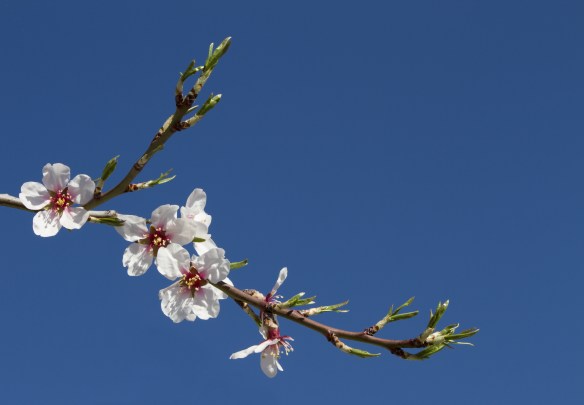
Verse 9 says God touched his lips that day and the Word was put in him. But, what is the comparison with or analogy of 1:11b… “the rod of an almond tree?” almond flowersIn Hebrew history, the almond tree is one of the first trees to “wake up” in the spring and it produces its fruit (nuts) far earlier than do other similar trees. If we went back to Numbers 17 we could get the significance of the rod(s) and almonds. The twelve tribes, each represented by a rod, were bound together. The next day Moses upon entering the Tabernacle saw that Aaron’s rod had sprouted and produced almonds. This was not so of the other 11 rods.

“There is nothing remarkable about a piece of wood with buds, blossoms, or fruit on it. But a piece of dead wood with all these things appearing in one night after sitting in a tent is remarkable. “Miracles in the Bible are often of this sort: natural events in unnatural conditions, timing, and placement.” (Allen)

The leaders of Judah in particular those from the Tribe of Levi and in charge of the Tabernacle at this time would have known the significance of this. Jeremiah was a Levite and a direct descendant of Aaron, the first Levite.

Jeremiah times [https://www.biblicaltraining.org/library/jeremiah-prophet]

Chronology for Jeremiah times (686 B.C.-586 B.C.).

686—Manasseh assumed sole kingship of Judah

– Jewish tradition says that it was during the rule of Manasseh Isaiah was put to death

648—Birth of Josiah, son of Manasseh

642—Amon succeeded Manasseh as king of Judah

640—Josiah succeeded Amon in the line and DNA of King David.

633—Josiah sought after God (2 Chron 34:3)

– Ashurbanipal, king of Assyria died

– Cyaxares became king of Media

628—Josiah began reforms in Judah

627—Jeremiah called to be a prophet

626—Nabopolassar became king of Babylonia

621—book of the law found in the Temple

612—Nineveh destroyed

609—Josiah slain at Megiddo

– Jehoahaz ruled three months

– Jehoiakim enthroned in Jerusalem

605—Babylonians defeated Egyptians at Carchemish

– Daniel, other hostages, and vessels taken to Babylon (Dan 1:1)

– Nebuchadnezzar became king of Babylon

604—Nebuchadnezzar returned to Pal. to receive tribute

601—Nebuchadnezzar defeated near Egypt

598—Jehoiakim’s reign ended

– Jehoiachin ruled from 9 Dec 598 to 16 March 597 and deported 22 April 597.

597—Zedekiah began as king in Judah

588—Siege of Jerusalem began on January 15

587—Jeremiah imprisoned (Jer 32:1, 2)

586—July 18, Zedekiah fled (2 Kings 25:2, 3; Jer 39:4; 52:5-7) Aug. 14, destruction began (2 Kings 25:8-10)

Oct. 7, 586 — Gedaliah slain and Jews migrated to Egypt taking Jeremiah with them but against his will.
The above gives us a great look at other events during the life of Jeremiah. It helps us to put things into historical context and perspective. We might like to know that it is also during the life of Jeremiah King Sennacherib of Assyria sacked Babylon; King Xi of Zhou becomes King of the Zhou Dynasty of China; the Assyria and Egypt were at war; 668 B.C. Nineveh of Jonah fame becomes the largest known city in the world; the Mayan empire of South America was in full swing; Lucius Tarquinius Priscus becomes king of Rome; by 612 B.C. Babylon replaces Nineveh as the largest city of the known world; the Chinese invent printing; 640 B.C. Macedonia of (future) Alexander the Great fame is established as a city-state; the Kingdom of Judah followed Baal including child sacrifice.

God concludes chapter 1 with this promise to Jeremiah…

(ESV) They will fight against you, but they shall not prevail against you, for I am with you, declares the LORD, to deliver you.”miniJim

Jeremiah: The Weeping Prophet

jeremiahHe began his prophecy during the time of the prophet Zephaniah and prophetess Huldah, in the thirteenth year of King Josiah’s reign around 627 B.C. His ministry immediately preceded that of Zephaniah. Habakkuk was a contemporary, as most likely was Obadiah. Since Ezekiel began his ministry in Babylon in 593, he too was a late contemporary of the great prophet in Jerusalem. Jeremiah lived until around 560 B.C. but his prophesying ended with the capture of Jerusalem around 597 B.C. Jewish history tells us he fled or was taken to Egypt. However, Nebuchadnezzar befriended him as he had prophesied NOT to resist since this was a judgment of God.
Jeremiah was probably 20 to 22 years old when God called him. That is quite young for a guy to be called in front of the King of Judah or any high official. He would fit in well with the protests of the college campus students over everything and anything they want to protest per his age grouping. The major difference, Jeremiah was called of God, not some protest group. They protest without answers or solutions. Jeremiah didn’t protests. He simply gave the solution; one the kings of Judah did not want to follow. Jeremiah served as one of God’s prophets through the rule of five kings of Judah; Josiah, Jehoahaz, Jehoiakim, Jehoiachin and Zedekiah. Contemporary prophets during the time of Jeremiah include Zephaniah, Nahum, Habakkuk, Daniel and Ezekiel.

A great timeline website for the deep study bible student, one who enjoys historical knowledge go to http://www.generationword.com/notes/jeremiah/prelim-notes.pdf

He was repeatedly arrested and King Jehoiakim had his prophecies burned after personally shredding them. But, Jeremiah’s scribe Baruch produced new copy.

Jer 1:1-10 – Jeremiah’s call
Jer 7:1-34 – Sermon against the Temple
Jer 16:1-4 – God instructs Jeremiah not to marry
Jer 36:1-32 – Jeremiah’s burned scroll by king Jehoiakim of Judah
Jer 43:1-7 – Jeremiah taken to Egypt (voluntarily or involuntarily is not know)

Jeremiah was born in Anathoth. Other mentions of this village in Jeremiah are found below:

Jeremiah 1:1 The words of Jeremiah the son of Hilkiah, of the priests who were in Anathoth in the land of Benjamin:

Jeremiah 11:21 Therefore thus says Yahweh concerning the men of Anathoth, who seek your life, saying, You shall not prophesy in the name of Yahweh, that you not die by our hand;

Jeremiah 11:23 and there shall be no remnant to them: for I will bring evil on the men of Anathoth, even the year of their visitation.

Jeremiah 29:27 Now therefore, why have you not rebuked Jeremiah of Anathoth, who makes himself a prophet to you,

Jeremiah 32:7 Behold, Hanamel the son of Shallum your uncle shall come to you, saying, Buy my field that is in Anathoth; for the right of redemption is yours to buy it.

Jeremiah 32:8 So Hanamel my uncle’s son came to me in the court of the guard according to the word of Yahweh, and said to me, Please buy my field that is in Anathoth, which is in the land of Benjamin; for the right of inheritance is yours, and the redemption is yours; buy it for yourself. Then I knew that this was the word of Yahweh.

Jeremiah 32:9 I bought the field that was in Anathoth of Hanamel my uncle’s son, and weighed him the money, even seventeen shekels of silver.


ANATHOTH

an’-a-thoth (`anathoth; Anathoth): A town which lay between Michmash and Jerusalem (Isaiah 10:30), in the territory of Benjamin, assigned to the Levites (Joshua 21:18). It was the native place of Abiathar (1 Kings 2:26), and of the prophet Jeremiah (Jeremiah 1:1; Jeremiah 11:21, etc.). Here lay the field which, under remarkable circumstances, the prophet purchased (Jeremiah 32:7). Two of David’s distinguished soldiers, Abiezer (2 Samuel 23:27) and Jehu (1 Chronicles 12:3), also hailed from Anathoth. It was again occupied by the Benjamites after the return from the Exile (Nehemiah 11:32, etc.). It is identified with `Anata, two and a quarter miles Northeast of Jerusalem, a small village of some fifteen houses with remains of ancient walls. There are quarries in the neighborhood from which stones are still carried to Jerusalem. It commands a spacious outlook over the uplands to the North, and especially to the Southeast, over the Jordan valley toward the Dead Sea and the mountains of Moab. There is nothing to shelter it from the withering power of the winds from the eastern deserts (Jeremiah 4:11; Jeremiah 18:17, etc.).  (Wikipedia)


  1. Ewing:
    Jeremiah’s attitude toward the *Deuteronomic reforms of King Josiah of Judah is difficult to assess. Clearly, he would have found much in them with which to agree; a passage in chapter 11 of Jeremiah, in which he is called on by Yahweh to urge adherence to the ancient Covenant upon “the men of Judah and the inhabitants of Jerusalem,” is frequently interpreted as indicating that the prophet traveled around Jerusalem and the villages of Judah exhorting the people to follow the reforms. If this was the case, Jeremiah later became disillusioned with the reforms because they dealt too largely with the externals of religion and not with the inner spirit and ethical conduct of the people. This is not uncommon even in today’s churches.

*Deuteronomists were a school or movement who edited the books of Joshua, Judges, Samuel and Kings into a more or less unified history of Israel (the so-called Deuteronomistic History) during the Jewish exile in Babylon (6th century BCE).[

Jeremiah prophesied not just during the reign of Jehoiakim, but began his prophetic career during the reign of Josiah ramping it up when Jehoiakim came to the throne of Judah. Josiah is seen as a good king. However, Jehoiakim very much disliked Jeremiah and his prophecies per the Kingdom of Judah. King Zedekiah, the son of Jehoiakin, put him in prison and on the run a number of times. He prophesied through the end of the reign of Zedekiah who himself was taken into captivity by the Babylonians. Jeremiah was allowed to remain wherever he wanted as the Babylonians saw him as an okay guy. This attitude was not shared by others in Judah.

It is difficult to discern any structure in Jeremiah, probably because the book had such a long and complex composition history. It can be divided into roughly 6 sections:Book of Jeremiah

  • Chapters 1–25 (The earliest and main core of Jeremiah’s message)
  • Chapters 26–29 (Biographic material and interaction with other prophets)
  • Chapters 30–33 (God’s promise of restoration including Jeremiah’s “new covenant” which is interpreted differently in Judaism than it is in Christianity)
  • Chapters 34–45 (Mostly interaction with Zedekiah and the fall of Jerusalem)
  • Chapters 46–51 (Divine punishment to the nations surrounding Israel)
  • Chapter 52 (Appendix that retells 2 Kings 24.18–25.30)

Jeremiah was active for forty years, from the thirteenth year of Josiah (627 BCE) to the fall of Jerusalem in 587. It is clear from the last chapters of the book, however, that he continued to speak in Egypt after the assassination of Gedaliah, the Babylonian-appointed governor of Judah, in 582. This suggests a theological parallel about Jeremiah comparing him to Moses . Moses spent forty years leading Israel from slavery in Egypt to the Promised Land, Jeremiah’s forty years saw Israel exiled from the land and Jeremiah himself ultimately exiled in Egypt.

Several passages in Jeremiah that can be understood as “confessions or laments;” they occur in the first section of the book (chapters 1–25) and are 11:18–12.6, 15:10–21, 17:14–18, 18:18–23, and 20:7–18. Jeremiah wrote the book of Lament-ations (Lamentations).

The following is a list – not exhaustive – of noteworthy sign-acts found in Jeremiah:

  • Jeremiah 13:1–11 The wearing, burial, and retrieval of a linen waistband.
  • Jeremiah 16:1–9 The shunning of the expected customs of marriage, mourning, and general celebration.
  • Jeremiah 19:1–13 the acquisition of a clay jug and the breaking of said jug in front of the religious leaders of Jerusalem.
  • Jeremiah 27–28 The wearing of an oxen yoke and its subsequent breaking by a false prophet, Hananiah.
  • Jeremiah 32:6-15 The purchase of a field in Anathoth for the price of seventeen silver shekels. A demonstration of Jeremiah’s prophecy of a return to this land.
  • Jeremiah 35:1–19 The offering of wine to the Rechabites, a tribe known for living in tents and refusing to drink wine. This was done in the Temple, which is an important part of the breaking of societal norms.

Nebo-Sarsekim Tablet is a clay cuneiform inscription referring to an official at the court of Nebuchadnezzar II, king of Babylon. It may also refer to an official named in the Biblical Book of Jeremiah.

It is currently in the collection of the British Museum. Dated to 595 BC, the tablet was part of an archive from a large sun-worship temple at Sippar. Archaeologists unearthed the tablet in the ancient city of Sippar (about a mile from modern Baghdad) in the 1870s. The tablet is dated just eight years before the events in Jeremiah. According to Jursa, the rarity of the Babylonian name, the high rank of the rab ša-rēši and the close proximity in time make it almost certain that the person mentioned on the tablet is identical with the biblical figure.

No one knows for sure how Jeremiah died. Some think he was stoned to death while in Egypt and by his own people. Some connect him with the British Isles. Some say he returned to Judah to possess the lands he purchased as stated in Jeremiah 32.

His book that bears his name is full of ancient and modern advice about the human character, our mind, and being close to God. Even though he never married he often gives examples of Israel (a wife) and her relationship with her husband (God). It might be wise here to point out to the reader that in Old Testament times God declared himself as the father of Israel. In the New Testament Jesus makes this claim over the church; bride and bride-groom. For those confused by these two seemingly at-odds statements read within this website our lessons on Daniel and Revelation. For those who want the short of it, Daniel 2:4 states: “In the time of those kings, the God of heaven will set up a kingdom that will never be destroyed, nor will it be left to another people. It will crush all those kingdoms and bring them to an end, but it will itself endure forever.”

Revelation 19:16 brings Jesus to the forefront of this kingdom mentioned by Daniel. It reads: On his [Jesus’] robe and on his thigh he has this name written: king of kings and lord of lords.”

Add Revelation 19:6c and 21:3 to this understanding we find in 19:6… “For the Lord our GOD the Almighty reigns.” Then in 21:3 we read: “…the Lord our GOD will live with them. God himself will be with them.”

Jeremiah knew this but Israel continually refused to honor the covenants made between God and them as a separate people. Jesus covenants with the church, although they differ from God’s covenants with Israel, lead to the same conclusion and singular kingdom on earth.  Much of what Daniel studied in his years and lifetime in Babylon was the writings of Jeremiah. It will do us as students of the Word to do the same thing.miniJim


+———————-++++++++++++++++++++++

In Search of Purpose

Young people today are looking for their purpose in life. The world offers external stimuli that caters to the feelings and emotions of the younger generation. The Rev Paul Hoffmasterproblem with the secular approach is the ever changing satisfaction level of the recipient. When the level of acceptance begins to diminish, something new and exciting must be offered to fend off complacency. The world strives to feed the hungry seekers with high energy experiences that it hopes will fill the void in their lives. The problem with these approaches is they are temporary and ever changing. Apologist Ravi Zacharias once said, “People listen with their eyes and think with their feelings.” So many people are influenced by what they read and hear. Whatever goes through the air waves seems to carry an hypnotic affect on the hearers. If it is presented through the media outlets, many believe it must be right. Television and its cohorts, the news, and social media, all carry an invitation to experience truth through opinionated editorials. The evidence of this is the post election exchanges. To hear people’s reactions to the election evidences the biased rhetoric they have adopted from their selected sources. Young people are swayed to a large degree by what they see and hear. The world’s invitation to personal fulfillment is only a temporary fix to a permanent need.

What is the Church doing to counter the world’s offers? What can the Church do to attract young people from the wilderness of endless wanderings? Young people are looking for honesty, truthfulness, and integrity. They are tired of trying different things that continue to change seasonally. Young people listen to what they see and if it doesn’t fulfill their void, they will reject it for something else. Since the Church is made up of people, the younger generation will judge the validity of its claim by Christians themselves. If they see hypocrisy, they will dismiss the Church as just another movement that is trying to enlist their involvement. The Church is failing to understand what the younger generation is saying.

The Church seems to be caught up in the world’s methodology. Music is changed to cater to the emotions of the hearers. If you were to take the words out of Christian contemporary music, you could not tell the difference from the world’s music. Many churches are having two Sunday morning services; one a traditional worship, the other a contemporary gathering. Instead of keeping the unity of the Believers, there is a division. Family worship was just that, but today many young people never sit with their parents due to competing services or programs. One local church advertised a second service with an invitation that if they felt uncomfortable with worshiping in their sanctuary, they could come to their alternate service that meets in their gym. Pastors are shedding their suits and ties for jeans and sandals. The efforts that the Church is taking to reach the unchurched is meeting with little or no success. Yet the Church charges on with the hope that somehow they will find an answer for numerical growth.

The biggest problem facing the Church today is Christians who are not complementing Biblical teachings. It is not the type of worship that draws people to the Church, it is the One whom we promote. The younger generation wants unfaltering Truth. The kind of Truth that will set them free! They don’t want a cleaned up worldly approach. They want Truth with integrity.

In these changing times, it is not time for the Church to change from what has worked for generations. It is the proclaimed Word, not the logistics that makes the difference. It seems we sing “more like the world, we shall ever be,” instead of singing, “more like the Master I will ever be.” When we stay faithful to His Word, God will add to the Church! 

The Unpardonable Sin


  • Unpardonable sin…

    This means once committed it is not pardonable! Not now; not later; not ever. Satan are you listening?

    One of the most often asked questions is what is the unpardonable sin? What is blasphemy? Let’s take a look at what scripture tells us per these questions. However, it must be emphasized that if one is busy following Jesus and worshiping God, there is no chance of committing the unpardonable sin. Here are three synoptic gospel verses to consider.

    Jesus is the one making these statements:

    Therefore I say to you, every sin and blasphemy will be forgiven men, but the blasphemy against the Spirit will not be forgiven men. Anyone who speaks a word against the Son of Man, it will be forgiven him; but whoever speaks against the Holy Spirit, it will not be forgiven him, either in this age or in the age to come (Matthew 12:31-32).

    Assuredly, I say to you, all sins will be forgiven the sons of men, and whatever blasphemies they may utter; but he who blasphemes against the Holy Spirit never has forgiveness, but is subject to eternal condemnation—because they said, “He has an unclean spirit” (Mark 3:28-30).

    And anyone who speaks a word against the Son of Man, it will be forgiven him; but to him who blasphemes against the Holy Spirit, it will not be forgiven (Luke 12:10).

    Now let’s also include from our website Revelation Study the same word… “blasphemy.” Revelation 17:3 states, in part “…and I saw a woman sitting on a scarlet beast that was full of blasphemous names…” Wikipedia defines it as Blasphemy is the act of insulting or showing contempt or lack of reverence to a deity…” It is a deliberate act on one’s part.

    Insulting; showing contempt; a lack of reverence? There goes the excuse of the one who says s/he is neutral per believing in a saving God and committing to Jesus. The blasphemy is found in the words, “lack of reverence.” Insulting and/or showing contempt are overt and obvious acts. But included in this definition is the simple act of not showing reverence; i.e. trying to be neutral, open minded or politically correct no matter what is the truth.

    Example: One knows that stealing is a crime. When one does not violate the law or simply does not get caught, they are not issued a penalty for their actions. When it comes to God, there is no such thing as “not getting caught” so that one does not fit in this situation. However, stealing is punishable. This is true even if up to this point it is the very first time one steals; i.e. a deliberate act on or one’s part or showing a lack of reverence for the law.

    Including the word “CONTEMPT” per the above definition adds to problem. It means getting caught and still showing contempt for the justice system and the law. A personal choice has been made. God is gracious in telling us in the above scriptures that such is forgivable if done against the son of God, Jesus. However, no such contempt against the Holy Spirit is forgivable. Just as in stealing, one made a choice and did the deed. The same is true of God the Holy Spirit. To reject him or turn ones back on him in a deliberate act is unforgivable. This is precisely why Satan does not have a choice to seek forgiveness and make everything alright between him and God. He showed contempt and there is no turning back or forgiveness.

    I recall a bible study where the instructor asked the question, “If Satan sought forgiveness, would God’s love be extended to him and forgive him.” There was great silence in the room as no one wanted to risk the fact that they believe God Is (only) Love. That statement alone, “God is Love,” is very misleading just as declaring the bible is full of stories. Stories may be true, but also may be just stories. It is very misleading to identify the Bible content as anything but history. Two books I have read include a History of the Civil War in America and “StoriesFrom the Civil War. The latter was qualified as unverified but still interesting as a read.  The author of this second book stated: “inside every story is often found a thread of truth.” A thread of truth????? What about Bible stories???? This is a gross misuse of Bible history when one relegates it to a book full of stories.

    Now back to the unpardonable sin focus of this article. None of the verses in our opening quotes from Matthew, Mark and Luke have a qualification. Satan has already done it. The Harlot (institution) will do it. The world has received the gospel of salvation but to reject it by NOT accepting God’s Provided Salvation (spiritual GPS) is akin to rejecting the civil statute of stealing. Once committed it is a done deal. There is and will be a price to pay.

    Nothing is said per who does the blasphemy or contempt. It remains a very loving and assuring statement to realize we can blaspheme Jesus or the Father God and it will be forgiven us. But rejecting, a deliberate act or not or no longer accepting HIM as holy is blasphemy. Notice in Matthew 12 that Jesus has just declared that a kingdom divided against itself (casting out demons in the name of Beelzebub) cannot stand. Without going into the detail of this history found in Matthew 12, anyone at any time can commit the one unforgivable sin. The only qualifier is one’s vocalization or demonstration of contempt for and/or claiming the Holy Spirit to be an unclean or non-existent spirit.

    So, can one lose his salvation? No! Can one surrender his salvation? Yes!

    Hebrews 13:5 “Keep your lives free from the love of money and be content with what you have, because God has said, Never will I leave you; never will I forsake you.” [NIV]

    Deuteronomy 31: 6 “Be strong and courageous. Do not be afraid or terrified because of them, for the LORD your God goes with you; he will never leave you nor forsake you.”

    However, three passages in the New Testament say, blasphemy of the Holy Spirit will not be forgiven. Satan is already condemned but was once an angel of light in heaven. God will not forsake us, but we can at any time forsake His Spirit.

    Truth Text Red Black BurstFor the purpose of the series thinker, Let me add an after-thought. John 4:23, 24 states, “…a time is coming and has now come when the true worshipers will worship the Father in the Spirit and in truth, for they are the kind of worshipers the Father seeks. God is spirit, and his worshipers must worship in the Spirit and in truth” [NIV].

    miniJimJstark
    November 1, 2016


Faith With Secular Evidence

Faith is the flag ship of the Christian movement.  Faith is believing and seeing the reality of God’s Kingdom without the benefit of any “outside stimuli.”  Faith left to itself is Rev Paul Hoffmastersimply a word in the dictionary.  The faith that is exhibited by Believers today is more like hope, which Webster defines as “A feeling that what is wanted will happen.”  This secular definition of hope is what has been substituted by Believers for faith.  Many believe that feelings will not only jump start their faith, but will also give them the help they need in fulfilling their hopeful desires.  Feelings tend to dilute faith.  All of us have been propelled and decelerated by feelings.  Feelings tend to decide how we respond to life.  “I don’t feel like going to church today.”  “I don’t feel like reading my Bible.”  “I don’t feel like praying,” etc…  Feeling is the antidote to faith.  When Believers use feelings to nudge along their faith, they will experience limited spiritual accomplishments.  So many Christians limit their faith by their feelings.  They will take a Scripture and initially accept its intent, but as time passes and the Word does not seem to work in their lives, they begin to question whether they correctly understood the verses.  The “can of feelings” opens and everything from sadness, disappointment, depression, anger, and confusion push against the truthful reality of God’s Word.

Faith rests in the integrity of the Scriptures.  God means what He says and says what He means.  There is no need for secular evidence or prompting by feelings to bring about the reality of God’s Word.  What is needed is faith upon faith, faith to believe in faith.  We must have faith that the Bible is the Word of God, and faith to believe the fulfillment of the Word.  A Syrophenician woman came to Jesus to seek healing for her daughter.  After a challenging statement from Jesus and her response, she left for her home with faith in His words that her daughter was delivered. (Mark 7:25-30)  Feelings had nothing to do with her faith.  She simply believed and responded in faith.  I can imagine that as she returned home, she walked with a confidence that was not attached to feelings, but with an assurance that her daughter was healed.

A Christian must never allow feelings to interfere with their faithful obedience.  There should never be a time when feelings determine the degree of one’s faith.  Feelings can compliment faith, but never question faith.  Whenever feelings dominate our reaction to the Word, the Word will be limited in its action.  A number of times, Jesus confronted His disciples for not exhibiting faith.  The reason for their faithless behavior was they were operating on feelings and emotions.  On the Sea of Galilee, they saw the boisterous waves and wind and feared for their lives.  Feelings snuffed out their faith. (Matthew 8:23-27)  When are we going to stop letting feelings challenge our faith?  Feelings should be subject to the Word, not the Word subject to our feelings.  One of my favorite songs is, “The Word Is Working Mightily In Me.”  David Ingles composed this little tune that simply says, “No matter what I feel or see, the Word is working mightily in me.”  The Word takes precedence over every emotion or feeling that our mind wants to exhibit.  We don’t need any evidence to help secure our faith.  Faith is simply believing and acting on what God says, no matter what our eyes and emotions tell us!

Revelation Chapter 22

Chapter 22 (“It Is Done” says God)

Having carried his description of Satan’s destiny and the resurrection of unbelievers to miniJimtheir conclusions in chapter 20, John now returns to the beginning of the Millennium to describe the new home of the Church in chapter 21 and the new Heaven and Earth in chapter 22 [Jack Kelly; https://gracethrufaith.com/the-book-of-revelation/revelation-21-22/#more-314].

We should keep in mind that when discussing the harlot, the Great City of Babylon and the dragon [in some senses], we are discussing political, economic, and religious institutions; each distinct. There are three different positions from which to study these three involved factors. Each of the three is connected to one another one way or another but each of these three institutions has their individual destructions; i.e. the kings and rulers; the great wealth and economies through Babylon, the merchants and those made wealthy because of her; the false prophet and false religious institution.

EXAMPLE: In chapter 17 we have the religious aspect of these three institutions: the harlot, Great City of Babylon (by name only) and the multi-horned/headed dragon. In chapter 18 we probably have the political and economic factors. Babylon is not only a false religious system but one of political impact and economies.

Word cloud for Events of RevelationIn a very real sense, chapter 20 sets the stage for the binding of Satan, the thousand year millennial reign of God and His son Jesus, the New Jerusalem and the eventual new heaven and new earth. We also find the Great White Throne judgment of those who have died in the past “since the creation of earth.”
Verse 1-5 in Revelation 22 is distinct as is Ezekiel 47:1-12 but similar in context. Chapter 21 is also a distinct point in time. We can find the WHEN by reading verses within each reference. All are end time issues. The Ezekiel passage is the millennial reign as is Revelation 20 from the binding of Satan to his release and judgment. Revelation 21:1 explains this is the New Earth and New Heaven “for the old [first] heaven and earth are passed away” [Revelation 20:11].

John is instructed to write out what he has seen and heard. Do not keep it a secret [Revelation 21:5b]. Daniel was told to NOT write all that he had seen and heard for it was for another time in history yet to be played out.  This is probably what Daniel also saw in Old Testament time. The Apostle Paul is post crucifixion and New Testament.

It is likely that Revelation 22:2, which talks about twelve manners of fruit cannot be the new Heaven and Earth. Why? Eternity by definition means there is no longer “time.” As one person (originator unknown) put it some time ago… eternity is the total absence of time. There is also no longer a need to heal nations after the Great White Throne judgment at the end of the Millennial Kingdom. We don’t know if such will still exist after the white throne judgment.

Revelation 22:5 skips ahead in its own time capsule; “..and there shall be no more night.” This suggests that since there is no distinction between a day time hour and a night time hour; there must no longer be anything called TIME. Although much of Revelation is sequential or “at the same time” reports by John, he sometimes follows a given topic through to its end before returning to the concurrent or chronological events.

A most likely scenario is that twelve manner of fruits [22:2] is during the Millennial Reign itself. We do not understand what is on the other side of the wall dividing current earth and heavens and when eternity, which by default means time does not exist, begins. We do know from chapter 21 that tears are no longer, there is no more death or sorrow, hell and hades are cast into the lake of Fire…

In a simple way, chapter 22 of Revelation is God putting his stamp of finality on his initial plan for man from the creation of earth, that is, the Garden of Eden. John is told a second time, now by an angel in 22:9 & 10 that he is not to keep this information and prophecies to himself. We read in the verses following 9 & 10 that the world will continue to be as it has since the fall of Adam and Eve up to the point of Jesus Christ and God’s “living amongst us” [21:3].

When Christ does return the second time he will bring his rewards with him. This is a point needing clarification. The Greek for the word reward (misthos) can mean a good thing or a bad thing; i.e. everyone’s JUST reward for what s/he has done during his or her life on earth [v12]. God again points out that He is the Alpha and Omega, the beginning and the end, the first and the last [v13].

In verse 14 we must go back to the only other times the Tree of Life is mentioned:  Genesis 2:9; 3:22; 3:24 and once again in Revelation 22:14. We begin in the bible with the Tree of Life and no one being able to pick its fruit and eat of it to that restriction being removed in Revelation 22. “Those who do his commandments have right to the tree of life.”  In some way of thinking, God will re-institute the Garden of Eden without the ability of Satan to again interfere of influence whose occupying it.

With verse 16 it is not John talking. It is Jesus himself authenticating the truths and correctness of the Book of Revelation. Jesus is declaring his position as a descendant of King David per his physical birth and right to the throne. He also has another right that is found in John 1…

Joh 1:1  In the beginning was the Word, and the Word was with God, and the Word was God.

Joh 1:2  He was in the beginning with God.

Joh 1:3  All things were made through him, and without him was not any thing made that was made.

Joh 1:4  In him was life, and the life was the light of men.

Joh 1:5  The light shines in the darkness, and the darkness has not overcome it.


jesusJesus is the word; Jesus is God.


Can we lose our salvation? This is addressed in a backhanded way in the one of the final verses of the bible; i.e. 22:19…


“…if anyone takes away from the words of the book of this prophecy, God will take away his share in the tree of life and in the holy city, which are described in this book.”


One can only take away something that the losing individual originally had, right?


Jstark (M.M., Th.D. Rev.; ordained unaffiliated)

The Fourth Commandment

Across America, Believers are resurrecting the exhibiting of lawnRev Paul Hoffmaster signs that depict the Ten Commandments.  What they hope to achieve can only be interpreted as a conscientious response to activating their Christian duty.  Bringing awareness to Biblical principles may identify one as a Christian, but does little to influence others into seeking a hunger for the things of God.

Believers emphatically believe that the Ten Commandments are the basis for social justice.  It is through obedience to these laws that the Sermon on the Mount can build Christian character.  If we promote the Ten Commandments, we are obligated to affirm all of them through our actions.  A problem seems to arise when the Fourth Commandment calls us to an action that is hard to justify by the Church.  “REMEMBER THE SABBATH DAY TO KEEP IT HOLY.”  There is very little, if any, wiggle room to try to adjust or substitute a word for the Sabbath.  The observance of the Sabbath was to be perpetual, which means everlasting and never ending.  (Exodus 31:16)  What the Church tries to do is substitute the “Lord’s Day” for the Sabbath.  It is true the New Testament church did meet on the first day of the week to worship through the sharing of the Word, Communion, and fellowship, but that was not the purpose of the Sabbath.  It was to be a day of separation from the world.  It was a time to cease from the grind of six days and to rest in the Truths of God’s Word.  It was a time to shut out the world and its pollutants.  It was a time of worshipping God with spirit, soul, and body.  It was a time for renewal and spiritual reflection.  Jesus stated that the Sabbath was made for man, not man for the Sabbath. (Mark 2:27)   What a gift God gave us, and yet we lose its blessing by diluting God’s intention.  We attempt to have the Lord’s Day be our Sabbath.  The problem is we think by going to church we have honored the intent of the Fourth Commandment.  In fact, if we take out Sunday worship, there is really no difference from any other day.    If we are going to substitute the Lord’s Day for the Sabbath, we must also be dedicated to keeping it Holy!

I remember years ago, as a young boy, my parents would not even let me change out of my church clothes. (People use to dress up to go the church, but today we dress down as we worship our God!)  I could not go out and play baseball.  My parents made sure we had enough food in the house so we did not need to go to the store.  Many stores were closed on this special day.  We would share the Word together and pray as a family.  There was also a time for a nap.  The day wrapped up by going to church in the evening. (It is very difficult today to find churches with Sunday night services.)  By Monday morning, we were ready for the challenges of the week.

The argument of Saturday or Sunday as the Biblical day for the Sabbath has long been the focal point of division.  It has even come to the point of birthing new denominations.  Straining over the actual day of Holiness has dwarfed the intent of the Fourth Commandment.  One day of the week is to be set aside for the renewing of our body, soul, and spirit.  If we want that day to be Sunday, then let it be.  We must be certain that whatever that day is, it is totally dedicated to God.  When we fail to keep any of His commandments and try to teach others the insignificance of any of His teachings, we will be called “least in the kingdom of heaven.” (Matthew 5:19)  Many Believers claim this Fourth Commandment pertains only to the Jewish people.  If we want to be completely truthful, all the Commandments were for the Jews because the Church had not yet been conceived.  Yet, the Ten Commandments have a place in the Church today, and all we have to do is let the Holy Spirit guide us into the application of not only the Commandments, but all the teachings in the Old Testament.  Instead of looking for loop holes in Scriptural principles, let us simply obey what God says.  Is it that difficult to set aside a day, different from all other days, to focus on Him and to honor Him?  May our Sabbath be a day that prepares us for the challenges of the upcoming week.  Let us rest in the Lord that we may serve Him in the days ahead!

Revelation Chapter 21

The last book of the Bible - RevelationsWe are about to conclude our look at and study of the Book of Revelation. Other than the first three chapters it is all about Israel and those who live in and during the tribulation 7 years. It will be good for us to recall a few things about Israel.

Every conflict in or around Israel is not THE [Revelation] SIGN of End Time. There has been conflict in the Middle East and especially with Israel since recorded history. The only time on can point to a semi-peaceful time in Israel was BEFORE King Saul. For 400 years the 12 Tribes lived within their own territories and only joined forces when an outside force caused problems or attacked one of the other tribal territories. But, even during the time of the Judges there was trouble, wars and in some instances, inter/intra-tribal conflict. We do not wish to get off topic so here are a few reminders of Israel and End Time: [God’s covenants with Israel are FOR ISRAEL and will be fulfilled to the letter]

  1. There will be a mass return of Jews to the land of Israel (Deuteronomy 30:3; Isaiah 43:6; Ezekiel 34:11-13; 36:24; 37:1-14).
  2. The Antichrist will make a 7-year covenant of “peace” with Israel (Isaiah 28:18; Daniel 9:27)… but will violate it at the 3 ½ year point (Daniel 9:27)
  3. The temple will be rebuilt in Jerusalem (Daniel 9:27; Matthew 24:15; 2 Thessalonians 2:3-4; Revelation 11:1).
  4. The Antichrist will break his covenant with Israel, and worldwide persecution of Israel will result (Daniel 9:27; 12:1, 11; Zechariah 11:16; Matthew 24:15, 21; Revelation 12:13). Israel will be invaded (Ezekiel chapters 38-39).
  5. Israel will finally recognize Jesus as their Messiah (Zechariah 12:10). Israel will be regenerated, restored, and regathered (Jeremiah 33:8; Ezekiel 11:17; Romans 11:26).
  6. James 1:1 “… To God’s people who are scattered all over the world” [ERV].
  7. Genesis 32:12 “…and they (Israelis’) will be as the sands of the sea.” This means there will be so many of Israeli DNA in so many different places no one will be able to count them. One reason is that millions of these people do not know they are DNA of Israel. Yes, truly lost in annals of time that is no more.

Jeremiah wrote: The LORD says, “At that time [End Time Tribulation or beginning of the Millennial Reign] the people of Israel and the people of Judah will be together…once again. The dispersions of the Northern Kingdom was in 722 B.C., and the Southern Kingdom, 597 B.C.). They will cry and cry together, and together, they will go look for the LORD their God.”  (Jeremiah 50:4-5).

Ezekiel as does Isaiah has much to say about the same thing. What God reveals to him is miniJimwhat is going to happen during the return of Jesus Christ to Jerusalem by setting foot on the Mount of Olives. God says (not Jesus) that He will join the two sticks of Judah and Israel.

“Surely I will take the stick of Joseph, which is in the hand of Ephraim and the tribes of Israel, his companions; and I will join them with it, with the stick of Judah, and make them one stick…” [Ezekiel 37:19; NKJV]
In Revelation 21 we get a glimpse of the New Heaven and the New Earth through the eyes of the Apostle John. Recall that the first heavens (the skies above) and earth flee from the presents of God in our previous blog (Chapter 20:11 & 21:1). Judgement has come and these created elements flee their creator.

This brings to mind Philippians 2:10… “… at the name of Jesus every knee shall bow, in heaven, on earth AND UNDER THE EARTH.” Even the fallen angels (demons; servants of Lucifer) will bow a knee. Can we even imagine this? It is the pinnacle example of the word TOTAL.

The New Jerusalem descends from Heaven and “Now God’s home is with [the, among] His people. He will live with them…” Verses 3 and 4 of Revelation 20 summarize it for us. No more pain, death, sorrow, tears, regrets, all of the old is no-more. God says that he will make EVERYTHING NEW. The Greek for all or everything is pas. It means “totally inclusive. No exceptions.” Then, the most famous of statements; reminiscent of what Jesus said on the cross when he gave up his spirit, God himself says in verse 6 of Revelation 21… “IT IS DONE!”  What God created in the beginning, the Alpha, is now the Omega; the end. All things will be new. We are given a very small glimpse of the new. Whatever it is, it didn’t exist prior to this moment. This also means that “TIME” as created back in Genesis 1:5 is no longer. This is the definition of eternity. Time is not a factor as it no longer exists. We will see this in chapter 22; our final blog on Revelation.

People often miss the fact that all this happens after the Tribulation, the Millennial Reign of Jesus and God, the Great White Throne Judgment, and the Battle of Gog/Magog when Satan is released for a short time.  John does not record nor is there any evidence that he has a glimpse of what is on the other side of the wall separating the old creation and the beginning of the ALL NEW. John simply tells us it is all new and only the faithful, chosen, redeemed and Saints will be there. During the Millennial Reign there will still be those who reject the rule of Jesus. Satan will call on these people for his Gog-Magog war against Jerusalem after the Millennial Reign.

Verse 7 is very telling: He who overcomes will inherit all things, and I will be his God, and he will be my son. The faithful, chosen, redeemed and Saints will:

  1. Inherit all things…
  2. God will be their (father because)…
  3. They will be his sons (children)

What happens to the rest of the judged? Verse 8 is quite clear on this matter; i.e. the second death and lake of brimstone.

V9: One of the seven angels who had [take note as this is past tense… *had] one of the 7 bowls or vials of judgment (plagues) comes to John to give him additional insight. This time it is something good. John is going to see “the bride, the Lamb’s wife.” We must once again note why we believe Revelation, after the first three chapters, is mostly about Israel. John is shown the bride of Christ; i.e. the New Jerusalem descending from and going to a place not mentioned. We can easily figure this to be located on the new Earth. Verses 12-14 are all related to Israeli identifications. After all, this is the New Jerusalem so it is Israelites who occupy it and probably those Christians who have been grafted in per Romans 11:17.

*This means that each of the 7 bowls of judgment are now empty; judgment done.

The New Jerusalem [v10] John sees descending from heaven is given exact measurements (1,400 miles in length, width and height). For more detail go to http://www.tourofheaven.com/eternal/new-jerusalem/size.aspx

Verse 21 is where we find the description of the streets paved with gold. The description of the New Jerusalem is not the entirety of the new earth. What John sees is only Jerusalem that descends from heaven (v10). We are not given any additional information as far as what the rest of the New Earth looks like; just the new Jerusalem. But we do know that more than the New Jerusalem exists. Verses 24 tells us:

“And the nations of them that are saved shall walk in the light of it: and the kings of the earth bring their glory into it.” [KJV]

There is some form of “nations” that will receive their light from the glory of Jesus and God residing in the New Jerusalem. We find this “light” described in V23; “…for the glory of God did lighten it, and the lamb is the light thereof” [KJV].

Verse 25 tells us that the night and day created back in Genesis 1:5 is no more. This verse tells us that “there shall be no night there.” The closure of verse 27 in Revelation 21 is very clear as to who will and who will not be part of this “new everything.”

written.jpgThe only ones who will enter into this new creation will be those whose names are written in the Lamb’s “book of life.” The names are entered when one receives and accepts Jesus as his or her Lord and Savior. We demonstrate our faith in our actions, prayer, and bible study life. Being a Christian is a life style, not a religion.

Final word of caution to those who think Christianity is a religion and God is only love, not just(ice). Revelation 3:5

He who is overcoming–this one–shall be arrayed in white garments, and I will not blot out his name from the scroll of the life, and I will confess his name before my Father, and before His messengers.

Are you overcoming and making Christ the center of your life thus overcoming? If not, then pay very close attention to the condition for NOT BEING BLOTTED OUT of the Book of Life. [I John 2:19; Hebrews 3:12; Mark 13:13; Exodus 32:32,33; Psalm 69:28]


Revelation – Chapter 20

There is plenty to discuss in this short chapter but as usual, we will take the approach of Dr. jStarkidentifying or defining the significant and major points made by the Apostle John. Revelation 20, 21, and 22 could easily fall in sub captions of 1) the fall of the dragon (Satan), 2) The new Heaven, and 3) The New Earth; a closing well deserving our attention.

A Revelation 20 outline subhead form looks like this:

  1. Millennial or statement per the thousand years,
  2. Satan’s final judgment,
  3. The Great White Throne judgment of those resurrected to face their eternal decision on earth while alive.

We could add the Battle of Gog and Magog along with the Lake of Fire but these will fall into our discussion of the above outline of a, b, & c.  In chapter 19 many theologians and commentators would identify as Armageddon and chapter 20 as the Battle of Gog/Magog. Either way, keep in mind that both battles follow the 7-year Tribulation. Yes, there will be wars and rumors of wars [Matthew 24:6] but these lead us up to and into the Great Tribulation. Satan is alive and well and can cause such destruction that Jesus has to return to the earth less there are no humans left alive [Matthew 24:22].

Hosea the prophet clearly tells us that the latter days are a specific time when the Tribes of Israel will return to the State of Israel. They are dispersed throughout the world; the four corners of the earth. [Isaiah 11:12]. However, Israel today is mostly those descended from the Tribe of Judah. They are the New Testament Jews who crucified Jesus. “Jews” descended from those who were exiled for 70 years in Babylon. Only a very small remnant returned. There has yet to be a massive return of Israelites from the other 11 tribes. We mistakenly try to identify the Jew as all-inclusive of Israelites. In the first five books of the Bible [written by Moses] he never Identifies Israelis as Jews. The word Jew is the Anglo-Saxon/Greek version of Judah or from the country or territory of Judah; the predominant people in Jerusalem at the time of Jesus Christ on earth. [https://en.wikipedia.org/wiki/Jew_(word)]

The sequence so far is: Church Rapture – 3 ½ Tribulation plus 3 ½ years of Great Tribulation – The return of Jesus to the Mount of Olives – the earth shudders, shakes and divides along natural fault lines (including the one geologists say goes right through the center of the Mount of Olives – Armageddon – the beast and false prophet captured, judged, and thrown into the Lake of Fire – birds of the wild feast on the dead the dead 200 million man combined army in Har Megiddo 55 miles north of Jerusalem who try to attack Jerusalem – THEN CHAPTER 20: the beginning of the Millennial Reign of Jesus Christ on the Throne of David in Jerusalem.

This is the point at which one can get distracted by or caught up in the theological positions of a-millennialism [no millennium], postmillennialism [all after the fact including Christ’s return; the power of the church binds Satan not the angel from heaven], and premillennialism [the position of this website since it makes most sense without drawing at straws or spiritualizing factual scripture throughout the Bible]. We are deliberately side-stepping the minor disagreements between the classical and the dispensational premillennialists; both for the sake of the reader of this blog and its authorJ.
A lengthy but good discussion on Revelation 20 can be found at: http://www.centralbaptist1873.org/downloads/revelation/Outline%20for%20Revelation%2020.pdf.  Not yet studied by us, website blog appears to be solid.

We won’t get into the theories of what the key or chain may represent in verse one. The bottom line: this angel has the power to grab, hold, restrain, and bind Satan in such a manner as his personal powers are useless to either escape or to any longer influence the peoples and nations of this world. Powerless until the thousand year millennium is over. One might ask as we addressed in the previous blog, “why must Satan be released even if it is but for a short time after the millennial reign of Jesus and God?”

Good question. The answer is hidden in plain sight. If Satan is able to assemble a huge army after the thousand years of “iron scepter” (Revelation 2:27; Psalms 2:9; Revelation 12:5) rule of Jesus, it is obvious there are still those who do not Love or Accept Jesus as his or her Savior or King. Satan’s last stand (phrase borrowed from Custer’s Last Stand) will be judged. Satan first, then the books (plural) are opened and each person is judged according to his or her deeds; i.e. different levels of eternity in Hell (?).

Taking a slight step backward, be mindful that Jerusalem is the bride of God (O.T.) just as the church is the bride of Jesus Christ (N.T.). Let me borrow a quote from:  http://tedmontgomery.com/bblovrvw/emails/thewoman.html

The Church did not “replace” Israel; rather, it was grafted into Israel. At a future time, Israel (Zion) will receive all of the blessings promised to her millennia ago by God (Isaiah 45:17, 51:2,3,16; Jeremiah 50:4,5; Ezekiel 36:1–37:28). Also, the “woman” does not represent only Jews, who are descendants of Judah, since they are only one of the twelve tribes of Israel. (Read Revelation 11 once again or revisit the blogs in this website of Revelation 11, 12, 13, and 14)

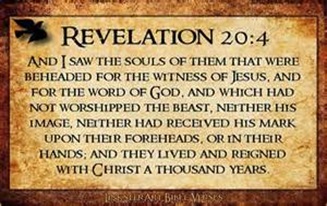
Verse 4 of C20 is significant:revelation-20

(paraphrased) The souls (not bodies) of those beheaded, who had not worshiped the beast, his image, or taken the mark of the beast. These must be the Christians martyred DURING the tribulation and probably the voices of those “souls” heard under the Throne (Revelation 6:9) asking for justice (Revelation 6:10).

This, as hinted to in Revelation 6:11 and as previously discussed in this series of Revelation blogs, could be one of the two 144,000 mentioned in Revelation 7:4 and again Revelation 14:1-5. It matters little as to if separate or different groups of 144,000 per Revelation 20:4. Those who die, for their witness of Jesus Christ during the Tribulation, will “Live and reign with Messiah (Christ) a thousand years.” (Also read Isaiah 51:11)

However, verse 6 should not be overlooked per a resurrection. This can get to be sticky theological detail here but here is the quick kick of it all. Being that if there is a pretribulation rapture, those who are the bride or church of Jesus Christ are already gone; i.e. Rapture. Those who die for their witness during the Tribulation are resurrected in verse 4.

Easy answer to the obvious question… who is left on earth before this resurrection? Answer: those who rejected God (O.T.) or reject Jesus (N.T.). This is how we get the first and the second resurrection. The dead in God/Christ are resurrected for the Millennial Reign. Recall from previous blogs in this study that millions have died by now via Satan’s effort to destroy mankind. Millions have also died at Armageddon; Tribulation ended. We calculate that between 1/3 and ½ of the world’s population have died within a short period of time. Then Gog and Magog deaths. No problem with overcrowding on earth.

The second resurrection is those who died without God or Christ. This is the Great White Throne judgment and capacity is no problem since “the heavens [sky] and earth flee the presents of God.” We see this verse in Revelation 20:11. But first let’s not skip some important discussion beginning in verse 7; i.e. Satan’s final judgment.

If unbelievers are wrong and chapter 20 is right, they have a serious and eternal problem of resurrection, judgment, and Hell. If I am wrong as a believer, then I will simply die like the rest of the world’s population; past and present. You decide but there are only two options. Reject Christ and possibly be wrong and the judgment correct, or accept Christ and be safe regardless of end time. Being a believer is not a safety net; it is a life style!

As already mentioned, Satan is bound a thousand years. When released, he raises an army the sized or “like the sand on the seashore; [then] march the breadth of the earth, surround Jerusalem [V9c], but never get to fight. They are devoured by fire from heaven… only to be raised in judgment in the second resurrection shortly thereafter. They see a second death; one of eternal punishment. I have been asked many times; what might Hell be likened to? My best guess is like the fire or burning of a deep-rooted hate, or lust for something one cannot get or get over. This feeling will be stamped into one’s mind to the power of ten, never to leave or be replaced by another thought while camping out at the lake of fire.

In verse 10 we are reminded that the beast (anti-Christ) and his false prophet are already in the Lake of Sulfur waiting for their cherished and loving Satan (pun intended) with very warm and open arms of welcome. Thanks for joining us you devil!!!!!! The beast and false prophet have already been there a 1,000 years. That is plenty of time to develop a very warm welcome for their master deceiver… Satan.

Finally, chapter 20 closes on the subject of the Great White Throne Judgment. We previously discussed some of this but allow us to point to or remind the reader-student the exposé of a few additional facts.

  1. The earth and sky flee from the presents of “him who is seated on the throne.”
  2. The dead resurrected, small and great, stand before the Great White Throne.
  3. The BOOKS are opened; books that have recorded his and her life and deeds while on earth. This opens up the possibilities of greater or lesser punishments but does not eliminate the fact of a judgment.
  4. Another book (singular) is opened and those whose names are written in the [Lamb’s] Book of Life are given life with God (trinity). These are possibly those who are still alive on earth but repent of their sin before the judgment day of reckoning. (emphasis mine)
  5. V13c: (NIV) “…and each person was judged according to what s/he had done (while on earth). (emphasis mine – see #3)
  6. “If anyone’s name is not found written in the Book of Life, s/he is thrown (accordingly) into their Lake of fire for eternity.” (emphasis mine)