
There is reasonable consideration or allowance for this final chapter in Jeremiah, although penned by Baruch, was may also have been authored by him, not dictated by Jeremiah. In a sense it is a summary of the previous 51 chapters from prophecies to fulfillments. Bright quotes: “In its present context the chapter (51) seems to say: the divine word both has been fulfilled – and will be fulfilled!” Bright is pointing out that there was both imminent and eminent prophecy in Jeremiah; similar outcomes but two very different time periods. One was a current event and the others are events yet to happen.
Let’s not forget or learn for the first time, the Book of Lamentations, the book following Jeremiah, is also Jeremiahs’ pen. In Lamentations he did not lament the Babylonian captivity as much as his fellow countrymen not heading his warnings. We will only point out a few incidents in this chapter that should be reviewed per chapter 52 since it does summarize the previous 51 chapters. We encourage the reader to take it upon her or his-self to read the Book of lamentation to add depth of personal understanding.
Jeremiah 34 to 36 describes the situation in Judah before the fall. Chapter 37 to 39 describe the time of the fall of the kingdom of Judah. Chapter 40 to 45 describes the fulfillment of the prophecy and fall of Judah; a fall that remains contested to this date. This will only change upon the second advent of Jesus when he returns to earth as King of kings in Jerusalem. C40 to 45 is consequential to the fall but chapters 46 to 51 describe an End Time element that includes the judgment of not only the world opposed to Israel but judgement awaiting the unbelieving Gentiles and Israelites.
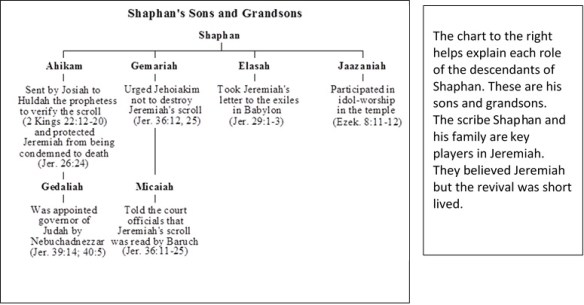
If we back up to Jeremiah 30 to 33 we find the “hope of a future” Jerusalem. Let’s review some of the major players in Jeremiah. One of them is a person named Shaphan; Biblical account. When the chief Temple priest Hilkiah discovers an ancient Torah scroll, he gives it to the scribe Shaphan, who in turn brings in to King Josiah. Josiah reads it aloud to a crowd in Jerusalem, resulting in a great religious revival. Josiah was the last good king of Judah.
Shaphan’s sons play significant roles in Jeremiah:
The chronology of rulers on the throne in Jerusalem during the time of Jeremiah:
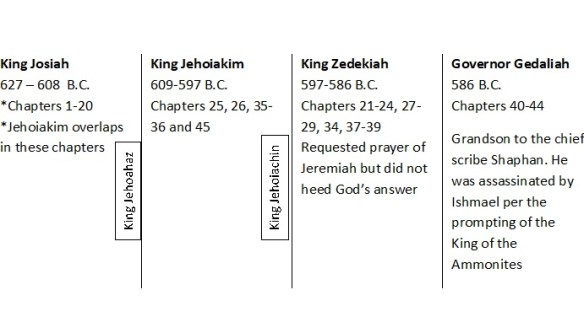
JIV NOTE: I did not include Kings Jehoahaz or Jehoiachin (Jeconiah) in the above chart. Jehoahaz was almost immediately replaced by Pharaoh Necho upon defeating Judah and King Josiah at Megiddo (he was 3 months on the throne). Jehoiachin only ruled 3 months 10 days. He followed his father Jehoiakim to the throne but was removed by Nebuchadnezzar almost upon his taking the throne. A fascinating and historical connection or ahamoment is found in 1 Chronicles. It states that Jeconiah (Jehoiachin) is the father of Pedaiah. That in and of itself means little, but Pedaiah was the father of Zerubbabel. It was Zerubbabel along with Ezra who lead the first Judeans out of captivity in Babylon back to Judah. He also set the foundations for the second temple according to Ezra 5:2.
Chapters 30 – 33 are considered chapters of consolation and not easily identified as being written of prophesied during the era of any of the particular kings identified in Jeremiah. They are promises of a future reunited Israel; the people and twelve Tribes of Israel/Jacob. These chapters could have been revealed to Jeremiah at any time during his years. They assured him and his fellow countrymen of a true Promised Land guaranteed under the signature and promise of God him-self.
The same is true of chapters 44-46. These passages are judgement passages that cover two distinct prophetic time periods; one that is during the life of Jeremiah/Baruch and one that is End Time. They include both the destinies of Israel and all Gentile nations.
There are actually two different 70 year judgements running parallel to each other in Jeremiah. It was 70 years between the first exiles of Judeans (includes Jehoiachin; aka Jeconiah or Coniah) and their release by Darius the Mede [605 to 536 B.C.]. The other 70 years is between the time Nebuchadnezzar totally destroyed the Temple and when the Temple was completed a second time [586 – 515 B.C.] We usually only here of the 70 year Babylonian activity but there was parallel judgement periods. One for the Tribe of Judah and one for the Temple.
Lamentation, also written by Jeremiah, was penned sometime after 586 B.C. The year 586 B.C. was when the third and final deportation of Jews (Tribe of Judah) occurred.
The following may help a bible student better grasp the events and dates.
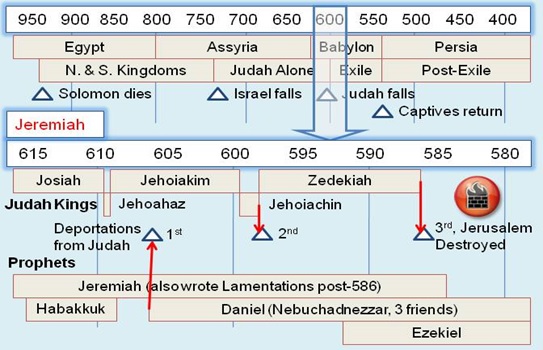
The above chart was created by biblequestions.org
Kings of Judah during the life of Jeremiah: Josiah – Jehoahaz – Jehoiakim – Jehoiachin – Zedekiah – Gov. Gedaliah
 Dr. Jstark

 To the left is a picture of the former great city-state of Babylon as seen in 1932. Itb. was twice a known primer world power; once under Hammurabi, 1800’s B.C. and again 1,200 years later under Nebuchadnezzar. Hammurabi is famous for codifying laws that the world often defers to today.
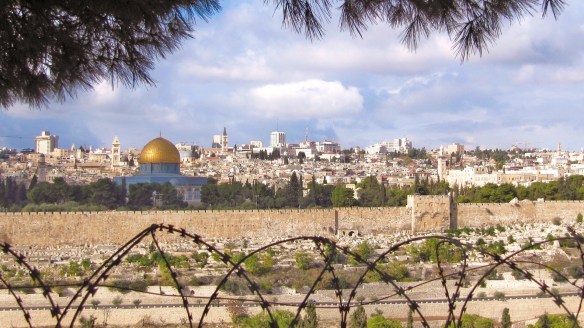 Jeremiah 51:50 to me is one of those verses that have such personal meaning. “Remember the Lord from far away, and let Jerusalem come to mind.” Now that President Trump has officially declared recognition of Jerusalem as past, present and future capital of Israel, it all fits into God’s plans for his son’s millennial reign; Jesus Christ. That means everything to this author. The original legislation to relocate the U.S> Embassy to Jerusalem was under President Clinton in 1996.
 YUP! 70 years later when released from further Babylonian captivity as promised by God himself, most of the Judeans had become successful in the Mesopotamia, Chaldean, Babylonian territories and did not want to leave it all behind. Today’s Christian-claiming church pew dweller could learn from this verse if s/he studied rather than simply read it.



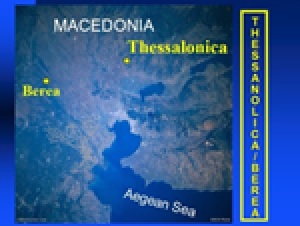 is a bit of fascination to look at the word “north” in V3, for out of the north… The Hebrew here is Boreas…a north, north east wind. It is very close in spelling to the city the Apostle Paul visited in the New Testament; Berea. Today Boreas is a stronghold of ISIS and is called Aleppo. There is also a military outpost in another Berea near Macedonia, Greece. If we take Thayer or Strong for their translation(s), NNE would be the Boreas/ Aleppo. The map here shows, Berea, Greece/Macedonian would be NNW of Babylon.
 or yet understand if the “Babylon” to which Jeremiah is referring is a symbolic area under God’s future judgement upon the return Of Jesus Christ as King of kings.
 Jeremiah 50:24 may hint of God’s judgement of the world by identifying this world as Babylon. You will all be judged because you challenged the Lord. V25: “…a work of the Lord GOD of the Heavenly Armies will be in the land…” Again in verse 29 God says “repay Babylon (the world?) for her deeds” against the Lord God. Why might this be the world and only symbolically identified as Babylon? In verse 33 both Israel and Judah are identified as those who have been oppressed. It was only the Judeans who were captive in the biblical Babylon. Then in verse 34 we read (ESV) that it is the world that will get rest.


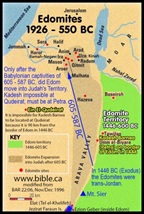 went south and eventually established what we know today as Saudi-Arabia. Even though Esau was a direct descendant of Abraham through Jacob, he married a daughter of Ishmael; the first born of Abraham through Sarah’s handmaid Hagar. Hagar and Ishmael were not part of the blessing of Abraham or God himself. They knew the truth but went elsewhere. For greater knowledge read Ezekiel 48 as it regards End Time and these same people.
 Basra and its oil fields as their economic capital. Money is their god. Go back to Jeremiah 49:4 to better connect this insight.
 It is between Edom and Ammon. Today this is mostly Jordan. To the north is war-torn Syria; a true source of potential war that could spread with powerful weapons of mass destruction in their hands. This may very easily fit into God’s final judgement plans. The orange indicates the map as it stood in 1000 B.C. The gray is how it politically and geographically lines up today (2017 A.D.).
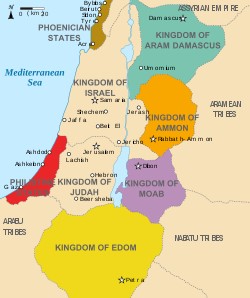 It would be safe by now to understand that this very descriptive chapter in Jeremiah is location specific. In short, it is a complete destruction. Moab, a tribe descended from Lot and his daughter, and per other verses in chapter 48, is important to God-Jehovah. In verse 42 it explains that they magnified themselves above the Lord (ESV). Not unusual but a sin against God. It is a sin for which there is a cost and God is judge; the only judge. The existence of the Kingdom of Moab is attested to by numerous archaeological findings, most notably the
 This map shows where Ur is located. It is almost directly east of Israel, thus Philistia/Gaza strip. Ur is the land from where Abraham came. It was identified as the Land of the Chaldeans. Ur is the city, part of what we would see today as Kuwait at the head of the Persian Gulf and outlet of the Tigris and Euphrates Rivers. See Genesis 11:31.


 This chapter is almost short enough to read out loud in one or two deep breaths. That is the oddity of Jeremiah 45. In fact, not only is it short in comparison to the rest of the chapters in Jeremiah, it seems to be totally out of place. It reads like it could follow chapter 36 of Jeremiah. Chapter 36 identifies Baruch as the penman or recording secretary for Jeremiah himself and after whom the book is titled. It will now be Baruch’s second effort to write the words of God through Jeremiah. King Jehoiakim had shred and burned the original scroll(s) as it was being read to him. Baruch had to return to Jeremiah with the bad news. No wonder he was distraught.


 AHA Bible Moments